
Choosing a webbing construction usually starts with the product, not with a webbing type. You may already know where the strap will be used and what it needs to do, but still be unsure whether it should be elastic, soft or firm, lightweight, supportive, or even flat or tubular.
These are common questions we work through in custom webbing projects. A change in one requirement can also affect another—a softer webbing may not give the support you expected, while adding thickness does not always make a strap perform better.
This page shares the practical points we have learned to check when defining a webbing for a product, so you can decide what your strap actually needs before getting too far into development.
If your product uses a conventional strap, flat webbing is usually where we start unless the application gives us a reason to use another form. It gives a stable contact area and works well with the sewing, buckles, adjusters, and other hardware used in many products.
We start considering tubular webbing when the strap needs to fold, wrap, or behave differently around the product. But wanting a softer strap alone is not a reason to move away from flat webbing—we can often change the feel and flexibility while keeping the flat form.
Cord usually enters the discussion when space is limited or the product needs a narrow routing path. That smaller contact area works well for pulling or adjustment, but it can become a disadvantage when the same part carries tension against the body.
| What Happens in Your Product? | Usually Consider | Why It Matters |
|---|---|---|
| The strap lies flat against the product or body | Flat webbing | More contact area and a stable strap profile |
| The strap needs to fold, wrap, or collapse easily | Tubular webbing | The hollow form behaves differently when bent or folded |
| The strap passes through a narrow space | Cord | A smaller profile is easier to route |
| The strap carries tension against the body | Usually flat webbing | A wider contact area helps spread the pressure |
| You only need a softer or more flexible strap | Don’t change form yet | Flat webbing can often be adjusted without changing to tubular |
A wearable strap is a simple example. Replacing a 25–30 mm flat section with a narrow cord changes more than the appearance—the same tension is now concentrated over a much smaller contact area. That may be acceptable for a short adjustment or pull section, but not for a section worn against the body for hours. This is why we often adjust the construction of a flat webbing before changing its form. If the real problem is softness, flexibility, or support, switching to another form may solve the wrong problem.
Not every adjustable or body-worn strap needs elastic webbing. What matters is whether the webbing itself needs to move during use, or whether the adjustment can be handled by the strap length and hardware.
A ski goggle strap is a clear example. It needs to stretch over the helmet and then maintain tension, so elasticity is part of how the strap works. A positioning strap can be very different. Once its length is adjusted, extra movement in the webbing may add nothing and can actually make the product less stable.
We see another common assumption with wearable products: adding stretch will make the strap more comfortable. Sometimes it does, but comfort alone is not enough reason to make a webbing elastic. A headlamp strap, sports bra strap, waistband, and wearable-device belt may all need elasticity, but for different jobs—following body movement, maintaining fit, or allowing some movement without losing support.
We decide what the stretch needs to do before deciding how elastic the webbing should be. Once that job is clear, stretch range, tension, and recovery can be developed around it.
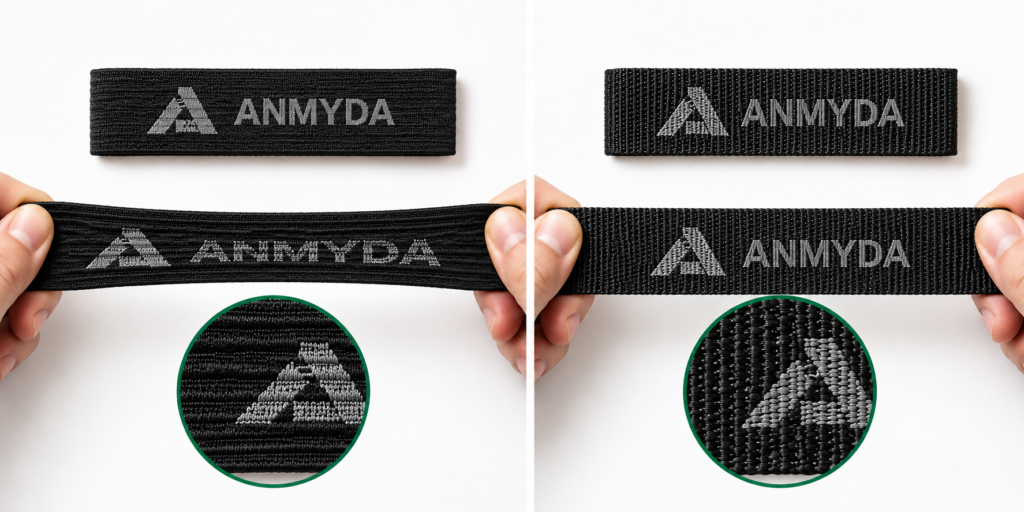
A softer webbing is not automatically better, even when the strap is worn against the body. We first look at what feels too firm and what the webbing still needs to do before making it softer.
When a sample is described as “too hard,” the problem can be quite different from one project to another. The surface may feel rough, the edges may press into the skin, the webbing may not bend easily enough, or the whole strap may feel too rigid under tension. These problems do not need the same adjustment. “Too hard” is useful feedback, but it is not yet a manufacturing instruction.
We see this clearly in wearable projects. A sports bra strap may need a softer skin-contact surface while still keeping enough body to support and adjust well. For an orthopedic strap, we have worked with requirements for firm support together with soft surfaces and edges. Making the whole construction softer would work against what the strap was supposed to do.
This is why we often separate surface feel, edge feel, and the firmness of the webbing body. A surface or edge can sometimes be softened without making the whole webbing looser. Once the body construction is also made too soft, the strap may start folding, curling, or losing the stability the product needs.
If a sample feels too hard or too soft, tell your manufacturer what feels wrong and where. “The edge feels hard against the skin” or “the strap does not bend easily enough” gives a much clearer direction than simply asking for softer webbing.
A webbing does not need to feel stiff to stay stable in a product. What matters is whether it keeps the shape your product needs once it is fitted, bent, or put under tension. We have seen flexible webbings work very well in supportive applications, while firm-looking samples can still fold, curl, or deform once they are actually used.
A headlamp strap is a good example. It needs enough flexibility to follow the curve of the head, but once tensioned, it should stay flat and help keep the lamp stable. Simply making the webbing firmer can make it less comfortable without necessarily solving the stability problem. An orthopedic wrap has a similar challenge: it needs to follow the body closely while resisting unwanted folding or rolling during use.
This is why we do not judge construction from a loose sample alone. Hand feel tells you one thing; shape stability in use tells you another. Some change in shape is normal, especially when elastic webbing is stretched or a strap follows a tight curve. We usually treat it as a construction problem when that change starts affecting fit, stability, comfort, or how the product works.
| In Your Product, the Webbing Needs to… | What We Would Check |
|---|---|
| Follow a curved body or product surface | Whether it conforms without becoming bulky or resisting the curve |
| Stay flat under tension | Whether it folds, twists, curls, or narrows too much |
| Stabilize an attached component | Whether it keeps its working shape once the product is fitted |
| Bend around a product edge or component | Whether it bends where needed without losing its shape elsewhere |
| Move with the product | Whether movement makes the webbing increasingly loose or unstable |
When you evaluate a sample, put it into the position where it will actually work. Wrap it, tension it, bend it, or load it as the finished product will. If something goes wrong, describe what you see—“the edge rolls under tension” or “the strap twists around this curve” is much more useful than simply asking for a firmer webbing.
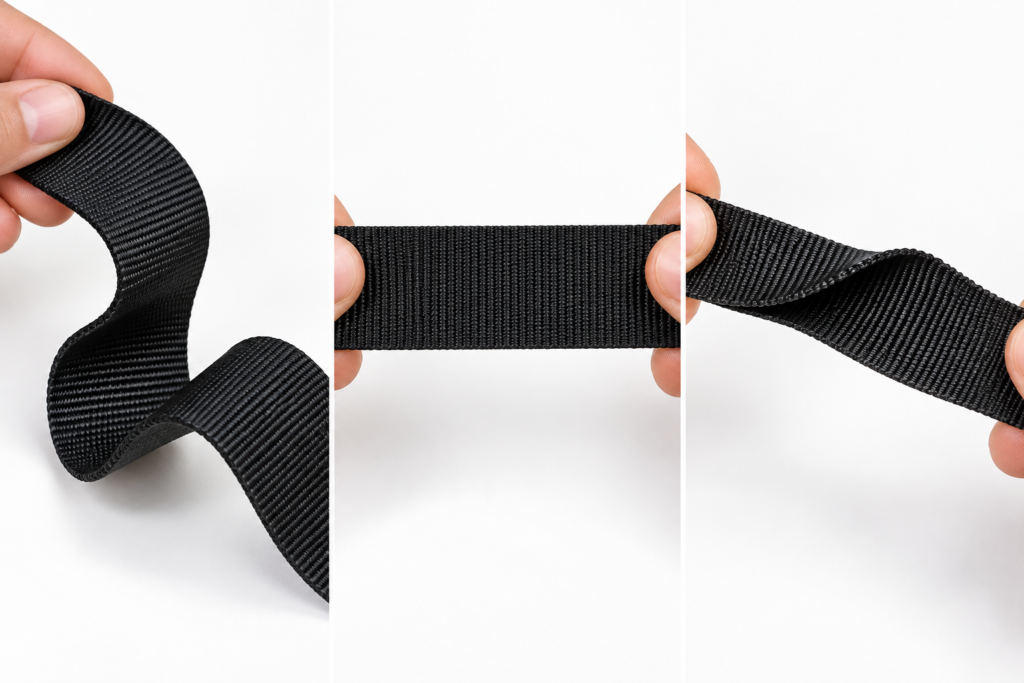
“High strength” sounds like a safe requirement, but we would not make a webbing stronger simply because stronger sounds better. What matters is what the strap actually needs to withstand in your product.
A lightweight wearable-device strap, for example, may carry very little load. Making it heavier or firmer just to increase strength can add something the product does not need. A load-bearing strap is different—the actual working load becomes an important part of choosing the construction.
We also look at where that load goes after it leaves the webbing. A strap may be sewn, looped through hardware, or attached to another component. If one of those connections becomes the weakest point, increasing the webbing strength alone does not make the finished strap equally stronger.
Before specifying “high strength,” it is more useful to define:
Tell your manufacturer what the strap has to hold and how it is loaded. That gives a much better basis for choosing the construction than simply asking for the strongest webbing available.
When a sample feels rough or uncomfortable, we do not immediately change the material or make the whole webbing softer. We first check whether the problem comes from the surface, the edge, or how the webbing changes under tension.
This matters especially for skin-contact straps. A sports bra strap can have a smooth face but still feel uncomfortable at the edges. And with elastic webbing, a surface that feels smooth when relaxed may become noticeably different once stretched. Surface and edge should be checked separately, and under the conditions in which the strap will actually be used.
Softer edges are not always better either. If the edge becomes too loose compared with the webbing body, you may improve comfort but introduce curling, waviness, or poor shape stability. The target is usually edge comfort with enough stability—not the softest edge possible.
When evaluating your sample, check:
If something feels wrong, describe where and when it happens. “The edge feels hard against the skin when stretched” gives a much clearer development direction than simply asking for softer webbing.
Lightweight and breathable often come up together in wearable projects, but they do not always describe the same problem. Before changing the webbing, separate what you actually need to improve: weight, bulk, heat, moisture, or long-wear comfort.
Simply making a webbing thinner can reduce weight, but it can also change support and shape stability. Opening the construction can improve airflow, but too much openness may make the strap easier to deform. Reducing material is not the same as developing a lightweight construction.
We see this with breathable elastic webbing used for waist and ankle support. The open construction reduces bulk and improves ventilation, but it still needs enough body to sit properly under tension. If we opened the construction only to maximize airflow, we could lose part of the support the strap was meant to provide.
So be specific about the problem you want to solve. If weight or bulk is the issue, say that. If the real problem is heat or moisture against the body, say that instead. It gives a much better development direction than simply asking for the webbing to be “lightweight and breathable.”
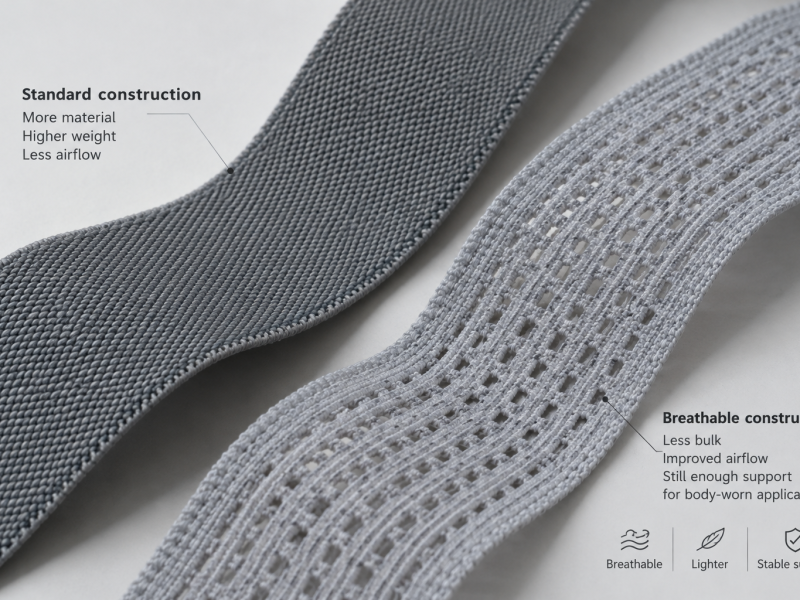
The difficult projects are rarely difficult because of one unusual requirement. Problems usually start when several reasonable requirements are pushed too far at the same time. A webbing may need to be thin, soft, breathable, supportive, stable, and strong—but improving one can start working against another.
We see this often with body-worn straps. Opening the construction may improve airflow but reduce stability. Making the body firmer can improve support but change the feel. Reducing thickness can leave less room to achieve the same support. The question is not whether each requirement is possible, but whether they can all be pushed to the same level in one webbing.
When requirements conflict, protect what the product needs to work first, then adjust what has more room to move:
If improving one requirement repeatedly makes another worse during sampling, stop adjusting individual numbers and reconsider the combination. You do not need every specification at its maximum—you need them to work together in the finished product.
We turn your ideas into webbing, manufacture it, and deliver it straight to your doorstep.
Have your product requirements, specifications, or artwork ready? Share your project with us to discuss the next step in development.
We will contact you within 1 working day, please pay attention to the email with the suffix “@anmyda.com”.