
A webbing size on your drawing is not always the same as the size that matters in your finished product. The specified size is where development starts, but manufacturing tolerance, later processing, stretch, and product assembly can all affect how that dimension should be judged.
This does not mean you need tighter tolerances everywhere. What matters is knowing which dimensions your product actually depends on, what variation is acceptable, and under what condition the webbing needs to meet that requirement.
Getting these points clear during sampling is more useful than simply asking your manufacturer to make every dimension as exact as possible.
If you specify 25 mm webbing, the finished webbing may not measure exactly 25.00 mm. That does not automatically mean something went wrong. For webbing, 25 mm is a target size, with an acceptable tolerance around it.
Webbing is woven from yarn under tension, not cut to size like a rigid part. Once it comes off the loom and the tension is released, the woven structure can settle. Material, yarn size, construction, and density also affect how closely the finished width can be held. This is why some dimensional variation is normal even when the webbing is made correctly.
For a new development, start with the nominal size your product needs. If you do not already have a proven tolerance, do not choose an unusually tight range just to make the specification more precise. Make the finished sample first and see what its actual size means in your product.
Use that sample with the real hardware and assembly. If a slightly wider or narrower webbing still fits, assembles correctly, and looks right, that variation may be acceptable. If a small difference causes binding, poor alignment, or another fit problem, you have found where tighter dimensional control is needed.
This is how a useful tolerance is established: start with the nominal size, validate the actual variation in your product, and set the acceptable range around what your product can reliably use.
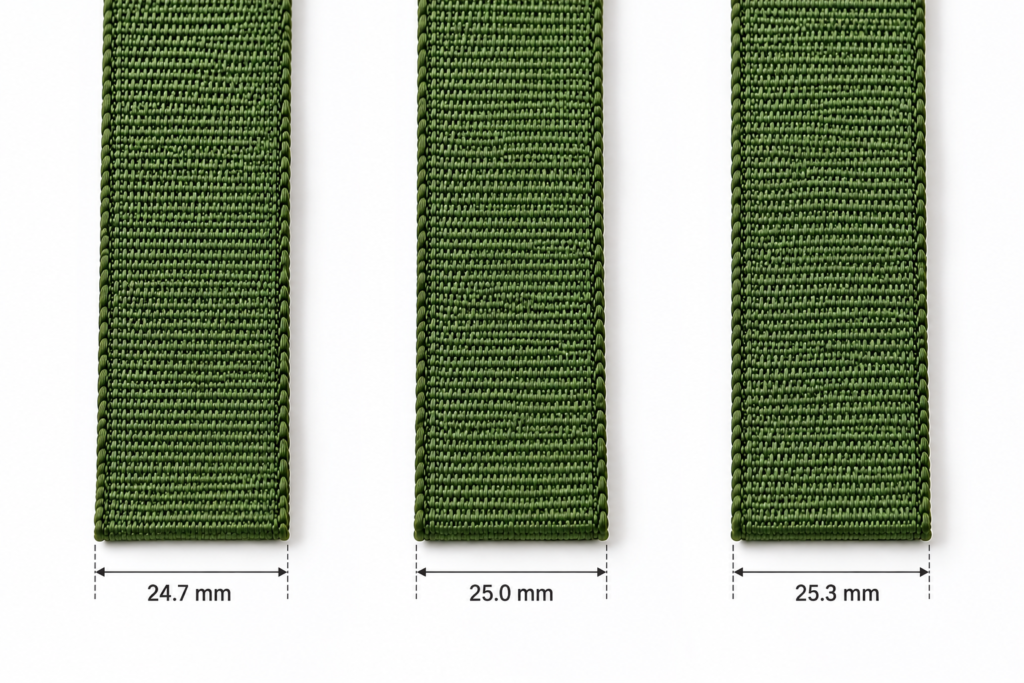
A tight tolerance is useful only when your product needs it. The right tolerance is the amount of dimensional variation your finished product can accept without affecting fit, assembly, appearance, or function.
For example, a small width difference may have little effect when 25 mm webbing is sewn onto an open fabric panel. The same difference can matter when the webbing must pass through a molded slot with limited clearance. Thickness can also become important when webbing is folded, layered, or fitted into hardware.
This is why the product interface should guide the tolerance. Look at what happens when the webbing becomes slightly wider, narrower, thicker, or thinner. The point where that change starts to affect the product helps define the acceptable range.
Share that limitation with your manufacturer. Saying “the webbing must pass freely through this 26 mm slot” is more useful than simply asking for a very tight tolerance.
Start with the variation your product can accept, then use it to define a realistic production tolerance.
Webbing size changes as it goes through production. What you should care about is the size after the last process, not the size at every production stage.
This is especially important with elastic webbing. If your finished requirement is 25 mm, we would not normally expect the webbing to come off the loom at 25 mm. It may need to start around 28–29 mm because heat setting will bring the width down, and printing can reduce it again.
A typical project may look like this:
| Production Stage | Example Width | What This Means |
|---|---|---|
| After weaving | 28–29 mm | Intentionally wider; this is not the finished target |
| After heat setting | ~26–27 mm | Heat and tension stabilize the elastic structure and reduce the width |
| After printing | ~25–26 mm | Heat and pressure reduce width and thickness again |
| Finished webbing | Around 25 mm | This is the size your product should be approved against |
Do not use these numbers as a shrinkage formula. Another construction may need a different starting width. The useful experience here is the direction of development: start from the finished size your product needs and work backward through the processes.
There is another detail worth knowing. After processing, thickness is usually fairly consistent along the webbing, but width can move slightly. A 25 mm finished webbing may measure 25.0 mm here, 25.2 mm further along, and 24.9 mm somewhere else. With a flexible woven structure continuously running under tension, small width movement is normal; the important question is whether it remains inside the finished range your product can use.
So when you send a dimensional requirement, make clear that 25 mm means 25 mm after heat setting, printing, or any other required finishing. Leave the intermediate dimensions to the manufacturer.
You define the finished size your product needs. The manufacturer works backward to get there.
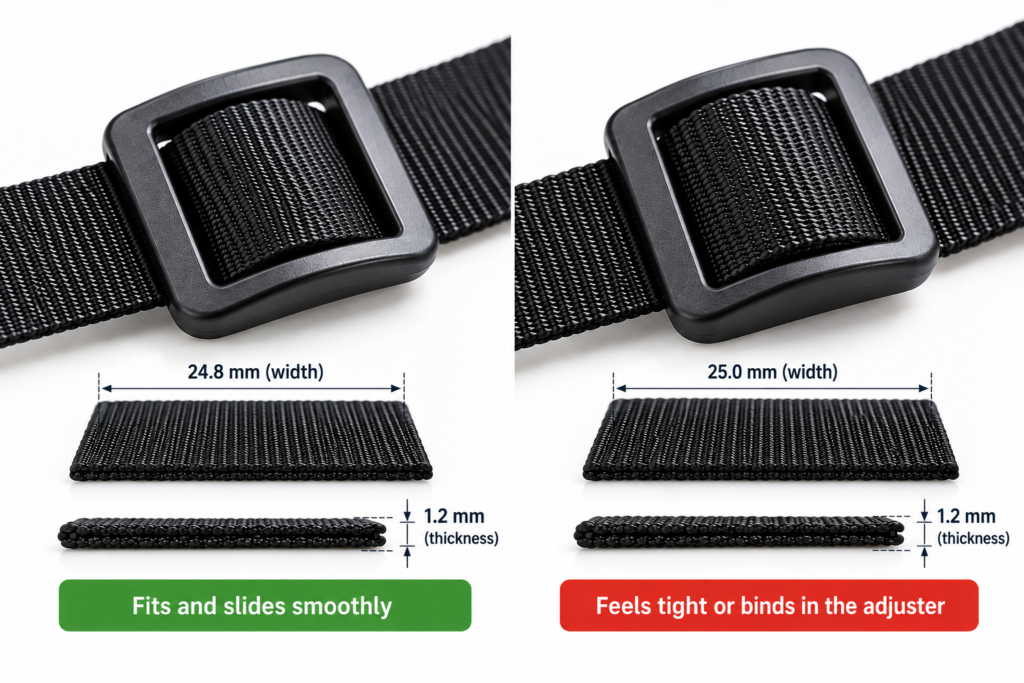
A webbing can meet the width tolerance on your drawing and still not fit your product properly. This usually happens when the width looks right on its own, but thickness and construction change how the webbing actually fits.
We see this often with buckles and adjusters. Two samples can both be made for the same 25 mm hardware. A 25.2 mm webbing that is thinner and more flexible may slide smoothly, while another sample closer to 25.0 mm can bind because it is thicker or firmer. On paper, the second sample looks more accurate. In the product, the first one may work better.
That is why we use the finished assembly to judge critical dimensions. Once the webbing has gone through heat setting, printing, or other finishing, test it with the actual buckle, slot, or sewn structure. See how it threads, slides, folds, and sits in the product. If the fit is not right, tightening the width tolerance may not solve it. Sometimes the better adjustment is thickness or construction rather than width.
Check the dimensions on the drawing, but approve the fit in the product.
Two elastic straps can have the same relaxed size and still fit differently in the finished product. The size tells us where the elastic starts; stretch and recovery determine how that size behaves once the product is in use.
For example, two straps may both measure 500 mm when relaxed and both meet the dimensional tolerance. The difference may only appear when they start working in the product:
This is why the relaxed dimension alone cannot tell you whether an elastic webbing will give your product the fit you expect.
You do not need to turn this into technical stretch or recovery specifications yourself. If you already have an approved product, send the existing strap or sample for comparison. For a new product, tell your manufacturer the relaxed size, how far the strap normally stretches in use, and the fit you want.
Give your manufacturer the actual working condition behind the size. They can then develop the stretch, recovery, and construction needed to achieve the fit your product needs
Some webbing is supplied as finished cut pieces, while other projects require webbing in rolls for later cutting, sewing, or assembly. For roll goods, 50 m per roll is a common packing length, but that does not necessarily mean one uninterrupted 50 m piece.
During weaving, yarn can break or a local defect may need to be removed. When this happens, good sections can still be joined and wound into the same roll. The roll still contains approximately 50 m of usable webbing, but it may contain a join.
For many products, this makes little difference. If the webbing will later be cut into short straps, the joined section can simply be removed during cutting. The requirement changes when your production needs long uninterrupted pieces.
| Requirement | What It Means |
|---|---|
| 50 m per roll | Approximately 50 m of webbing on the roll; a join may be present |
| 50 m continuous | One uninterrupted 50 m length without joins |
| Minimum 20 m continuous | Each usable continuous section must be at least 20 m long |
This distinction is worth making before production. Requiring long continuous lengths means more production allowance and selection: one yarn break or defect can prevent an otherwise usable length from meeting the requirement. As the required continuous length increases, the production difficulty and cost can increase with it.
If joins affect your cutting or assembly, tell your manufacturer the minimum continuous length your production actually needs, rather than only specifying the roll length.
We turn your ideas into webbing, manufacture it, and deliver it straight to your doorstep.
Have your product requirements, specifications, or artwork ready? Share your project with us to discuss the next step in development.
We will contact you within 1 working day, please pay attention to the email with the suffix “@anmyda.com”.