
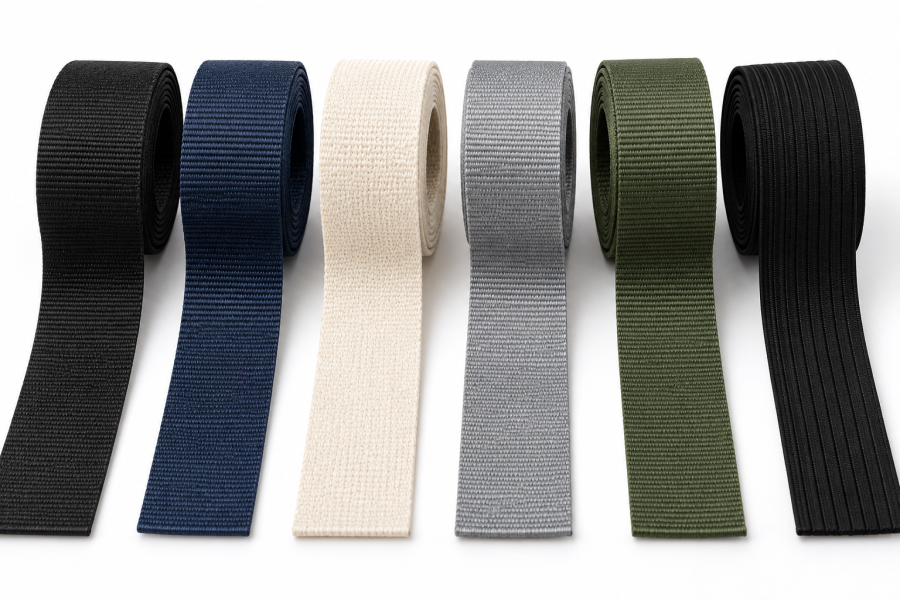
There is no single best material for custom webbing. The right choice depends on what the webbing needs to do in your product and the conditions it will face during use.
Polyester, nylon, cotton, polypropylene, and other materials can all be suitable, but for different reasons. A sportswear strap may need to handle sweat and repeated washing, while an outdoor strap may place more importance on UV resistance, moisture, or abrasion. Elastic webbing also brings another question because the surface yarn and elastic component may use different materials.
Material is therefore one part of the development, not a decision to make in isolation. It needs to work with your required stretch, strength, construction, branding, size, production quantity, and finished-product use.
Polyester and nylon cover many custom webbing projects. Cotton, polypropylene, recycled yarns, and elastic materials usually come into the discussion when the product has a more specific requirement.
The useful question is not how many materials are available, but why one of them would make sense for your webbing.
| Material | Why It Usually Enters a Webbing Project |
|---|---|
| Polyester | A practical starting point for many general, sportswear, outdoor, and elastic webbing applications. |
| Nylon | Often considered when flexibility, abrasion performance, or a different surface feel matters. |
| Cotton | Usually specified when natural fiber content or a particular hand feel is part of the product requirement. |
| Polypropylene | Often considered when low weight, low moisture absorption, or cost is important. |
| Recycled yarns | Used when recycled content is part of the product specification. Availability and certification may need to be confirmed for the project. |
| Spandex / rubber | Used to provide elasticity and normally combined with polyester, nylon, or other yarns rather than used as the webbing by themselves. |
If your drawing already specifies a material, give that information to the manufacturer. But if the material has not been decided, there is no need to choose polyester or nylon simply because one is commonly used for a similar product.
In many projects, the application gives us a better starting point.
For example:
“30 mm polyester webbing”
tells the manufacturer the width and material.
But:
“30 mm strap for repeated skin contact, regular washing, moderate stretch, and daily wear”
tells us much more about what the webbing actually needs to do. From there, the material can be considered together with the construction, elastic component, thickness, and surface requirements.
This is also why two products that look similar may not use the same material. A sportswear strap, outdoor equipment strap, and bag strap may all be 30 mm wide, but the conditions they face in use can lead to different material choices.
The material list is therefore only the starting point. What matters during development is whether the material can work with the rest of the requirements in your product.
Changing the material rarely means changing only one specification. In custom webbing development, the more useful question is: what does the finished strap need to keep after the material changes?
We often see material changes treated as a direct substitution—keep the same width, thickness, construction, stretch, and appearance, then replace one yarn with another. That can work in some projects, but it should not be assumed.
Different materials behave differently during weaving and finishing. If the new yarn changes the feel, strength, flexibility, or processing behavior, the construction may need to move with it. Yarn size, density, thickness, or even the weave may be adjusted to bring the finished webbing back toward the original requirement.
Suppose an approved nylon strap needs to change to polyester. If the product needs to keep the same flexibility, hardware fit, and strength, those should become the reference points.
Trying to lock every existing webbing specification can actually make it harder to achieve that result.
| What Needs to Stay | What May Need Adjustment |
|---|---|
| Softness or flexibility | Yarn size, density, construction |
| Required strength | Yarn specification, density, thickness |
| Buckle or adjuster fit | Finished thickness, edge construction |
| Elastic support | Body yarn, elastic yarn, density |
| Logo appearance | Yarn, density, branding construction |
| Overall hand feel | Construction, thickness, finishing |
This is why two samples made from different materials may require different constructions even when they are being developed for the same product.
A recent 100% cotton webbing project is a good example.
The requirement looked straightforward: 25.4 mm wide, soft but durable, abrasion resistant, low shrinkage, and supplied in continuous 100 m rolls.
The difficult part was not the width.
Cotton yarn is more prone to breakage during weaving than the synthetic yarns normally used for this type of webbing. Once a long continuous roll is required, yarn breakage becomes more than a material issue—it affects how many finished rolls can actually meet the length requirement.
For that project, 50 m continuous rolls were a more realistic target. Even then, producing extra webbing and selecting the uninterrupted rolls may be necessary.
Now add another requirement such as higher durability. Increasing yarn or density may help, but it can also increase thickness, weight, or stiffness. If softness and a thin profile must also remain, the specifications begin to work against one another.
That is the part a material datasheet does not show.
When a material changes, first identify which finished-product requirements cannot move. Then let the webbing specifications that can move—construction, density, yarn size, thickness, or finishing—be reconsidered around those priorities.
If an approved sample already exists, keep it as the physical reference. Compare the new sample for the characteristics that actually matter in the product rather than asking whether the new material is simply “equivalent” to the old one.
A successful material change is not one where every old specification stays the same. It is one where the new webbing still does the job the product requires.
No. Two webbings made from the same material can feel and perform very differently because yarn size, construction, density, thickness, elastic content, and finishing also shape the finished webbing.
This matters when a performance requirement is described as a material requirement.
We often hear requests such as “softer material,” “stronger material,” or “more breathable material.” These are useful clues, but they do not always tell us which specification needs to change.
| What You Need | What May Actually Need Adjustment |
|---|---|
| Softer webbing | Yarn, density, construction, thickness, finishing |
| More strength | Yarn size, density, construction, thickness |
| More support | Construction, thickness, stretch, elastic arrangement |
| More breathability | Construction openness, density, thickness |
| Better stretch or recovery | Elastic yarn, elastic content, construction |
For example, if an elastic strap feels too tight against the body, changing to a softer surface material may improve the touch but leave the tension almost unchanged. The stronger influence may be the elastic yarn, elastic content, construction, or thickness.
The same applies during sampling. If a polyester sample feels too stiff, changing it to nylon is one option—but not automatically the first one. If the stiffness is mainly coming from a dense construction, the manufacturer may be able to adjust the structure while keeping the original material.
Describe the performance problem before prescribing the material solution.
“The strap feels too stiff” gives the manufacturer room to identify what is causing it. “Change it to nylon” has already chosen a solution before that cause is known.
Material is one variable in webbing performance, not the answer to every performance problem.
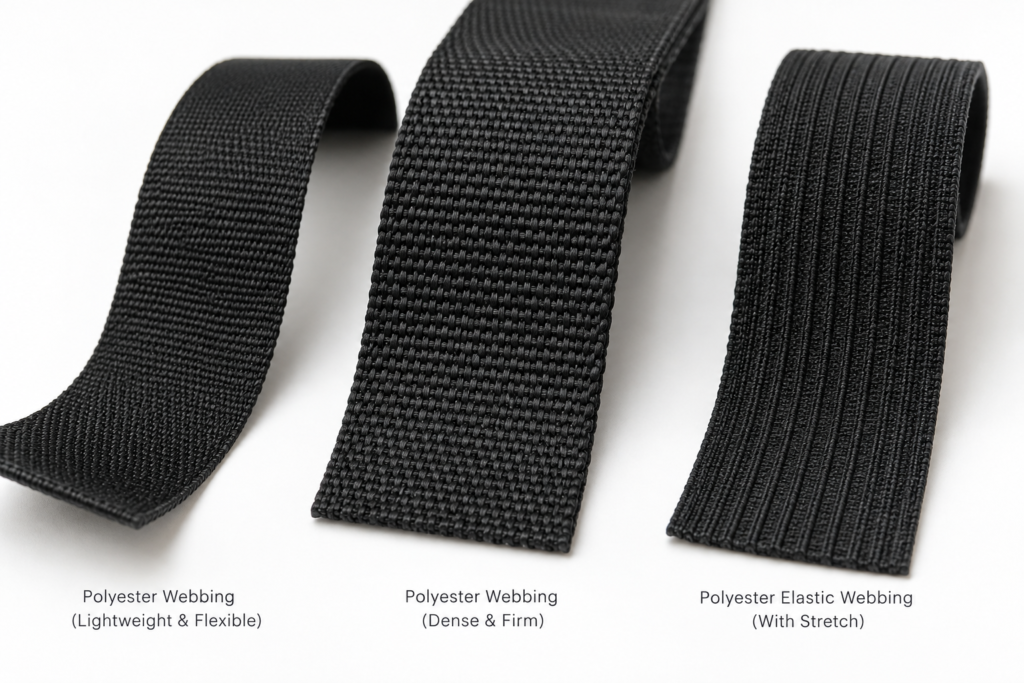
Yes. This is common in custom webbing because different materials often have different jobs. In elastic webbing, polyester or nylon may form the surface, carry the color, and create the woven logo, while spandex or rubber inside the structure provides stretch and recovery. What you see on the surface is not necessarily the full material composition.
Problems usually start when a composition percentage is fixed before the required performance is clear. We see specifications such as 90% polyester / 10% spandex, but that percentage alone does not tell us whether the webbing can reach the required stretch, recovery, support, thickness, or logo appearance. If the stretch target changes, we may need to change the elastic yarn specification, amount, arrangement, or the surrounding woven structure—not simply add more spandex.
This matters even more with elastic jacquard webbing. Changing the elastic structure can change how the webbing contracts when relaxed and opens when stretched. The surface density changes with it, so a logo that looks clear in the relaxed sample may distort more than expected when the strap is worn. Stretch, recovery, construction, and logo appearance need to be checked together during sampling.
We handle surface feel in the same way. If the strap feels uncomfortable, changing the surface yarn may help, but it will not necessarily reduce the tension created by the elastic structure underneath. First identify whether the problem is coming from the surface or from the elastic construction, then change the material that is actually responsible.
If a fiber percentage is fixed for labeling, recycled-content claims, or another product requirement, put it into the specification from the beginning. If it is not fixed, give the manufacturer the stretch, recovery, support, surface feel, and branding targets first. The material combination can then be developed around those requirements.
Lock the composition when the product requires it. Otherwise, lock the performance first.
Yes, but the product name alone is rarely enough. We have seen very similar straps end up with different material choices simply because they are used differently.
Take an “outdoor strap.” One may stay in the sun for hours, while another only sees occasional outdoor use. One gets wet regularly; another mainly deals with abrasion. A ski goggle strap adds repeated stretch, helmet contact, and cold temperatures. We would not make the same material decision for all of them just because they are used outdoors.
We see the same thing with skin-contact straps. Developers often start by asking for a softer material, but when a sample feels uncomfortable, the material is not always the reason. The strap may be too thick, the edge may feel hard, or the elastic tension may simply be too high. If the strap is also exposed to sweat and repeated washing, those conditions need to be considered before changing the yarn.
| Product Use | Information That Changes the Material Decision |
|---|---|
| Outdoor | UV exposure, moisture, temperature, abrasion |
| Skin contact | Sweat, washing frequency, wear time, required feel |
| Marine / wet use | Water or saltwater exposure, drying, wet/dry cycles |
| Elastic strap | Stretch frequency, required tension, recovery |
| Load-bearing use | Working load, abrasion points, repeated loading |
This is why we do not keep one fixed “best material” for each application. The application tells us where to start; the actual use conditions tell us what needs to be checked.
Give those conditions before sampling when you can. It gives the manufacturer a much better basis for choosing the material and construction than simply knowing the strap is for “outdoor,” “sportswear,” or “wearable” use.
Sometimes, but the difficult part is often not finding the material. It is making the requirements work together in the finished webbing.
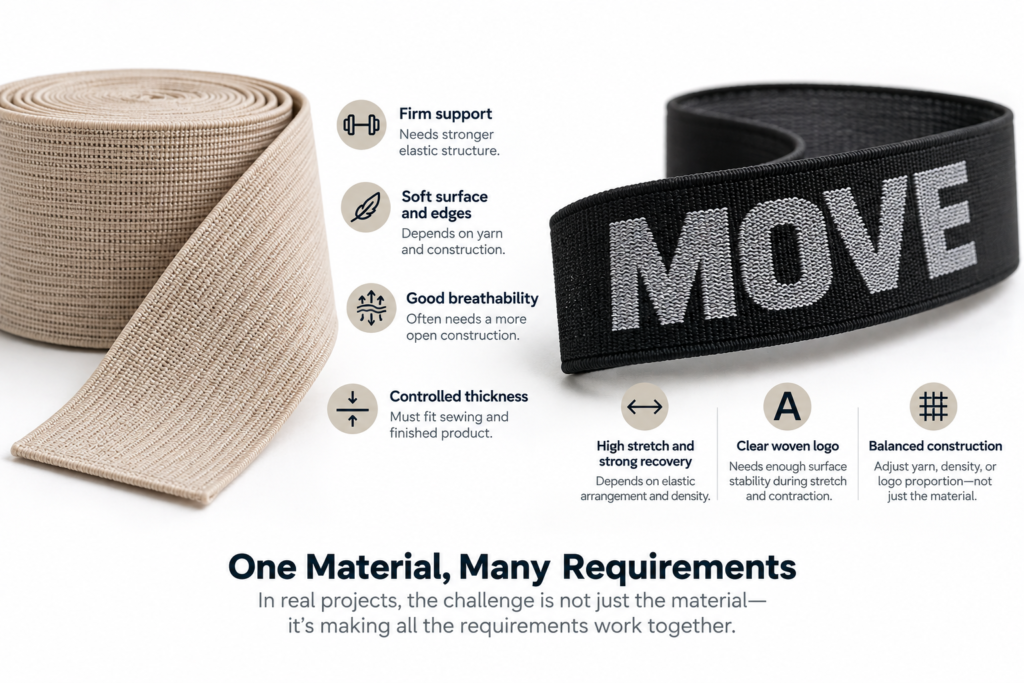
We saw this in an orthopedic-wrap project that required firm support, soft surface and edges, good breathability, and controlled thickness for sewing. Increasing the elastic structure or density can improve support, but may also make the webbing firmer or thicker. Opening the construction for better airflow can change the support again. Changing the surface material alone does not solve these conflicts.
Elastic jacquard projects create another trade-off. A strap may need high stretch and strong recovery while keeping a woven logo clear. As the webbing contracts and stretches, the surface structure moves with it. The elastic arrangement, density, or even logo proportion may need adjustment—not necessarily the material.
Some specifications are already fixed by the finished product. A strap may have to stay at 30 mm to fit existing hardware or within a thickness range to pass through an adjuster. Once those dimensions are fixed, there are fewer places left to adjust the construction. When everything is marked “must keep,” there is often nowhere left to make the adjustment needed during sampling.
Separate the requirements that truly cannot move—hardware fit, support, load, or stretch range—from those that can. Yarn, density, construction, or thickness can then be adjusted within the available range. The goal is not to find one material that satisfies every specification, but to build a webbing in which the important requirements can work together.
Material matters, but if branding is important to the product, we want to see the artwork while the webbing is still being developed. Once the material, width, construction, and stretch are fixed, some branding options may already be limited.
Polyester may be suitable for sublimation, for example, but that does not mean every polyester webbing will print the same way. Surface texture, stretch, and construction still affect the finished result.
We see the same issue with woven logos. A 30 mm elastic jacquard strap has more room for multiple colors and small details than a 20 mm strap. As the width decreases, fine artwork becomes harder to reproduce. Increasing density can improve woven detail, but it may also make the strap firmer or affect its stretch.
This is why we check the artwork together with the webbing specification. If a small detail cannot be woven clearly, the better solution may be to simplify the artwork, increase the logo size, change the branding method, or adjust the construction—not necessarily change the material.
If the logo matters to the product, send the artwork early. It gives the manufacturer room to develop the material, construction, stretch, and branding around the same target.
Material can affect all three, and in many projects the reason is not the yarn price. It is whether the required yarn is already available in the right specification and color.
We sometimes receive a 500 m webbing inquiry where the required yarn has to be purchased or dyed in a much larger quantity. The weaving itself can handle 500 m, but the yarn supplier will not sell the small amount needed for that order. Reducing the webbing quantity does not solve the problem—the material is setting the MOQ.
| Project Situation | What Usually Happens | What We Check Next |
|---|---|---|
| Required yarn is in stock | Sampling can start sooner and material MOQ is less likely to be the constraint. | Confirm yarn specification and available color. |
| Custom color is required | Dyeing adds MOQ and lead time before weaving starts. | Can a stock color be used for the first construction sample? |
| Uncommon yarn is required | Supplier purchase MOQ may be much higher than the webbing quantity. | Is there an available yarn that can meet the same requirement? |
| Certified recycled yarn is fixed | Material options are narrower and MOQ may need to stay. | Confirm certification, yarn availability, and bulk requirement early. |
| Material changes after sampling | Part of the sample may need to be made again. | Which approved properties could change with the new material? |
If final material is holding up an early sample, an available yarn can sometimes be used to check construction, width, or hardware fit first. But we would not use that sample to approve properties that depend on the final material.
For example, if surface feel, stretch, color, or appearance matters, those still need to be confirmed with the production yarn. This distinction can keep development moving without treating a temporary sample as final approval.
When an MOQ looks high, ask what is driving it—material purchase, dyeing, weaving setup, or something else. Once the constraint is clear, it is much easier to see what can be changed and what simply belongs to the project.
If the material is already fixed for a real product reason, tell the manufacturer. If it is still open, say that too. We would rather receive an RFQ with the material left open than one with polyester, nylon, or a fiber percentage locked simply because the specification looked incomplete without it.
We see this most often when a material is chosen from a similar product or an existing supplier specification. Sampling then starts around that material, only to find that the required softness, stretch, thickness, branding, or use conditions point in another direction. Changing the material at that stage can also mean changing the construction and making the sample again.
For the material side of the project, these are the details we actually need:
| Tell Us | When It Matters |
|---|---|
| Material / composition | When it is already fixed |
| Required fiber percentage | When labeling or another product requirement makes it mandatory |
| Recycled content / certification | When it must apply to the production material |
| Material restriction | When a certain fiber cannot be used |
| Use conditions | When sweat, washing, UV, moisture, cold, abrasion, or other exposure may affect the choice |
| Target performance | When you want us to recommend the material rather than follow a fixed one |
If you already have a strap that performs the way you want, send the physical sample when possible. We can check its construction, thickness, stretch, surface, and yarn rather than trying to identify the material from a photograph alone.
And if you do not know the material, give us the information that is harder to guess: what the strap is used for, what it must do, which requirements cannot change, and what is still open. That gives us much more room to recommend the material around the actual product instead of developing around an assumption.
We turn your ideas into webbing, manufacture it, and deliver it straight to your doorstep.
Have your product requirements, specifications, or artwork ready? Share your project with us to discuss the next step in development.
We will contact you within 1 working day, please pay attention to the email with the suffix “@anmyda.com”.