
Elastic webbing may look simple when you first start a project, but getting the stretch right is only one part of the job. Where the webbing is used, what it needs to do, how it should feel under tension, its size, and even the way you add a logo can change the final result.
Many problems only become clear after the first sample is assembled into the product. A webbing that meets the requested stretch may still feel too firm, too loose, or behave differently once the width, construction, or branding changes.
This page shares the practical lessons behind those decisions, so you can define, test, and adjust elastic webbing more confidently as your product moves from the first requirement to bulk production.
Start with the application before deciding the elastic specifications. The same stretch ratio, width, or thickness can behave very differently once the webbing is built into different products. The application tells you which part of the elastic behavior matters most.
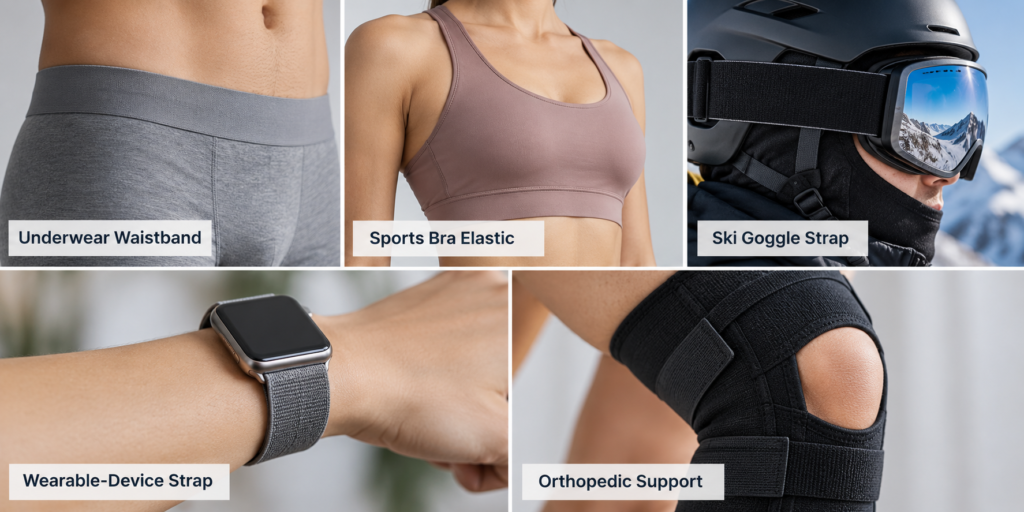
| Application | What Manufacturing Experience Tells You |
|---|---|
| Underwear waistband | High stretch can make dressing easier but still give poor holding. What matters more is resistance through the wearing range and how well it remains after repeated use. |
| Sports bra elastic | Wider or thicker does not automatically mean better support. Construction determines how resistance develops, while width changes how that force is distributed on the body. |
| Ski goggle strap | Maximum stretch tells you little about helmet fit. Retained tension at the normal helmet-fit range is usually more useful. |
| Wearable-device strap | More tension can improve positioning but reduce wearing comfort. The target is stable body contact within the working range, not maximum holding force. |
| Orthopedic support | Stretch percentage does not define support. Two elastics with the same elongation can produce very different resistance under load. |
The lesson across these applications is simple: do not define “elasticity” as one specification. First identify where the webbing will be used and which elastic behavior will control whether that product works. Then define what job the webbing needs to perform there.
Knowing the application is not enough. The same product can use elastic webbing for different jobs, and each job can require different elastic behavior.
Take a sports bra. The underband helps hold the garment against the body and contributes to support. A shoulder strap manages fit and load differently, while elastic binding needs to follow the garment edge without restricting movement. Using the same “soft, high-stretch elastic” for all three can give very different results.
The same happens with wearable devices. More stretch can help a strap follow body movement, but it can work against you when the strap’s main job is keeping a sensor in stable contact with the body.
When discussing your project, don’t stop at “this webbing is for a sports bra” or “this is for a wearable device.” Tell your manufacturer what the webbing must do in that product: hold, support, maintain contact, allow movement, compress, or return to position.
Once the function is clear, the working stretch can be defined around that job instead of choosing a stretch percentage first.
Define the working range before choosing a stretch percentage. What matters most is not how far the webbing can eventually stretch, but where it will spend most of its time after being assembled into your product.
If a 500 mm elastic normally works between 600–650 mm and only occasionally reaches 700 mm, design around the 600–650 mm range first. Being able to reach 700 mm does not mean the elastic will provide the right tension through normal use.
Also avoid placing the largest product or user size close to the webbing’s maximum stretch. Your required fit range should sit inside a usable elastic range, rather than simply inside what the webbing can physically reach.
One detail is often missed: strap length is not always working elastic length. Sewing, buckles, overlaps, fixed sections, and pre-tension can change how much webbing is actually free to stretch after assembly.
For development, give your manufacturer the relaxed length, normal working range, and maximum required length after assembly. That gives a much better starting point than asking for “50% stretch” alone.
Once you know the working range, judge the webbing at that range—not by how it feels when you pull a loose sample by hand. Two elastics can reach the same stretched length but provide very different resistance in the product.
This is also where sample feedback is often misunderstood. Words such as loose, firm, or soft describe what you feel, but they do not tell the manufacturer what should be changed.
| What You Tell the Manufacturer | What We Check Before Changing the Webbing |
|---|---|
| “It feels too loose.” | At what working length, and before or after assembly? If the length is right but holding is weak, resistance may need adjustment rather than maximum stretch. |
| “It feels too firm.” | Is the webbing difficult to stretch, or does it create too much pressure once worn? These can require different adjustments. |
| “Can you make it softer?” | Is the problem the surface, edge, thickness, or elastic resistance? Changing tension will not necessarily solve a surface or edge problem. |
| “The stretch feels right.” | At which working length, and does it remain right after repeated use? A good first pull does not confirm recovery or retained tension. |
For body-worn products, we normally prefer feedback from the webbing assembled at its intended length. A short piece pulled between your hands can help compare samples, but it does not reproduce the tension, contact area, or pre-stretch created by the finished product.
When something feels wrong, describe what happens, where it happens, and at what working length before asking for a specification change. That gives your manufacturer a much better basis for deciding whether to adjust the elastic resistance, construction, thickness, surface, or another part of the webbing.
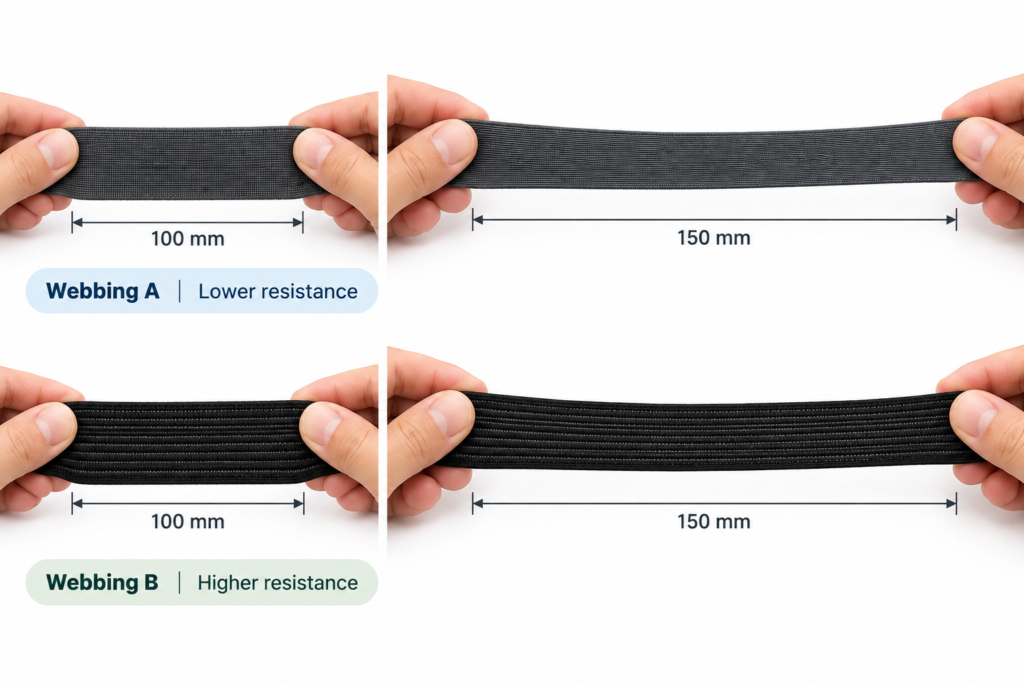
Once an elastic sample works, do not treat width or thickness as a simple size change. Changing either can mean developing the webbing again.
If an approved 25 mm elastic becomes 40 mm, the wider version may need a different yarn or elastic arrangement to maintain stability. That construction change can also change resistance and feel. The same stretch percentage does not guarantee the wider webbing will perform the same way.
Thickness often meets product constraints first. If your buckle, adjuster, or slot is already selected, share it before changing the webbing. A thicker elastic may become difficult to adjust, while a thinner one may move too freely or lose the required body.
The same applies to requests such as “make it thinner but keep the same stretch and support.” Maintaining those properties may require the construction to be rebalanced rather than simply made thinner.
Treat a new width or thickness as a development change. Recheck the working stretch, feel, hardware fit, and assembly before carrying the previous sample approval forward.
Jacquard weaving, screen printing, sublimation, and silicone printing can all work on elastic webbing. We usually narrow the choice by application, working stretch, artwork, and whether the branded surface has another function.
| Logo Method | Where We Usually Recommend It | What We Watch |
|---|---|---|
| Jacquard Woven | Underwear waistbands, sports bra bands, goggle straps, and elastic where the logo should be integrated | Width limits artwork space. Moving a logo from 30 mm to 20 mm can lose fine details or require higher density, which may make the logo area firmer. |
| Screen Printing | Simple logos or repeated marks where the base elastic construction should remain unchanged | Check the print at the working stretch. A logo approved only when relaxed can look different in use. |
| Sublimation Printing | Polyester elastic with multicolor, gradients, or detailed artwork | Better for complex artwork, but proportions and repeat spacing change as the webbing stretches. |
| Silicone Printing | Goggle, headlamp, or wearable straps where grip is also needed | Coverage and thickness affect both grip and surface feel. More silicone does not automatically mean better performance. |
For jacquard elastic, send the artwork before the construction is fully approved. Width, logo size, color count, density, and stretch interact, so adding a complex woven logo later can require the elastic construction to be adjusted again.
Whatever method you choose, evaluate the branded sample at its normal working stretch—not only while it is relaxed.
Test the elastic in your product before deciding what needs to change. A loose sample can meet the width, stretch, and logo requirements and still behave differently after sewing, hardware, and pre-tension are added.
When a sample does not work, describe the problem before prescribing the adjustment. “Reduce the stretch” gives your manufacturer less useful information than “the waistband feels loose at the normal wearing size” or “the goggle strap loses tension after being stretched around the helmet.”
We usually separate sample feedback into three questions:
Where does the problem appear? During stretching, after assembly, while worn, or after repeated use?
What changed? Fit, holding tension, surface feel, recovery, hardware movement, or logo appearance?
At what condition? Relaxed, normal working range, or near the maximum extension?
This matters because the visible problem and the specification that needs changing are not always the same. A loose strap may need more working resistance rather than less maximum stretch. A harsh feel may come from the surface or edge rather than the elastic tension. Poor logo appearance may require artwork or construction changes without changing the entire webbing.
Use the finished product problem as the starting point for the next sample—not the specification you assume caused it.
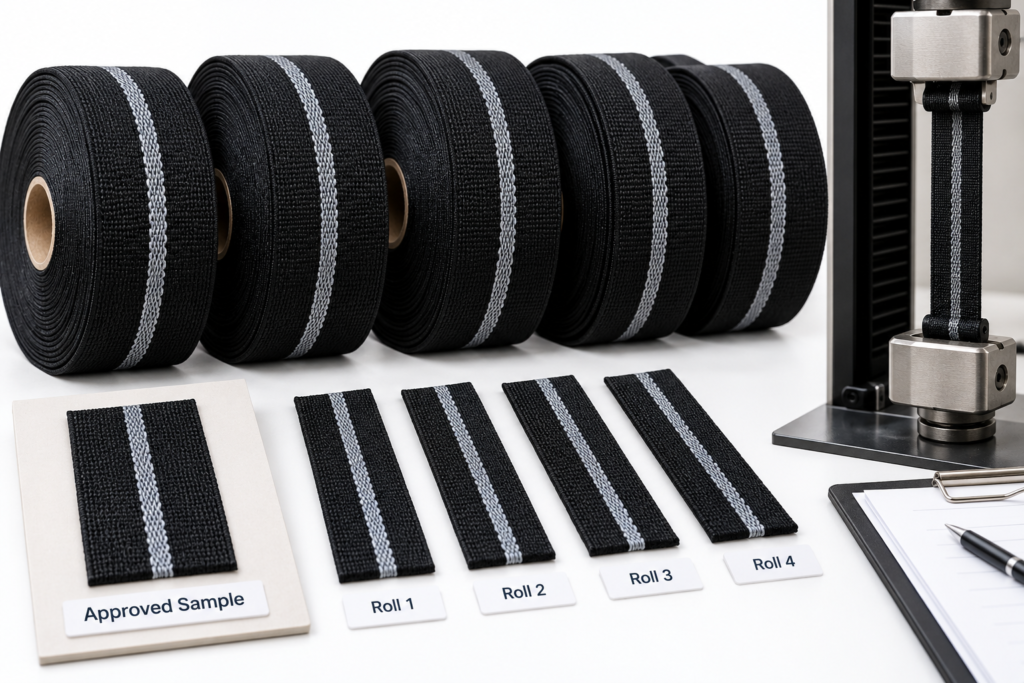
Before bulk production, move from approving one good sample to defining what an acceptable production range looks like. Elastic webbing will have normal production variation; the important question is how much variation your product can accept.
Agree on how the webbing will be measured, not only the target value. Stretch results can change with sample length, preload, pulling method, number of cycles, and rest time. Two measurements taken under different conditions can produce different results from the same webbing.
Timing matters too. Webbing measured immediately after weaving or finishing may not represent its settled condition. For dimensions and elastic performance that matter to your product, use a consistent conditioning and measurement point.
Finally, look for roll-to-roll consistency, not one perfect production piece. A bulk run can contain small differences in width, feel, or resistance while still remaining within the approved range.
Keep the approved sample as the reference from development, but define the production tolerance and test method around it. Bulk approval is about repeating an acceptable range consistently, not reproducing one perfect sample exactly.
We turn your ideas into webbing, manufacture it, and deliver it straight to your doorstep.
Have your product requirements, specifications, or artwork ready? Share your project with us to discuss the next step in development.
We will contact you within 1 working day, please pay attention to the email with the suffix “@anmyda.com”.