
Choosing a branding method is not only about how you want your logo to look. The same logo can work very differently depending on the webbing it needs to go on.
A detailed logo that looks good on a 40 mm strap may lose clarity on a 15 mm strap. A printing method that works well on one material may have poor adhesion on another. On elastic webbing, the logo also needs to work with the stretch and construction rather than only look right when the webbing is relaxed.
This is why we look at the logo, webbing, and finished product together before recommending a branding method. The goal is not simply to reproduce the artwork, but to make sure the branding works on the webbing your product actually needs.
Start with the logo you actually want on the webbing. Once we see the artwork at its real size, the suitable branding methods usually become much easier to judge.
A logo that looks simple on your screen can become a different problem when it is reduced to 15 or 20 mm webbing. Small text, thin outlines, narrow gaps, or tiny dots may no longer have enough physical space to reproduce clearly. This matters especially with jacquard because every detail has to be built into the woven structure rather than placed on top of it.
We have seen logos with only a few colors that are still difficult to weave. The problem is often not the number of colors, but where those colors need to appear. Three large color areas can be easier than two colors forming tiny letters, thin outlines, or small dots.
That does not automatically mean you need another branding method. Sometimes enlarging the logo, simplifying one small detail, or giving it more space is enough. If the artwork cannot change, printing may reproduce those fine details better than jacquard.
For a new project, send the original vector artwork, webbing width, and intended logo size or layout. That lets us judge the artwork at the scale it will actually be made and recommend any adjustment before sampling.
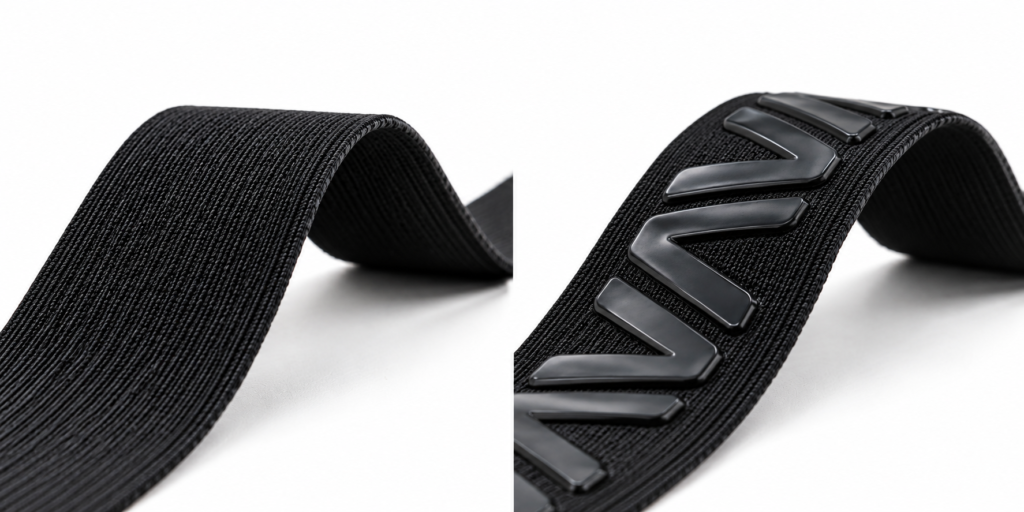
The same branding method can give very different results on different webbing. Material is the starting point, but surface and construction often decide how well the branding actually works.
A few practical starting points:
This is why “polyester” or “nylon” alone is not enough to judge the branding result. Two webbings made from the same material can perform differently when their surface, construction, or finishing changes.
Choose the webbing around your product needs first, but bring branding into the development early. Give your manufacturer both requirements so the material, construction, and branding method can be developed to work together.
It is easy to treat branding as the last visual step once the webbing has already been developed. In practice, adding the branding can change some of the webbing properties you have already approved.
A printed area can feel firmer than the unprinted webbing. Silicone adds a physical layer, so thickness, grip, and flexibility can change. With jacquard, the logo is part of the construction itself, so changing the artwork, yarns, or logo density can also change the feel of the webbing. Heat-transfer printing adds another round of heat and pressure, which can change the finished dimensions, especially on elastic constructions.
These changes do not automatically make the branding method unsuitable. What matters is which webbing properties your product cannot afford to lose. A sports bra strap may need to keep its softness and stretch, while webbing running through an adjuster may be more sensitive to thickness and flexibility.
Tell your manufacturer which properties matter most before the branded sample is made. They can then adjust the branding coverage, construction, or process around those requirements and check the finished branded webbing again. Approve the webbing after the branding is added—not the base webbing and logo as two separate things.
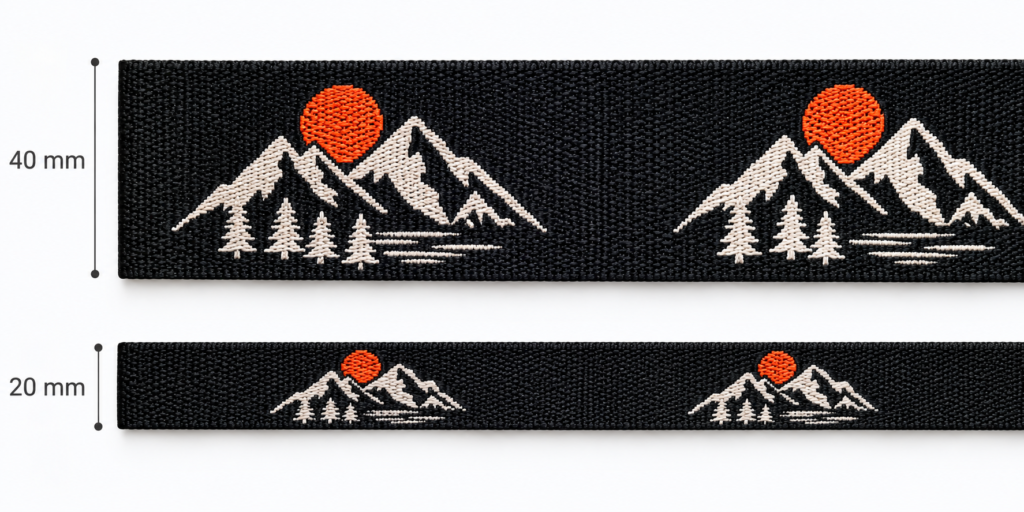
A logo that works well on 40 mm webbing may need a different approach on 20 mm webbing. As the webbing gets narrower, there is less physical space for colors, lettering, lines, and gaps. This can limit both the branding method and the finished appearance.
Color count alone does not tell us how difficult a logo will be. Three large color areas can be easier to reproduce than two colors used in tiny lettering, thin outlines, and narrow gaps.
From the projects we have developed, these are useful starting points rather than fixed limits:
| Webbing Width | Jacquard | Screen Printing | Silicone Printing | Heat Transfer / Sublimation |
|---|---|---|---|---|
| 15–20 mm | Simpler artwork; around 2 colors is a practical start | Fine details possible, but print area is limited | Better for simple logos or patterns | More color freedom, but tiny details may be lost |
| 20–30 mm | 2–4 colors often work with clearer details | Good flexibility for detailed, multicolor logos | More room for logos and spacing | Good for detailed, multicolor artwork |
| 30–40 mm+ | 3–5 colors and more complex artwork become practical | More room for complex artwork | Larger, more detailed patterns become practical | More space for fine details |
Width affects each method differently. Jacquard needs enough weaving space for colors and details, while printing is more limited by actual logo size, spacing, and printable area. This is why “we can make it” and “it will look good” are two different answers.
When your product has already fixed the webbing width, let the manufacturer work around it. Logo size, spacing, line weight, colors, or small details can be adjusted first. If the result still does not look right, changing the branding method is usually better than forcing the original artwork into too little space.
A branded sample can look right and still be wrong for the product. The part that causes trouble is different for each branding method, and some problems only appear after the webbing starts doing its job.
A jacquard logo may look clean, but a dense woven area can change the feel or stretch of the webbing. Screen printing may look perfect when the sample is flat, then show poor adhesion once the strap is bent or stretched. Silicone can have the right shape and thickness but start lifting if the bonding does not work with the surface or repeated stretch. Heat-transfer printing may reproduce the artwork well but leave the webbing slightly narrower after heat and pressure.
This is why we do not judge every branded sample in the same way. The appearance tells us whether the logo looks right; the branding method tells us where else to look for trouble.
You do not need to define those checks yourself. Tell your manufacturer how the webbing works in the product—whether it stretches, bends, rubs against hardware, or has a critical finished size. They can then check the branded sample where that particular method is most likely to cause a problem.
A logo can look perfectly balanced on relaxed elastic webbing and change once the strap reaches its working stretch. For an elastic product, the best-looking logo in the relaxed sample is not always the logo that will look best in use.
The change is not always as simple as stretching the artwork by the same percentage as the webbing. With jacquard elastic, the logo is part of the woven construction, and the branded area may not open in exactly the same way as the surrounding webbing. Logo density, yarn arrangement, repeat, and elastic construction can all affect the result. Printed and silicone branding behave differently again because the branding sits on a stretching base.
What matters is where the product normally uses the webbing. An underwear waistband may spend much of its wearing time under extension. A ski goggle strap is already stretched around the helmet when the logo is being seen. That working state can matter more than how perfect the logo looks while the sample is lying relaxed on a table.
If you know the approximate working length or stretch, give it to your manufacturer before the artwork is finalized. The logo proportion, spacing, repeat, or construction can then be adjusted around that condition and checked again on the branded sample.
For elastic webbing, approve the branding where your product actually uses it—not only in the relaxed state.
A branded sample can match your artwork and still not be ready for production. The real question is whether it is still the webbing your product needs after the branding has been added.
You do not need a new checklist just for branding. Go back to the requirements that made you approve the base webbing in the first place, and check the important ones again on the branded sample.
For a sports bra strap, that may be softness and stretch. For webbing running through an adjuster, thickness and hardware fit may matter more. For an underwear waistband, you may need to look again at stretch, recovery, and skin feel. The properties worth checking come from the product, not from a standard branding checklist.
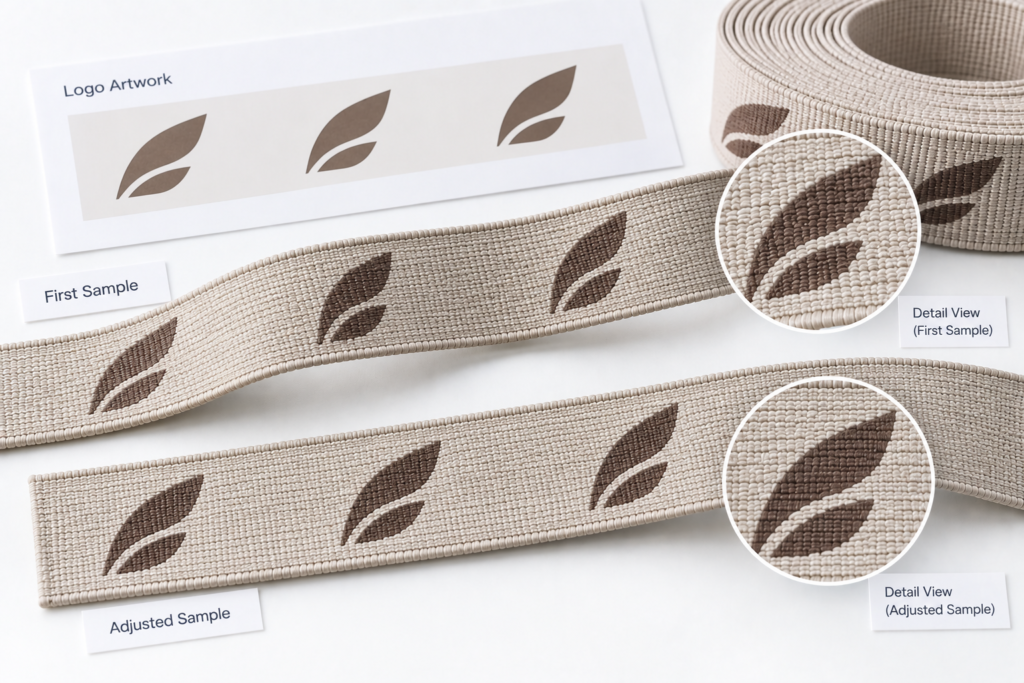
If one of those important properties has changed, it does not automatically mean the branding method is wrong. The manufacturer may be able to adjust the print coverage, logo construction, thickness, or webbing construction before another sample is made.
You started with a logo, but what you finally approve is a branded webbing component that still works the way your product needs it to.
We turn your ideas into webbing, manufacture it, and deliver it straight to your doorstep.
Have your product requirements, specifications, or artwork ready? Share your project with us to discuss the next step in development.
We will contact you within 1 working day, please pay attention to the email with the suffix “@anmyda.com”.