
“Strong and durable” is not a complete webbing requirement. A webbing can be strong but wear quickly, while another may remain intact but gradually lose the performance your product needs.
From the webbing projects we have worked on, durability usually comes down to several connected decisions: choosing a material that suits the required conditions, deciding what performance needs to last, building enough strength and wear resistance, and paying attention to the areas that experience more wear than the rest of the webbing. Improving one of these can also change thickness, flexibility, stretch, feel, or other properties you already need.
In this guide, we’ll share how we approach these decisions in real webbing development, so you can define the right strength and durability requirements for your own product.
The most durable material is not always the one with the highest strength or temperature rating. What matters is what your webbing must survive and what it still needs to do afterward.
A useful way to judge this is:
Condition × Severity × Duration/Frequency × Performance to Retain
For example, brief exposure to 150°C is different from continuous use at 150°C. At −40°C, simply remaining intact may not be enough if your strap still needs to bend, adjust, or carry load.
| Your Durability Need | Material Direction | Useful Reference | Typical Applications |
|---|---|---|---|
| General outdoor durability | Polyester | Good moisture, dimensional and UV performance | Outdoor equipment, bags, sports straps |
| Repeated abrasion | Nylon | Good toughness, flexibility and abrasion resistance | Adjustment and equipment straps |
| Wet / chemical exposure | Polypropylene | Low water absorption and good resistance to many chemicals | Marine, utility and wet-environment straps |
| High strength / low weight | UHMWPE / Dyneema | About 15× stronger than steel by weight; density ~0.97 g/cm³ | Marine, outdoor and high-strength straps |
| High heat / flame resistance | Nomex / aramid | Nomex: about 204°C maximum continuous operating temperature in DuPont’s specified long-duration context; does not melt or drip | Protective, industrial and aerospace webbing |
| Low-temperature use | Polyester / nylon; specialized fibers when needed | Defined textile-sling systems using polyester/polyamide allow use to about −40°C; finished webbing remains application-specific | Cold storage, winter and cold-region equipment |
| Long-term elastic recovery | Elastane / rubber elastic systems | No useful universal figure—recovery depends heavily on construction and working extension | Waistbands, sports and wearable straps |
Treat these numbers as material-selection references, not finished-webbing ratings. A Nomex yarn’s temperature capability does not automatically become the rating of a finished webbing containing elastic yarn, printing, coatings, or other materials.
Also, don’t jump to a specialized fiber because one number looks extreme. 150°C for seconds and 150°C continuously are different material decisions. The same applies to abrasion, chemicals, and cold.
Choose the material by the condition it must survive, how long and how often it faces that condition, and what performance must remain afterward.
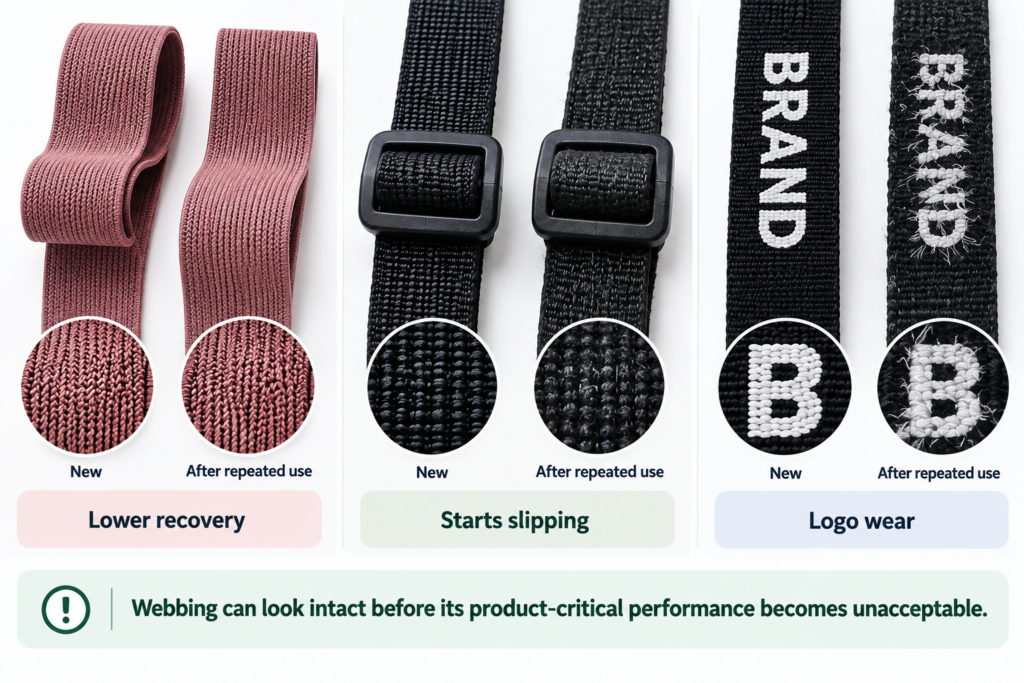
Don’t wait for your webbing to break before deciding it has reached the end of its useful life. In many projects, the first unacceptable change happens much earlier—and may not be easy to see.
What matters is the performance your finished product relies on. For example:
This is why we don’t judge durability by appearance alone. Compare used webbing with the approved sample under the condition that matters to your product. For elastic webbing, compare relaxed length, working stretch and tension. For an adjustment strap, run both through the same hardware. If appearance matters, compare the surface and logo after the same use condition.
You don’t need every property to remain unchanged. Focus on the first change that affects how your product fits, holds, adjusts, stretches, grips, or looks—and decide how much change you can accept during development.
That point, not eventual breakage, is the practical durability limit for your webbing.
When more strength is needed, a practical development order is:
Application → Material → Width → Thickness / Yarn Amount → Construction
Elastic webbing needs extra care. Adding non-elastic yarn or density may increase tensile strength while reducing stretch or changing working tension.
The goal is not maximum strength. Build enough strength for the application with the least disruption to the other performance your product needs.
The same webbing can last well in one product and wear quickly in another. Wear resistance depends not only on the webbing itself, but on where it is used, what it rubs against, and how that contact happens.
So when we improve wear resistance, we work in this order:
Application → Indoor or Outdoor → Material → Actual Wear Area → Adjust That Area
Don’t make the whole webbing heavier or thicker for a local wear problem. Find the real contact first, then improve the part that actually needs to survive it.
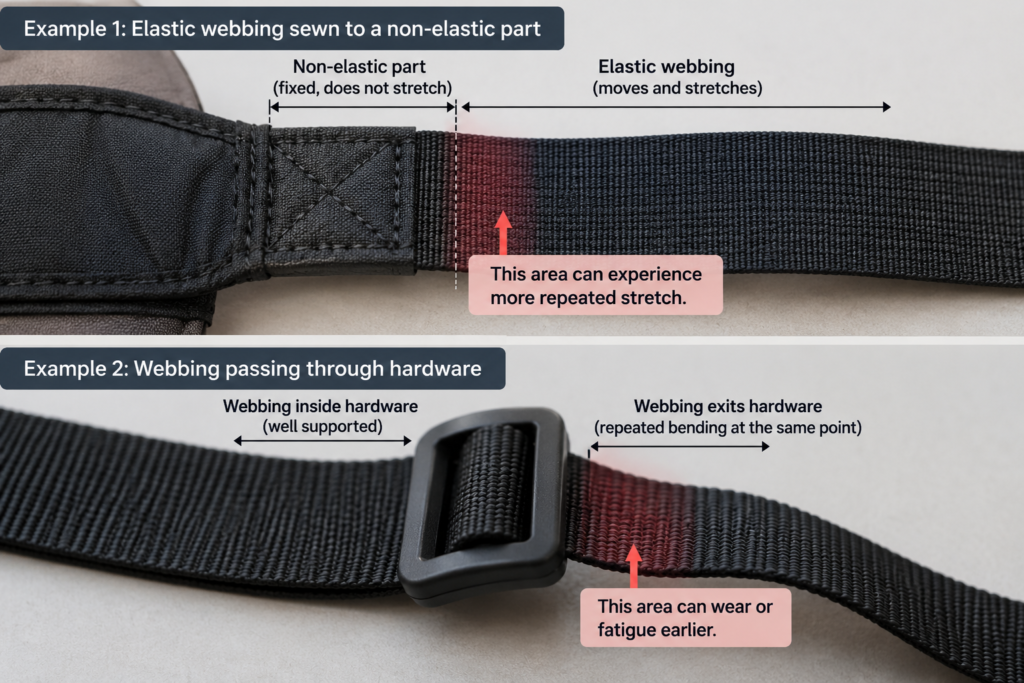
The durability weak point is often beside a connection, not directly at it. Look for where the webbing changes from moving freely to being fixed, stiff, or restricted. Repeated movement can become concentrated around that boundary.
An elastic strap is a good example. Where it is sewn to a non-elastic part, the stitched area can no longer stretch normally. The first free section immediately after the stitching may therefore take more repeated stretch. Simply reinforcing that area can make it stiffer and move the same problem to the end of the reinforcement.
The same can happen when flexible webbing passes through rigid hardware. If it repeatedly bends at the hardware exit, adding thickness may make that point stiffer and concentrate the bending even more.
In these situations, the better solution is not always more strength or more material. Sometimes the webbing needs more room to bend, a less abrupt change in stiffness, or a longer area over which the movement can spread.
When reviewing your product, follow the webbing and look for:
free movement → restricted movement
stretching → fixed
soft → stiff
The boundary between them deserves attention. If movement is concentrated there, don’t automatically reinforce the weak point—first see whether you can spread that movement over a larger area.
A new sample only tells you how the webbing performs today. To keep that performance longer, first decide which performance your product cannot afford to lose, then protect it under the condition that causes it to change.
For example:
You do not need every property to remain unchanged. Protect the performance your product depends on, under the condition that is most likely to make it change.
And evaluate the webbing as it actually works: stretched if it works stretched, with the hardware if it works through hardware, and outdoors if that is where your product will be used.
We turn your ideas into webbing, manufacture it, and deliver it straight to your doorstep.
Have your product requirements, specifications, or artwork ready? Share your project with us to discuss the next step in development.
We will contact you within 1 working day, please pay attention to the email with the suffix “@anmyda.com”.