
Webbing used in high or low temperatures, outdoors, around seawater, or in other demanding environments needs more than a material labeled for that condition. The strap still has a job to do, and that job is where we normally start when deciding the webbing material.
After working on different webbing projects for these environments, we have found that material choice is only part of the decision. You also need to consider the other components in the webbing, how long and how often it will be exposed, whether added protection is really needed, and when the webbing should be replaced even if it still looks usable.
This page shares the practical checks we use to make those decisions, so you can define the material requirement around how your strap will actually work and where it will be used.
The environment tells us where your webbing needs to work. What the strap still needs to do there is what really guides the material decision.
If you tell us, “This strap will be used at −30°C,” we know to look at materials suitable for low-temperature use. But we still do not know what you need the strap to keep doing at −30°C.
If the strap must also carry a required load, say that together: “The strap must still meet the required load at −30°C.” Now we are not simply looking for a material that can tolerate the temperature. We are looking for a material and construction that can maintain the performance your product actually needs there.
This is an important difference when you prepare your requirement. “Low temperature,” “marine,” or “outdoor” only gives your manufacturer the environment. Connect that environment directly to the function or performance that must remain.
Instead of giving the temperature and performance as separate specifications, tell us what must still work under that condition. That gives us a much clearer target for material selection, sampling, and later validation.
Define what the strap must still do in the environment, then decide the material.
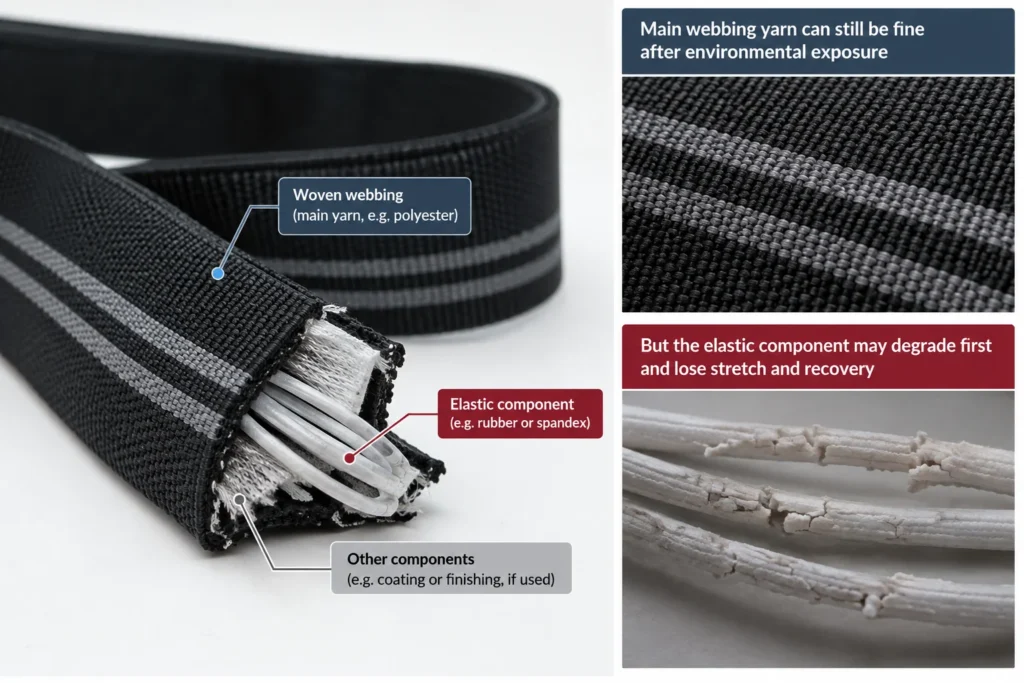
When a webbing contains more than one functional component, the material that handles the environment best does not decide how long the webbing can keep working. The component that reaches its performance limit first does.
Elastic webbing is a simple example. The main polyester yarn may still be suitable for the environment, but the strap also relies on its elastic component. If that elastic can no longer provide the stretch and recovery your product requires, the webbing has reached its functional limit even though the polyester itself is still fine.
We use the same thinking with coated webbing. The woven core and the outer coating have different jobs. A strong core does not help if the coating has already lost the surface function your product relies on. The finished webbing is only suitable while the components that matter to its function are still doing their jobs.
For your project, first identify which parts of the webbing actually create the function you need. Then check those parts against the environment—not just the main fiber listed on the specification.
If your strap depends on elasticity, check the elastic component. If it depends on a coated surface, check the coating as well as the core. The first critical component to fall below your required performance becomes the limit for the whole webbing.
When your webbing needs a specific environmental resistance, first check whether that performance can come from the material itself. If it can, we normally prioritize that route rather than create the same function through an added treatment or additive.
UV resistance is a good example. For outdoor webbing, you can choose a material that already provides the UV resistance your product needs, or use a regular material and add a UV stabilizer. Both routes can work. If the material itself already provides enough resistance, we normally prefer not to create the same function through an additional process.
The trade-off is often MOQ. In projects we handle, a material with the required resistance may have a raw-material MOQ of around 3,000 meters, while a regular material with added protection may allow production from around 500 meters. These are project examples, not fixed industry MOQs, but they show why our preferred material route may not always be the practical choice for your project.
Before you lock the material, ask your manufacturer to check both workable routes. First confirm that each can meet the environmental performance your product needs. Then compare the MOQ and cost of the material route with the added-protection route.
Performance comes first. Once both routes can meet it, use MOQ and cost to decide which one makes sense for your project.
One thing we would not rely on with webbing used in a demanding environment is appearance. A strap can still look fine even when its remaining functional life is getting short.
Long-term UV exposure is a good example. The webbing may not show an obvious break or serious surface damage, but its strength can already be lower than when it was new. For a strap carrying a load, holding equipment, or doing another critical job, waiting until it looks worn out can be too late.
For critical webbing, replacement should be part of the development plan. Start with the performance the new strap must provide, then decide the minimum performance your product can still accept. From there, you can evaluate how the expected environment affects that performance over time.
For example, expose the webbing to the relevant environmental condition and check the required performance afterward. This helps you see when the webbing begins to approach the limit your product has set. Together with the applicable standard, safety requirements, and material guidance, that information can be used to build a practical inspection or replacement rule.
You do not need to wait for the webbing to look damaged before replacing it. For critical applications, develop the service life together with the webbing.
When someone tells us “this strap will be used in seawater,” we usually ask one more question: for how long? That detail matters more than it may seem.
We have seen very different projects described simply as “seawater use.” One strap may go underwater for a few hours, then get rinsed and dried. Another may stay submerged for most of its working life. We would not take a webbing that works for the first situation and assume it will also work for the second.
The same thinking applies to temperature. If a webbing can handle a short period of high temperature, that does not tell us it can work there continuously. Once the exposure changes, we need to look at the material again.
So when you tell your manufacturer about a demanding environment, add how the webbing will actually meet that environment. How long is each exposure? How often? Does it return to normal conditions between uses, or does it stay there?
Instead of “used in seawater,” tell us “submerged for about four hours each time, then rinsed and dried,” or “continuously submerged during service.”
That gives us something we can actually use to judge the material, rather than assuming that one “seawater-resistant” webbing fits every seawater application.
When someone asks us for “webbing that can handle heat,” we first ask what the strap actually needs to do. Does it need to keep working at a high temperature, or does it need to handle exposure to flame? These are different requirements.
For heat-resistant webbing, define what the strap must still do at the working temperature. If it needs to carry a required load at 150°C, for example, that performance at 150°C is the real requirement.
Fire or flame resistance deals with how the webbing behaves when exposed to flame or an ignition source, often against a specific test or standard. We sometimes see these two requirements mixed together, which can send the material decision in the wrong direction.
Your product may also need both. If so, specify them separately: the function that must remain at the working temperature, and the fire or flame requirement that must be met.
That gives your manufacturer the right information to decide the material.
We turn your ideas into webbing, manufacture it, and deliver it straight to your doorstep.
Have your product requirements, specifications, or artwork ready? Share your project with us to discuss the next step in development.
We will contact you within 1 working day, please pay attention to the email with the suffix “@anmyda.com”.