
Finishing and treatments can give webbing functions such as better grip, water repellency, or flame resistance. But a required function does not always mean your webbing needs an added finish.
Sometimes the better solution starts with the webbing material or construction itself. When a finish is added, it has to work with the webbing underneath it—and it may also change stretch, feel, thickness, or other properties you already approved. The finish can even lose its function while the webbing itself is still usable.
The goal is not simply to add a function. It is to make sure that function works with your webbing, lasts as long as your product needs it, and can be verified when required.
Before adding a finish, first check whether the required performance should come from the webbing itself. Material and construction should provide the core properties your product needs; finishing is better used for functions the base webbing cannot provide without compromising those properties.
UV resistance is a good example. If your strap will spend long periods outdoors, start with the material rather than a UV treatment. Choosing a material suited to prolonged UV exposure gives the webbing the right foundation from the beginning. Consider an added treatment only when the required exposure exceeds what the selected webbing can provide on its own.
The same judgment works for other requirements:
UV exposure: start with the material.
Softness: check the yarn, construction, and thickness before using a softening finish.
Grip: when the webbing cannot provide enough friction itself, a surface application such as silicone can add the required grip.
There is also a point where changing the base webbing becomes the wrong solution. If its material and construction already give your product the right stretch, support, thickness, feel, and strength, changing them again for one additional function may sacrifice something you already need.
Keep the base webbing focused on its main job. Use finishing for the remaining function when changing the webbing itself would compromise the properties already working for your product.
If you want to copy a finish from an existing strap, don’t start with the finish. Look at the webbing underneath it first.
Take a silicone grip pattern as an example. Your reference strap may use a firm, smooth, low-stretch webbing, while your new strap needs a softer elastic construction. Copying the same silicone pattern, coverage, and application does not give the silicone the same working surface. The new webbing stretches differently, its surface moves differently, and the finished result needs to be developed around those differences.
Before copying a finish from a reference strap, compare the webbing underneath:
Material: Is the new webbing made from the same or a similar fiber?
Stretch: Does it extend and recover in a similar way?
Surface: Is it similarly smooth, textured, or open?
Firmness: Does it hold its shape in a similar way?
Construction: Does the surface remain similarly stable when the webbing moves?
The closer the base webbings are, the more useful the existing finish becomes as a reference. When the webbing is substantially different, expect to develop the finish again rather than simply transfer the old settings.
This distinction also helps when a treated sample goes wrong. If the grip is weak, the webbing becomes too stiff, or the finish behaves poorly during stretching, don’t start by adding more silicone or changing the coating. First separate the two possible problems: is the finish itself wrong, or is it wrong for this webbing?
That distinction can save unnecessary adjustments. The finish and the webbing underneath it should be developed as one finished structure, not approved separately and expected to work together later.
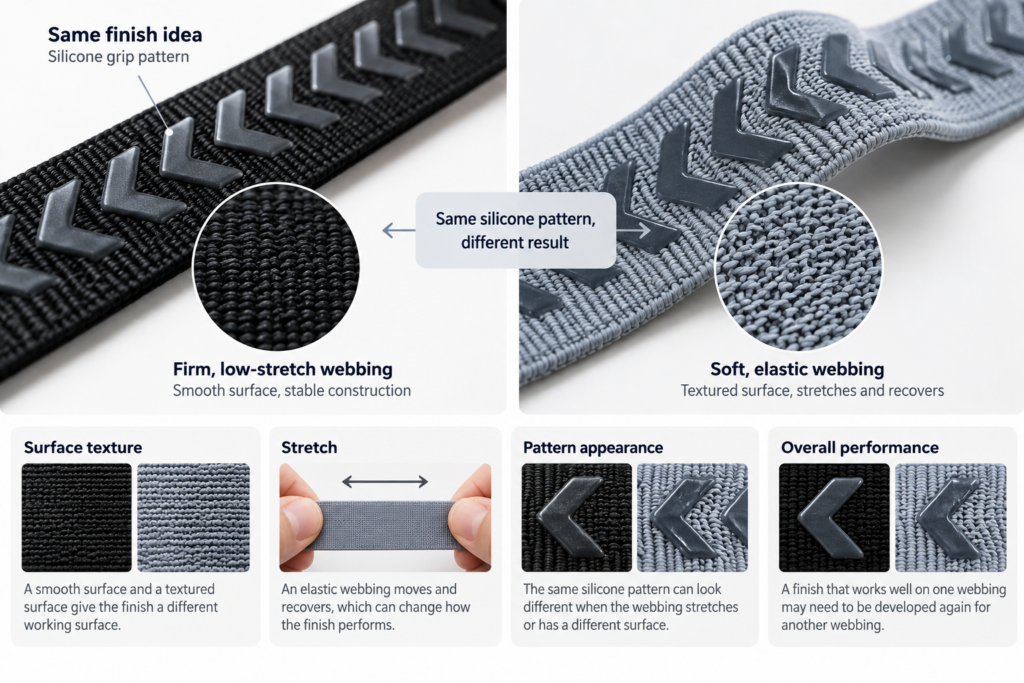
Adding a finish gives you more than a new function. Once it becomes part of the webbing, it can also change how the webbing stretches, bends, feels, and fits into your product.
Silicone grip on elastic webbing is a good example. More silicone coverage can increase grip, but it also makes more of the surface less free to move. As coverage or thickness increases, flexibility, surface feel, finished thickness, and even local stretch behavior can change with it.
This is why maximum finishing is rarely the target. A ski goggle strap needs enough grip to stay in position on the helmet. Beyond that point, more silicone may add little practical value while continuing to change the strap.
The finishing type alone also tells only part of the story. Pattern, coverage, spacing, and thickness can make two straps with the same “silicone grip” specification behave very differently.
Finishing is another part of your webbing specification, not simply an add-on. The useful level is where the new function works while the properties you already need from the webbing remain intact.
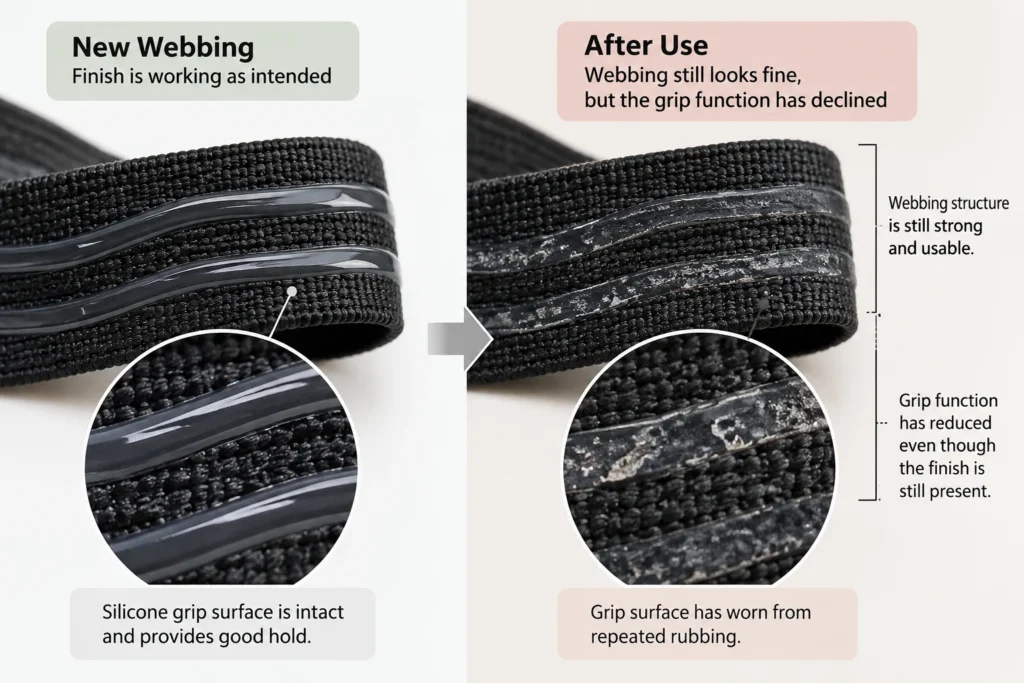
A treated webbing can still look usable after the function added to it has already declined. This matters most when that function plays an important role in how the strap protects, supports, grips, or performs in the finished product.
Take a strap that relies on a treated surface for grip. The webbing may still have good strength and stretch, while repeated rubbing gradually reduces the grip that originally kept the strap in position. At that point, the physical webbing has not reached the end of its life, but the reason that treatment was added may no longer be fully working.
The same distinction applies to functions that gradually decline through washing, abrasion, cleaning, or environmental exposure. Their useful life is better judged by how long the required function remains effective, rather than how long the webbing remains physically intact.
For protective or performance-critical straps, this can also become part of the replacement decision. The right time to replace a strap may come before visible webbing failure when a required function can no longer be relied on.
The service life that matters is the life of the function your product depends on—not simply the life of the webbing underneath it.
We have seen projects start with a test requirement before anyone has confirmed whether that test proves what the webbing actually needs to do. A test report looks reassuring, but the wrong test can give you a passing result without answering the real product question.
Silicone grip is a simple example. If it is added to keep a ski goggle strap in position, we first care whether the developed strap actually stays on the helmet it will be used with. A friction value can be added when the project needs one, but a number measured under different contact conditions does not replace the actual grip requirement.
Water-related requirements create a different problem. “Water resistant” may mean that water should bead on the surface, that it should not penetrate through the webbing, or simply that the strap should not hold much water after getting wet. A report proving one of these does not prove the other two.
For requirements tied to a defined standard, the situation changes. Flame resistance, for example, may need to meet the specific test method required by the finished product or market. In that case, passing the relevant standard is part of the requirement from the beginning.
The useful experience is simple: start with the reason the function was added, then use the evidence that proves that reason. A test report is valuable when it answers the product question—not just when it gives the webbing another passing result.
We turn your ideas into webbing, manufacture it, and deliver it straight to your doorstep.
Have your product requirements, specifications, or artwork ready? Share your project with us to discuss the next step in development.
We will contact you within 1 working day, please pay attention to the email with the suffix “@anmyda.com”.