
Most elastic webbing projects come to us with some specifications already decided. You may already have a material, width, thickness, or stretch range based on an existing strap, drawing, or similar product. Those specifications are useful, but we do not treat them as the final webbing design until we know what the strap actually needs to do in your application.
A better way to develop elastic webbing is to start with the job the finished strap needs to perform. Tell your manufacturer how it will be used, how you expect it to stretch and support, what size or assembly limits the product has, and any secondary requirements such as branding or grip. An experienced manufacturer can then turn those requirements into a webbing specification that is practical to manufacture and sample.
In this guide, we share how we work through that process with product developers, including what to decide yourself, what to leave open for your manufacturer, and what to verify before approving the finished strap.
You may already have a material in mind when you contact a webbing manufacturer. We often receive requirements such as “25 mm elastic webbing, polyester, for outdoor use.” Polyester is a reasonable starting point for many outdoor products, but we would not stop at “outdoor.”
A headlamp strap, marine strap, and ski strap may all use polyester, while facing very different conditions—UV, saltwater, cold, washing, or repeated stretching. Those working conditions are what we use to judge whether the material you proposed is enough.
With elastic webbing, we also look beyond the visible yarn. A polyester surface may still look fine while the elastic component inside starts losing recovery after repeated use and environmental exposure. In that case, the strap stops working properly before the polyester itself appears damaged.
So you do not need to decide the complete material specification yourself. Tell your manufacturer what the strap will actually go through. From there, they can judge whether your original material choice works, or whether the material system needs to change.
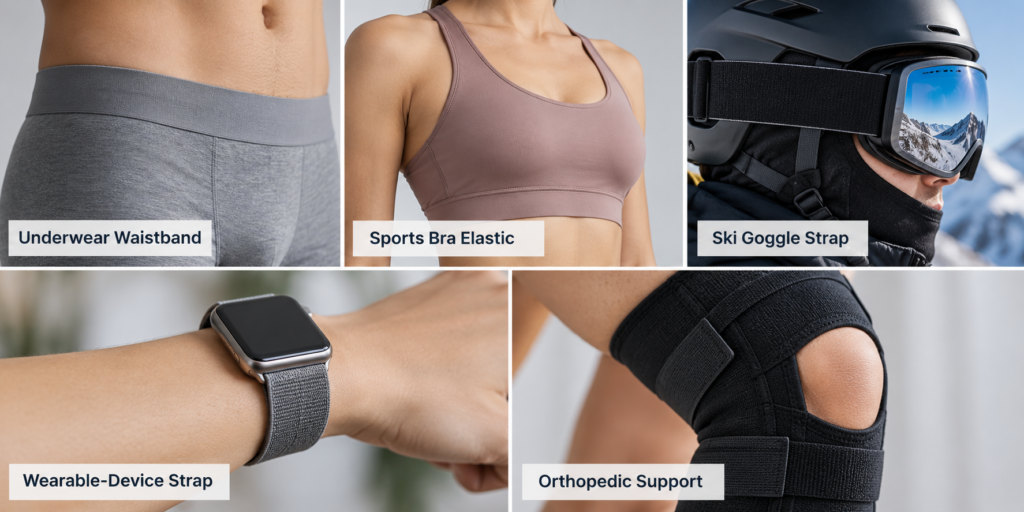
Once we know the application, we normally ask how you expect the strap to stretch and hold in actual use. You do not need to give us a precise stretch percentage. “150% stretch” tells us how far the webbing can extend, but it does not tell us how hard it should be to pull or how much support the finished strap needs to provide.
Take an orthopedic ankle wrap. Instead of simply asking for “firm support,” tell us roughly how the strap is used. If a 300 mm working section is normally pulled to around 360 mm before fastening, that is a very different requirement from pulling the same section to 450 mm. We can use that working range together with the support you want to set a realistic starting point for the elastic construction.
If that is difficult to describe, take a short phone video. Show us how you put the strap on, where you start pulling, how far you pull it, and how it sits after fastening. We can often learn more from a 20-second video than from a guessed stretch percentage.
A physical reference can come later if we need to measure the pulling force, stretch and recovery more closely. For the first discussion, showing us how the strap needs to work is usually enough to move the development in the right direction.
After we know how the strap needs to stretch and support, we start looking at width in the actual application. One thing we have learned from sampling wide elastic straps is that wider does not keep helping in the same way. Once the strap starts wrapping around a curved or moving area, extra width can create a new problem instead of adding useful support.
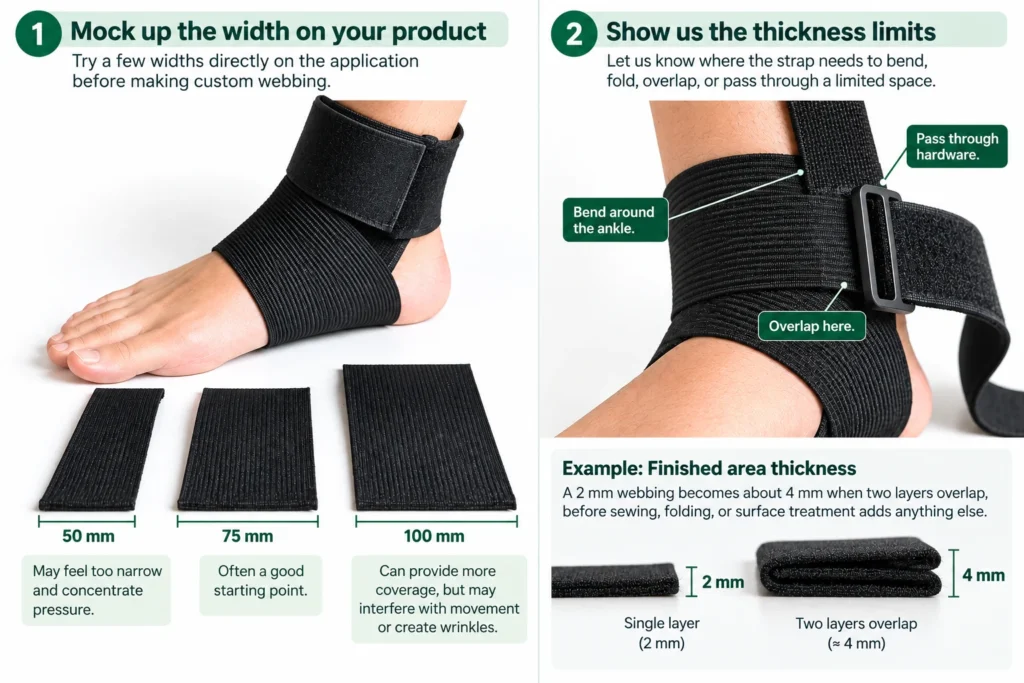
That is why we often suggest a simple three-width mock-up before making custom webbing. If you are considering 75 mm for an orthopedic ankle wrap, try something around 50, 75, and 100 mm directly on the product. You are looking for the range where the strap covers enough working area without crossing too far into a moving joint, wrinkling around the curve, or putting an edge where you do not want pressure. The final width can be refined later.
We handle thickness differently. We normally ask customers to show us where the finished strap needs to bend, fold, overlap, or pass through a limited space. In sampling, we care more about the thickness at those finished areas than the number measured from one flat layer of webbing. A 2 mm webbing is already about 4 mm where two layers overlap, before sewing, folding, or a surface treatment adds anything else.
So a useful rule is: mock up the width, but show us the thickness limits. Once we have those limits together with your stretch and support target, we can work out a thickness range that the elastic construction can realistically achieve.
Once the base webbing is close in stretch, support, width, and thickness, you can start adding branding or grip. A useful rule is to separate the base webbing from secondary treatments whenever the process allows it.
For silicone grip or surface printing, keep one untreated sample as a reference. After the treatment is added, stretch both samples to the same working length and compare the pulling feel, recovery, and surface. If something changes, you know to check the secondary process before changing a base webbing that was already working.
Jacquard branding is different because the logo is woven into the webbing construction. It needs to be included from the beginning. For elastic jacquard, also check the logo at the strap’s working stretch—not only while the sample is relaxed.
The rule is simple: add surface treatments after the base webbing is close; bring anything that changes the construction into the development from the beginning.
If your strap connects to a buckle, adjuster, hook and loop, or another part, do not judge the fit from nominal dimensions alone. A 25 mm webbing and a 25 mm slot may look compatible on a drawing, while the finished strap can still be difficult to assemble or adjust.
Thickness is easy to underestimate here. If a 1.5 mm webbing folds back through an adjuster, the hardware is already working with about 3.0 mm of webbing instead of 1.5 mm. Add a sewn joint, silicone grip, or another surface treatment in that area and the finished section can become thicker or harder to slide. This is why the thickest assembled section matters more than one flat layer.
When the hardware is already fixed, give your manufacturer the actual part or its drawing early in development. The goal is not simply to make sure the webbing can pass through it. Check whether the finished strap can be assembled without forcing it, moves or holds as the design requires, and comes out without excessive edge rubbing, curling, or surface damage. Too much clearance can also be a problem if the connection depends on friction to hold the strap.
A useful rule is: check the maximum finished thickness against the actual mating part, then make sure the connection works the way your product needs it to—not just that the webbing fits through.
Once the webbing sample is ready, we normally make a few finished strap samples based on the customer’s actual assembly and test them ourselves first. If everything works as expected, we then send sample webbing to the customer—usually around 30 meters—so they have enough material to cut, sew, add hardware, and try different assembly methods in their own product.
We always suggest testing the finished strap in the actual application rather than judging the webbing only by its appearance, dimensions, or a few hand stretches. Use it repeatedly and watch what happens after the webbing starts working together with the hardware, sewing, grip, and the rest of the product.
For example, if an elastic goggle strap starts curling after the customer assembles it onto the goggles and uses it on a helmet, that feedback gives us something useful to work from. We can look at where and when the curling happens, then judge whether the webbing construction, elastic performance, size, or assembly interaction needs to change.
This is how we prefer to finish a development: sample the webbing, test the finished strap, adjust from actual-use feedback, and move to bulk production only after the strap works properly in the customer’s application.
We turn your ideas into webbing, manufacture it, and deliver it straight to your doorstep.
We will contact you within 1 working day, please pay attention to the email with the suffix “@anmyda.com”.