
Choosing a thickness for an elastic headlamp strap is not simply a matter of making the webbing thicker for more support. Before sampling, the strap thickness needs to work with the headlamp weight, required flexibility, elastic construction, and selected adjuster.
For most elastic headlamp straps, around 1.2–2.0 mm is a practical starting thickness range for sampling. Start toward the thinner end when a lighter, more flexible strap is required, and evaluate a thicker construction when more webbing body is needed. For a heavier headlamp, increasing thickness alone is not the best way to create support—a tighter woven and elastic construction can provide a firmer strap without requiring a large increase in thickness.
Read on to see how to choose the right headlamp strap thickness and what should be checked before sampling.

Webbing manufacturing expert with 15+ years of experience helping product developers build high-performance straps for industrial, medical, and outdoor use.
A thicker headlamp strap is the better choice when the current webbing lacks enough body to stay flat through the headlamp attachment and adjuster, or when the strap tends to fold or twist during adjustment. If the strap already sits flat and the problem is that it extends too easily under the lamp, adding thickness is not the first correction. The elastic construction should be adjusted first because extra thickness can add bulk without solving the extension that is allowing the lamp to move.
This distinction is useful during sampling. If a thinner webbing has enough elastic resistance for the headlamp yet still folds or loses its shape around the attachment points, more thickness may give the strap the body it is missing. If the same sample stays flat and keeps its shape, increasing thickness has less justification. The problem may instead be the amount of extension or the way the elastic is built into the webbing.
Use the sample behavior to decide which specification to change. Folding, twisting, or insufficient body gives a reason to evaluate more thickness. Excessive extension without those problems gives a reason to work on the elastic construction first. Compare the revised sample with the same headlamp and hardware. This avoids adding thickness—and potentially more bulk—when another part of the webbing construction is actually controlling the problem.
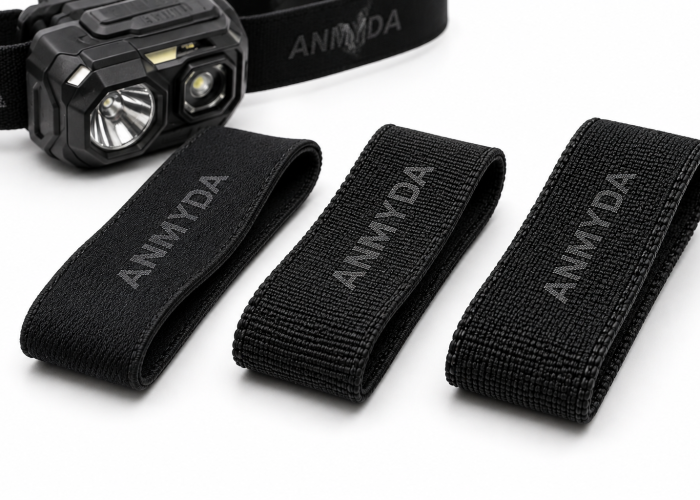
Yes. A thin headlamp strap can still support a heavier lamp when it stays flat at the attachment points and provides enough resistance to extension at the intended adjustment. A heavier lamp therefore does not automatically justify a thicker webbing. Width, woven structure, and elastic construction all influence how the finished strap behaves under the lamp.
This can be checked directly during sampling. Compare the thinner construction with a thicker candidate using the same headlamp, hardware, strap length, and a comparable fit. If the thin strap stays flat and controls the lamp without requiring the adjuster to be pulled unusually tight, its lower thickness is not by itself a reason to reject it. If it stretches too easily, changing the elastic construction should be evaluated before adding thickness simply to make the strap feel more substantial.
For a heavier headlamp, keep the thinner construction when it provides the required fit and stability within the available hardware clearance. Move toward a thicker construction when the thin sample still lacks enough body after its woven and elastic construction have been developed for the required support. This keeps thickness as a response to an observed sample problem rather than a specification chosen from lamp weight alone.
Send us your strap width, stretch requirement, and headlamp details to evaluate a practical starting construction.
No. A narrow headlamp strap does not need more thickness simply because its width is smaller, because width and thickness are solving different problems. Width gives you more strap surface to support the headlamp, while thickness gives the webbing more body. If your narrow strap already stays flat and has enough elastic resistance, making it thicker may only add bulk without giving you a better strap.
This matters when your strap width is already fixed by the headlamp attachment or adjuster. Suppose your first narrow sample folds or twists where it passes through the hardware. Before asking for a thicker version, look at the woven construction. A tighter, more structured construction may give the strap enough body while keeping the thickness you originally wanted. If the sample stays flat and the problem is that it stretches too easily, thickness is even less likely to be the right first change—the elastic construction needs attention instead.
For your next sample, keep the width and hardware unchanged so you can see what the construction change actually solves. If the strap stays flat, moves properly through the adjuster, and provides the required resistance, keep the thinner thickness. If it still folds or feels too soft after the woven construction is adjusted, then compare a slightly thicker version. This gives you a reason to increase thickness based on the sample, rather than using thickness to compensate for a narrow width.
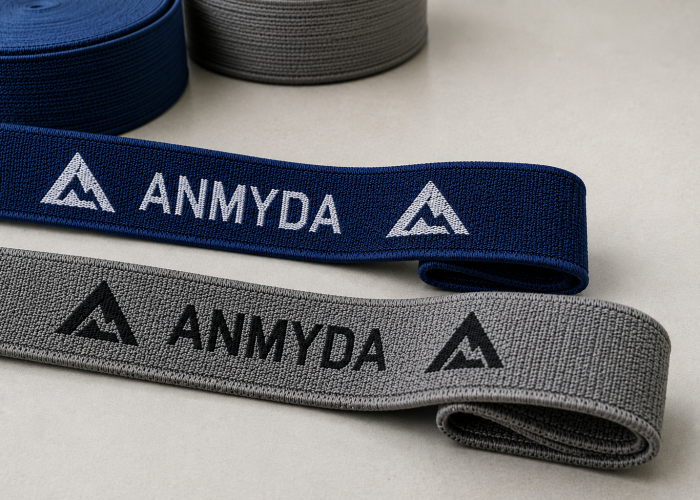
For most thin elastic headlamp straps, start with polyester and elastane. Polyester takes up relatively little moisture, while elastane provides the required stretch, making this a practical combination when you want to keep the strap thin. If a softer hand is more important for your project, nylon and elastane is worth sampling as a second option. Material alone, however, will not tell you whether the finished thin strap has enough body.
You can see this when you compare two finished samples at a similar thickness. Changing the face yarn also changes the hand you are working with, while yarn size, weave density, and elastic construction can make either sample feel firmer or softer. So if your nylon sample gives you the softer surface you want but feels too soft as a strap, don’t immediately make it thicker. First ask whether the woven construction can be tightened while keeping the target thickness and stretch.
For your first sample request, give the supplier the material together with your target thickness, width, and stretch rather than specifying “polyester elastic” or “nylon elastic” alone. If you don’t have a specific reason to use nylon, polyester and elastane is the more practical starting point. If hand feel is a priority, sample both materials to a similar thickness and stretch target. Then you can choose the material from the finished strap behavior instead of adding thickness later to correct a material decision that was made too early.
Share the sample specifications and what you want to change, and we can review which webbing variable should be adjusted first.
Yes. A thin headlamp strap can still use a woven logo if the artwork can be reproduced within the available strap width and woven construction. If the first sample loses logo detail, increasing the strap thickness should not be your first correction. The limitation may come from how much woven resolution is available for the logo rather than from the webbing being too thin.
Look closely at what is actually missing from the sample. If small lettering closes up or narrow spaces disappear, first check whether the logo is simply asking for more detail than the available width can reproduce. Making the webbing heavier will not necessarily solve that. If the artwork has enough space yet the logo still lacks definition, then the jacquard construction becomes the next place to work. Adding yarn or changing the woven structure may improve the logo, although that same change can also affect the strap thickness, hand, and stretch.
This is why the logo and thickness should be sampled together rather than approved as separate specifications. Send the actual artwork at the intended logo size together with your strap width, thickness, and stretch requirement. If the logo is clear, keep the thin construction. If it is not, identify whether artwork scale or webbing construction is limiting the result before changing thickness. When improving the logo requires a heavier construction, you then have a real development choice: accept the thickness change or reduce the logo detail to protect the original strap specification.
Yes. Changing headlamp strap thickness can affect color appearance when the thickness change also changes yarn coverage and woven density. This is especially important with elastic webbing because the surface construction opens as the strap stretches. If your sample has the correct color when relaxed but looks lighter or shows another yarn underneath when stretched, changing the yarn shade is usually the wrong first correction.
Check the same sample in both conditions. If the color already looks wrong while the strap is relaxed, you may have an actual yarn or color-matching issue. If it looks correct relaxed and changes mainly as you extend the strap, look at the construction first. A thin or more open surface can expose more of the elastic or backing yarn as the webbing stretches. Choosing a darker face yarn may disguise part of that change, but it can also make the relaxed strap darker than your approved color without fixing the underlying coverage.
For color approval, use the finished webbing construction you intend to produce rather than approving the yarn color separately. Compare the strap relaxed and at its expected working extension. Wrong relaxed color → review the color match. Correct relaxed color but poor stretched appearance → review yarn coverage and woven construction first. If improving coverage also increases thickness or changes stretch, compare that trade-off before approving the revised sample.
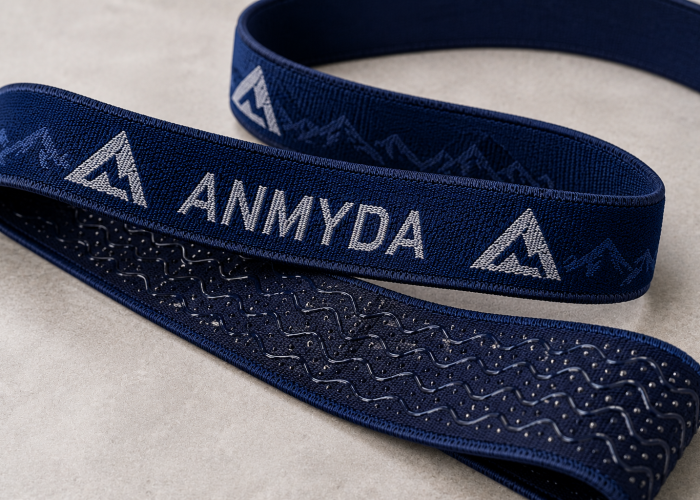
Yes. A thin headlamp strap can have different colors on each side, although the required two-sided appearance may change the webbing construction and make it harder to keep the same thin thickness. If your front and back colors need to stay clearly separated, the real manufacturing question is whether the yarn arrangement can create that separation within your target thickness and stretch.
Look at both faces of the first woven sample, especially where the strap bends and stretches. If the front color remains clean on the front and the back color stays on the back, the thin construction is working. If opposite-side yarn becomes visible or one face looks mixed, making the entire strap thicker is not the first correction. The yarn arrangement and woven structure should be adjusted first. If cleaner separation requires more yarn or a different structure, that change may also increase thickness or alter stretch.
For sampling, provide the required color for each side together with your target width, thickness, stretch, and logo artwork if you also need a woven logo. Then judge the colors on the finished elastic webbing rather than from yarn swatches alone. If color separation can be improved within the target thickness, keep the thin construction. If the required separation needs a heavier structure, decide which specification has priority: the original thickness or the two-sided color effect. That is the trade-off to settle before approving the webbing construction.
Send us your adjuster or attachment dimensions so the webbing thickness can be evaluated together with the actual hardware.
Yes. Silicone grip can work on a thin headlamp strap, as long as the base elastic webbing remains stable enough for the silicone pattern and the added silicone does not interfere with the required stretch or hardware. On a thin strap, the amount and placement of silicone matter more than simply asking for “silicone backing,” because the grip layer becomes a larger part of the finished strap construction.
If your thin webbing already has the right stretch and thickness, start with the minimum silicone coverage needed for grip rather than covering most of the back surface. A heavier or more continuous silicone pattern can make the strap feel firmer and change how easily that section extends. It also adds local thickness. If the strap then becomes harder to adjust or behaves differently where silicone is applied, increasing the base webbing thickness will only move the construction further away from the original thin-strap target.
Sample the base elastic first, then evaluate the same construction with the intended silicone pattern. Compare the stretch, hand, and movement through any hardware that contacts the printed area. If grip is insufficient, adjust the silicone pattern or coverage before making the webbing thicker. If the silicone provides enough grip but makes the strap too stiff, reduce the coverage rather than changing the elastic construction that was already working. This keeps the grip requirement from unnecessarily driving the entire strap thickness.
For most elastic headlamp straps, 1.2–2.0 mm is a practical range to start sampling, but thickness should not be finalized alone. Width, elastic resistance, woven structure, material, logo requirements, hardware, and silicone grip can all change what thickness works best. If you are developing a custom headlamp strap, send us your headlamp requirements, hardware, and artwork. We can help you evaluate a practical webbing construction before sampling.
We will contact you within 1 working day, please pay attention to the email with the suffix “@anmyda.com”.