
When a sports bra already has a target strap width and existing logo artwork, both requirements need to work within the same woven elastic construction. A logo that looks suitable on screen may not reproduce the same way once it is fitted into the available strap width.
Yes. A narrower sports bra strap gives a woven logo less usable weaving area, which can reduce the clarity of small letters, fine lines and gaps. Keep the strap width required by the sports bra first, then check whether the artwork works within its usable woven area and elastic construction. If not, compare adjusting the artwork, construction or width—and increase the width only when width is the actual constraint.
Read on to learn what width changes in a woven logo, how to identify the real limitation, and what to adjust before sampling.

Webbing manufacturing expert with 15+ years of experience helping product developers build high-performance straps for industrial, medical, and outdoor use.
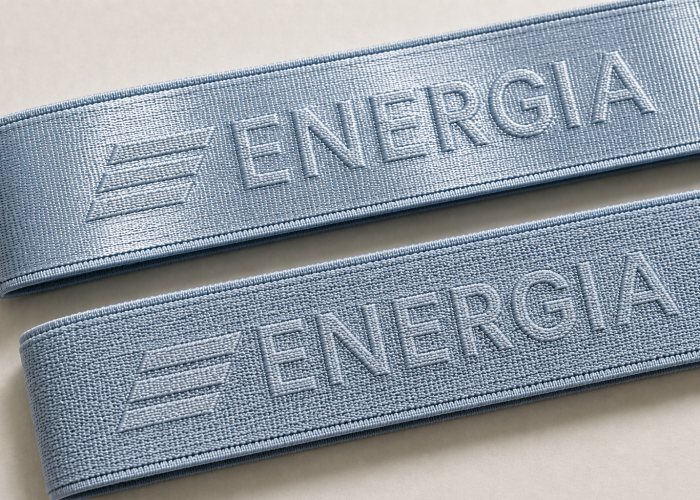
Strap width limits how large your logo can be woven because the artwork must be scaled to fit the available height. The narrower the strap, the smaller each letter, line, gap, and shape becomes. Your workable logo size is therefore determined by whether these features can still be reproduced clearly at the target width.
This is why logo height alone is not enough to judge feasibility. Two logos can both be 10 mm high but require different amounts of woven detail. A bold wordmark with large open spaces is generally less demanding than a 10 mm logo containing thin lettering, small counters, or closely spaced shapes. Jacquard suppliers specifically identify small text and fine lines as features that become difficult as the available design space decreases. A 20 mm elastic also provides only half the vertical design space of a 40 mm band, before the artwork itself is evaluated.
Send the manufacturer your target strap width and original vector artwork together, rather than resizing the logo yourself to make it fit. The artwork can then be converted at the intended woven size and its smallest important features checked against the proposed jacquard construction. If those features remain clear, increasing the strap width adds little branding benefit. If they do not, identify whether artwork detail or width is creating the constraint before changing the sports bra design.
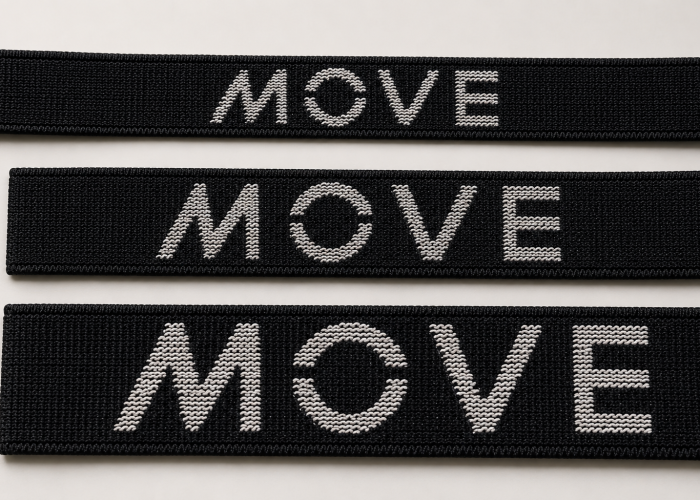
Keep reducing your logo only while its important letters, openings, gaps, and shapes remain clearly distinguishable. If fitting the artwork to the target strap width causes a brand-critical feature to close, merge, or lose its shape, stop reducing the whole logo and evaluate another adjustment.
A narrower width becomes a problem when it forces important artwork features below what the proposed jacquard construction can reproduce clearly. The whole logo does not necessarily fail at once. For example, a wordmark may remain readable while the opening inside one letter becomes too small, or a symbol may retain its outline while a narrow internal gap begins to merge. This is why two logos intended for the same 15 mm or 20 mm strap can reach very different practical limits. Industry guidance for custom jacquard elastic similarly flags small lettering and thin lines as details that may not translate well when artwork is reduced.
Check the smallest brand-critical feature at the final woven size, not only the overall logo dimensions. If a secondary decorative detail becomes unclear first, simplify or strengthen that feature and keep the target strap width. If a defining letter, opening, or shape begins losing separation, stop shrinking the artwork. At that point, compare a different jacquard construction or a wider strap rather than sacrificing the recognisable parts of the branding.
Send us the artwork and width. We can review the critical details before you move into sampling.
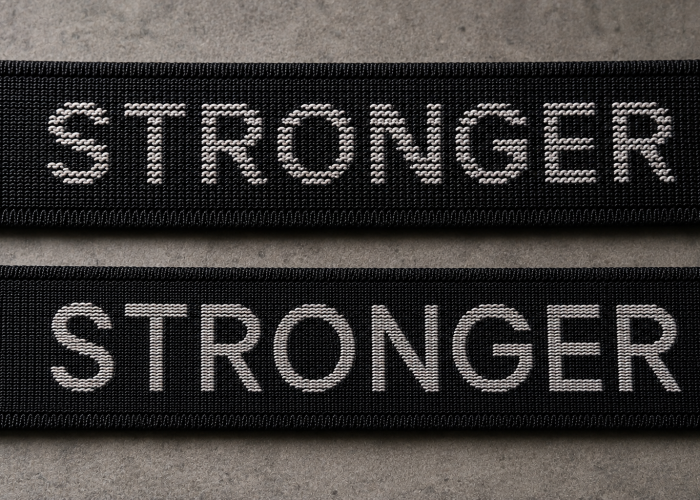
The same logo can look different on two straps of the same width because strap width provides the space, while the jacquard construction determines how much woven detail can be formed within that space. Finer yarns and a construction with more usable yarn intersections can reproduce smaller curves, gaps, and letter edges more precisely.
This means a logo that looks clear on one 20 mm strap is not automatically proven for every 20 mm construction. Jacquard patterns are built from warp and weft intersections, so changing yarn size or the number and arrangement of those intersections changes the available pattern resolution. Industry engineering guidance similarly links thread density and warp/weft intersections with graphic definition. But increasing density or changing yarn and structure purely for a sharper logo is not a free adjustment: the same construction also contributes to the strap’s thickness, flexibility, hand feel, and elastic behaviour.
Keep the target width fixed first and evaluate the logo in the construction needed for the sports bra. If the logo lacks definition, ask what construction change could improve the failing feature and what strap property that change would affect. When matching an existing strap, provide the physical reference as well as its width and artwork. Approve the revised construction only when both the branding and the required strap performance remain acceptable.
Yes. Your required stretch limits which jacquard constructions can be used because the same structure must create the woven logo while allowing the sports bra strap to extend and recover as required. Logo clarity therefore has to be achieved within the strap’s required elastic performance, not by sacrificing that performance for a sharper design.
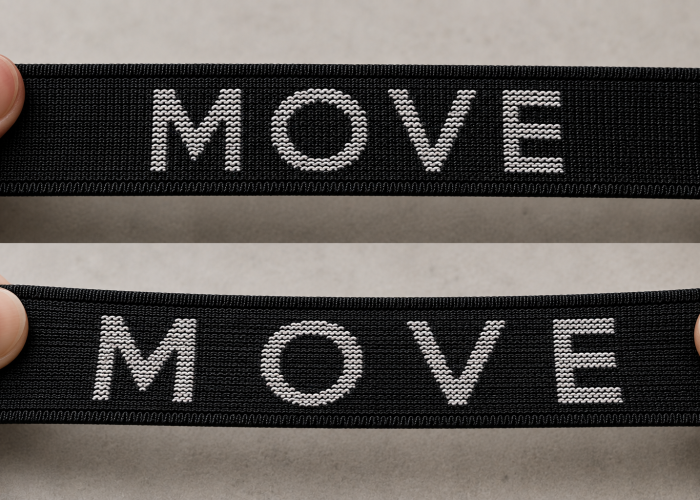
This interaction becomes important when construction is adjusted to improve branding. Increasing structural stability or changing density may help hold small logo features more consistently, but it can also make the elastic firmer or restrict how freely the structure extends. Conversely, a construction developed for greater extension gives the woven pattern more movement to accommodate. Industry testing of jacquard elastic identifies fabric structure, knitting density, and yarn tension as factors affecting stretched or compressed text, blurred edges, and small-font readability during extension.
Define the sports bra’s required stretch and recovery before approving the logo construction. Then review the sample both relaxed and at the actual working extension expected in the garment. If the logo looks clear relaxed but important shapes or spacing become unacceptable at working stretch, keep the functional stretch requirement fixed first. Compare an artwork adjustment or another jacquard construction before reducing stretch. Only change the stretch specification when the sports bra design itself allows that change.
Share your branding, stretch, and feel requirements with us so they can be evaluated as one jacquard construction.
Sample your logo at the actual target strap width and approve it only if the brand-critical details remain clear while the strap still meets the required stretch, recovery, and feel. Check the same sample relaxed and at its intended working extension; if both the branding and strap performance pass, keep the target width.
The key is to prove these requirements on the same final-width construction. Custom jacquard development commonly checks artwork readability together with width, handfeel, stretch and recovery before bulk approval. Small letters and thin lines are specifically identified as details that may become difficult after the artwork is scaled and stretched. A wider trial that produces a sharp logo therefore does not prove that your narrower sports bra strap will give the same result.
During sampling, check the smallest brand-critical feature relaxed, then hold the strap at the extension it will experience in the finished sports bra and check it again. Also confirm that the construction still delivers the required recovery and feel. Do not approve the width just because the relaxed logo looks sharp. If working stretch softens an important detail, or a construction change improves the logo but makes the strap too firm, the sample has exposed a specification conflict rather than passed it. Record which requirement fails before requesting the next adjustment; that failure determines whether artwork, construction or width should be reviewed next.
Change the requirement responsible for the failure, not automatically the strap width. Adjust the artwork when a non-critical detail causes the problem, review the jacquard construction when otherwise workable artwork lacks definition, and reconsider the width when brand-critical features need more space than the functional construction can provide.
Use the failure pattern on the sample to decide where to investigate. If one small gap, outline or decorative feature disappears while surrounding shapes remain clean, changing the whole strap is usually unnecessary; review that artwork feature first. If several adequately sized letters or edges look blurred or compressed, investigate the jacquard structure, density or yarn control instead. These construction variables are documented causes of blurred edges, distorted lettering and reduced small-font readability on jacquard elastic.
Do not keep increasing density simply because a denser sample makes the logo sharper. The construction must still deliver the sports bra’s required stretch, recovery and feel, and improving one woven area can change other strap properties. Likewise, don’t keep simplifying artwork once the feature being lost is essential to the brand. Move to a wider strap when the brand-critical geometry still needs more space after reasonable artwork and construction adjustments have reached their functional limits. At that point, width is supported by the sample evidence as the constraint—not chosen as the easiest fix.
Adjust the logo instead of widening the sports bra strap when the problem comes from a non-critical artwork detail and the target width already meets the garment’s fit, support, and appearance requirements. Preserve the strap specification when a small artwork change can improve woven clarity without changing the recognisable brand identity.
Not every failed detail deserves a wider strap. Small lettering, narrow gaps, fine outlines, and closely spaced shapes are repeatedly identified as difficult features in custom jacquard development. If one of these secondary details reaches the weaving limit while the main wordmark or symbol remains clear, changing the sports bra around that detail creates a larger product change than the branding problem requires. A wider strap can alter the visual proportion of the garment and may also require the elastic construction and attachment details to be reviewed again.
Start by separating brand-defining features from adjustable artwork features. Keep the wordmark shape, essential letterforms, and distinctive symbol elements protected; then test whether a fine outline can be strengthened, a narrow gap opened, or a secondary detail simplified. Do not accept an artwork adjustment from the manufacturer only because it is easier to weave. Compare the revised artwork with the brand master before sampling. If the change alters recognition, spacing, or another protected brand rule, artwork has reached its adjustment boundary. The next decision should move back to construction or width rather than continuing to simplify the brand.
Send us your current design. We can review which requirement is actually creating the limitation before you revise it.
Increase the strap width when brand-critical logo details still need more space after reasonable artwork and jacquard-construction adjustments have been tested without meeting both branding and strap-performance requirements. Width should change only when sample evidence shows that available space—not an adjustable detail or unsuitable construction—is the remaining constraint.
That conclusion should come from comparison, not assumption. If the logo fails on a 15 mm target strap, a wider sample can be useful as a controlled comparison: keep the artwork intent and required elastic performance as consistent as possible and check whether the extra space restores the critical features that failed at 15 mm. Jacquard guidance supports the underlying relationship—smaller available design areas place greater pressure on fine lettering and detail—but there is no universal width at which every logo becomes clear.
Do not approve the wider option from logo appearance alone. Put it back into the sports bra and reassess the garment requirement that originally set the width: fit, support, attachment, visual proportion, and intended feel. If the wider strap improves the branding but compromises those requirements, width is still not a successful solution. Increase it when the logo improvement is meaningful and the wider construction still passes the sports bra requirements. Otherwise, preserve the functional width and accept that the branding needs another solution.
Sports bra strap width matters to woven branding, but wider is not automatically better. Keep the width that works for the garment until sampling shows that brand-critical details genuinely need more space. When a conflict appears, identify whether the artwork, jacquard construction, or available width is responsible before changing the specification. If you have a target strap width and logo artwork, send them to Anmyda for a manufacturing review before sampling.
We will contact you within 1 working day, please pay attention to the email with the suffix “@anmyda.com”.