
When developing a new waistband, different suppliers may recommend different webbing materials for the same project. Polyester, nylon, and other options can all appear suitable on paper, making it difficult to know which recommendation will deliver the best long-term result.
For most standard apparel waistbands, polyester webbing is usually our first recommendation because it provides more consistent dimensional stability and long-term shape retention than other common webbing materials. However, material is only one part of the decision.
This article explains why polyester is often the preferred starting point and how manufacturers evaluate construction, stretch, thickness, heat setting, and other key factors before recommending a webbing material.

Webbing manufacturing expert with 15+ years of experience helping product developers build high-performance straps for industrial, medical, and outdoor use.
Polyester is usually recommended for standard apparel waistband webbing because it provides more consistent dimensional stability during repeated wearing and washing. When long-term shape retention is one of the project’s main priorities, it is often the most reliable material to begin with.
The reason isn’t that polyester outperforms every other material in every application. Material recommendations always depend on the primary development objective. If softness, appearance, or another performance requirement takes priority, a different material may be more appropriate. However, when the goal is to help a waistband maintain its original size and shape throughout its service life, polyester is often selected because it delivers more predictable performance during sampling and production.
Starting with a stable material also makes product development easier to control. Once the material performs consistently, the remaining specifications—such as construction, stretch level, and finishing—can be adjusted to fine-tune the waistband’s final performance. If the material itself introduces unnecessary variation, optimizing the rest of the specification becomes much more difficult.
For most standard apparel waistband projects, polyester is the practical starting point when long-term shape retention is a priority. The material recommendation should then be confirmed by evaluating the complete webbing specification rather than treating material as the final decision.
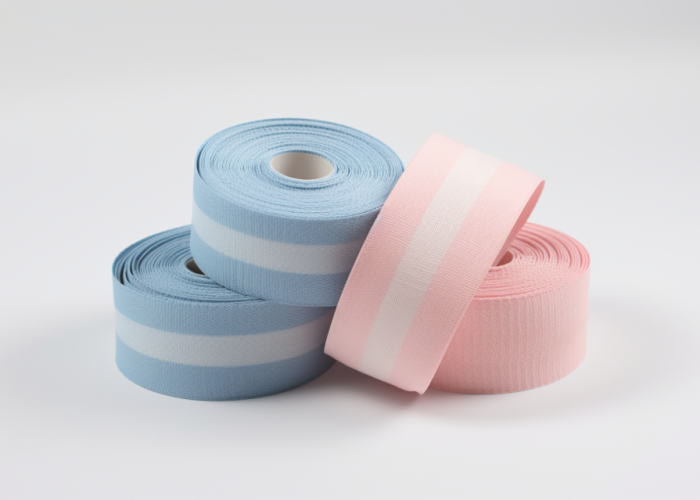
Construction, stretch level, thickness, heat setting, and production consistency can all influence how well a waistband maintains its original shape over time.
A common situation during development is that two waistband samples use the same polyester material but perform differently during testing. In many cases, the material is not what separates the better sample from the poorer one. A different construction may support the elastic yarn more effectively, a higher stretch level may reduce long-term recovery, or an unsuitable heat-setting process may prevent the webbing from stabilizing after production. Although the material remains unchanged, the final performance can be noticeably different.
This is why shape retention is rarely evaluated by looking at material in isolation. Each specification affects the others, and improving the wrong factor often adds development time without solving the real limitation. Understanding how these specifications interact usually leads to a more reliable result than replacing the material alone.
When shape retention is a key product requirement, changing material shouldn’t be the first recommendation. It is usually more effective to identify which specification is limiting the webbing’s performance, improve that factor first, and only consider a different material if the complete specification still cannot achieve the required result.
We’ll help you identify whether the limitation comes from the material or the complete webbing specification.
Yes. When the selected material already meets your product’s functional requirements, webbing construction can have a greater influence on long-term shape retention than changing to a different material. The way the webbing is constructed determines how the elastic yarn works together to resist deformation and recover after repeated stretching.
A common development situation is that two waistband samples are produced using the same polyester material, yet one maintains its shape noticeably better during wear testing. Although the material is identical, the webbing construction is not. Small changes in how the elastic and ground yarns are arranged can change how stress is distributed throughout the webbing. As a result, one construction may recover more consistently while another gradually loses its original shape, even though both use the same material.
This is why construction is often reviewed before introducing a new material. If the current material already satisfies the project’s requirements for durability, appearance, compliance, and cost, replacing it may create unnecessary work without solving the real problem. Refining the construction often improves recovery while allowing the rest of the product specification to remain unchanged.
If your current material already meets the product’s key requirements but shape retention is still below expectation, review the webbing construction before considering a material change. Solving the problem within the existing material is often a faster, lower-risk way to improve long-term performance.
Yes. Higher stretch can reduce long-term shape stability when it exceeds what the product actually needs. A waistband that feels softer and more flexible during fitting may not recover as consistently after repeated wearing and washing.
Increasing stretch is often seen as an easy way to improve comfort, especially during sample evaluation. However, every increase in stretch also places greater recovery demands on the webbing throughout its service life. If the product doesn’t require that additional extension during normal wear, the extra stretch may provide little practical benefit while making long-term shape retention more difficult to maintain.
Stretch also doesn’t work independently. As stretch increases, the webbing construction and finishing process must provide enough support to maintain recovery over thousands of stretch-and-release cycles. Without that balance, a waistband can feel comfortable when new but gradually lose its original shape during regular use. The problem isn’t simply “too much stretch”—it’s specifying more stretch than the application requires.
Instead of asking for the highest possible stretch, first define how much stretch your product actually needs to perform as intended. Once that requirement is clear, the webbing can be developed to balance comfort, recovery, and long-term shape retention without introducing unnecessary stability risks.
Before restarting sampling, we’ll help you determine whether changing the specification could achieve the same result.
No. A thicker waistband webbing doesn’t automatically provide better shape retention. If the construction and stretch level remain unchanged, increasing thickness alone may add support without significantly improving long-term recovery.
During sample evaluation, a thicker waistband often feels firmer than a thinner one. That difference in hand feel makes it easy to assume the thicker webbing will also maintain its shape better after repeated wearing and washing. However, development results don’t always support that assumption. Some thicker webbings still show disappointing recovery because the real limitation lies in the construction or the amount of stretch built into the webbing rather than its thickness.
Thickness is only one part of the complete webbing specification. It influences support and wearing feel, but recovery depends on how thickness works together with the construction, stretch level, and material. Improving one specification while leaving the others unchanged doesn’t necessarily improve the overall result. A waistband can feel firmer without becoming noticeably more stable throughout its service life.
Don’t increase webbing thickness simply because shape retention is a priority. First confirm that thickness is actually limiting the performance. If the current thickness already suits the application, refining the construction or stretch level is often a more effective way to improve long-term shape retention than adding more thickness.
Yes. An appropriate heat-setting process can improve waistband shape retention by stabilizing the webbing after production. However, it improves an already suitable specification rather than correcting an unsuitable one.
During sample development, two waistband webbings may be produced to the same specification on paper but perform differently during recovery testing. When the material, construction, thickness, and stretch level are equivalent, the difference is often found in how the webbing is processed after weaving rather than in the specification itself. One of the key manufacturing steps affecting long-term stability is heat setting.
Heat setting helps stabilize the webbing after production, making it more likely to maintain consistent dimensions and recovery during repeated use. It reduces internal stress introduced during manufacturing and improves the consistency of the finished product. However, it cannot compensate for an unsuitable material, an unbalanced construction, or a stretch level that exceeds the application’s actual requirement. A finishing process can optimize a sound specification, but it cannot rescue a poor one.
If the material, construction, thickness, and stretch level already match your product’s requirements but shape retention still needs improvement, reviewing the heat-setting process is usually the next step before redesigning the webbing. Optimizing the manufacturing process often delivers a more stable result while keeping the original specification unchanged.
The biggest reason is that polyester only defines the raw material, not the finished webbing. Construction, stretch level, thickness, and manufacturing process ultimately determine how that polyester performs in the final product.
During sample evaluation, it’s possible to compare two waistband webbings made from polyester and find that one maintains its shape significantly better after repeated stretching. At first glance, the material appears identical, so it’s natural to assume the difference comes from polyester quality. In reality, the material is often only the starting point. The finished performance depends on how the complete webbing has been developed and produced.
A polyester yarn can behave very differently once it is combined with different constructions, stretch levels, thicknesses, or finishing processes. These specifications don’t contribute independently—they influence one another. A more stable construction may improve recovery without changing the material. A higher stretch level may place greater demands on the same polyester. An appropriate heat-setting process may improve consistency, while an unsuitable one may reduce it. Although the material remains unchanged, the finished webbing can perform very differently because the complete specification has changed.
That’s why polyester waistband webbings shouldn’t be compared by material alone. Compare the complete webbing specification instead. If two polyester webbings deliver different results, the reason is usually found in how the webbing has been engineered and manufactured rather than in the polyester itself.
We’ll help you identify what actually causes the performance difference before you make a decision.
Changing the webbing material should usually be the last option, not the first. If the current material can still meet the product’s performance requirements by optimizing the webbing specification, changing the material often creates unnecessary development work without solving the real problem.
During sample development, it’s common for the first sample to miss the expected shape retention. The immediate reaction is often to request a different material. However, that assumption isn’t always correct. In many cases, the limitation comes from the complete webbing specification rather than the material itself. Construction, stretch level, thickness, or the manufacturing process may still have room for improvement. Replacing the material too early can restart sampling while leaving the original problem unchanged.
A material change becomes worthwhile only after the current specification has been evaluated and confirmed to have reached its practical limit. If construction adjustments, stretch optimization, thickness changes, and manufacturing improvements still cannot achieve the required performance, the material may have become the limiting factor. At that point, changing the material is based on engineering evidence rather than assumption, making the next development step more predictable.
That’s why we usually optimize the complete webbing specification before recommending a material change. Material should be changed because the current specification has reached its performance limit—not because the first sample didn’t meet expectations. This approach usually shortens development time and reduces unnecessary specification changes.
Choosing the right waistband webbing material isn’t about finding the highest-performing material—it’s about matching the complete webbing specification to your product’s performance requirements. Understanding how material, construction, stretch, thickness, and manufacturing process work together helps reduce development risks and avoid unnecessary specification changes. If you’re developing a new waistband or evaluating different webbing options, feel free to contact us to discuss your project and explore the most suitable solution.
We will contact you within 1 working day, please pay attention to the email with the suffix “@anmyda.com”.