
Choosing a sports bra strap material is usually driven by stretch, recovery, feel, durability, and colour requirements. But when the strap also carries a woven logo, the material becomes part of the branding decision too.
Yes. Sports bra strap material can affect woven logo clarity, surface appearance, and colour because different yarns behave differently within the jacquard construction. But material should not be selected for the logo alone—the strap still needs to meet its required stretch, recovery, feel, durability, and colour-performance requirements.
Read on to see how material and yarn choices interact with woven logo appearance, what to check during sampling, and how to tell whether a poor logo result actually requires a material change—or should be corrected through the artwork or jacquard construction instead.

Webbing manufacturing expert with 15+ years of experience helping product developers build high-performance straps for industrial, medical, and outdoor use.
Strap material can change a woven logo’s clarity, surface texture, lustre, and overall visual character because different materials are available in different yarn forms and behave differently within the jacquard construction. However, the fibre name alone does not determine the result; yarn characteristics and construction also affect how the logo is formed.
This is why two sports bra straps both specified as nylon should not automatically be expected to produce identical branding. Within the same material, the manufacturer may use yarns that differ in fineness, smoothness, texture, or lustre. How closely those yarns are arranged and how the jacquard structure is built also affect how cleanly small curves, edges, and gaps can be formed. At the same time, that construction still has to deliver the strap’s required stretch, recovery, thickness, and feel. Technical jacquard guidance similarly links thread density and woven structure with graphic definition.
Review the first sample against your original artwork and approved strap appearance or reference, if available. If the overall logo surface looks too shiny, matte, smooth, or textured, review the yarn/material direction first. If the surface looks right but individual edges, gaps, or letters lack definition, ask the manufacturer to review the jacquard construction and artwork translation before changing material. And if improving the logo requires a construction that makes the strap too firm or changes its stretch, don’t approve the branding improvement alone. The logo and strap performance need to pass on the same construction.
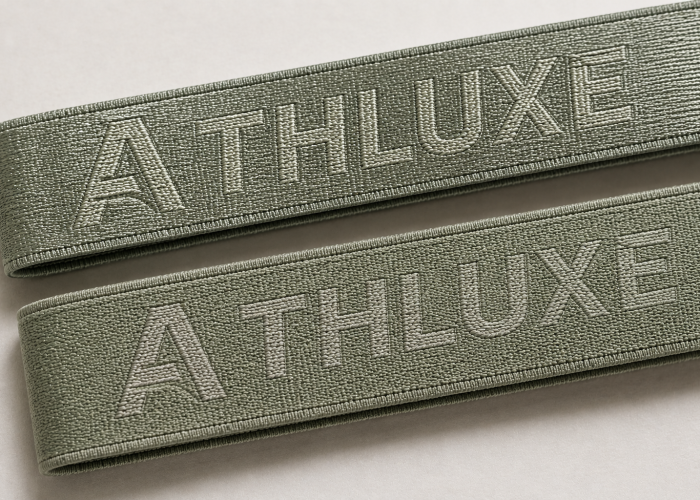
Yes. Strap material can affect how much logo detail can be woven, but the practical limit depends on the yarn available in that material and the jacquard construction, not the material name alone. Finer yarns and constructions that provide more opportunities to define the pattern can reproduce smaller logo features more clearly.
Small logo features need enough yarn positions in the jacquard structure to form their shape. When there are too few, a narrow gap may close, a curve may look stepped, or a small letter may lose its original shape. This is why simply specifying nylon or polyester does not tell you how much detail the finished logo can hold. The yarn selected within that material and the construction built around it still determine how the artwork is translated into the strap. Technical jacquard guidance similarly connects yarn density and woven structure with graphic definition.
Identify the smallest brand-critical feature that cannot change, such as a letter opening, narrow gap, or defining line, and have it checked at its actual finished size in the target strap construction. If that feature fails, first see whether a suitable construction adjustment within the selected material restores it without compromising stretch, recovery, or feel. If the construction reaches its functional limit, check whether that specific artwork feature can be enlarged or simplified without changing the brand identity. Don’t simplify the whole logo because one detail fails, and don’t switch material until the sample shows that the selected material and workable construction can no longer support the critical detail.
Send us your material specification and artwork. We can flag which logo details may need attention before the first jacquard sample.
Yes, the same logo detail can work on different strap materials, but it needs to be rechecked in the new material and jacquard construction. Keep the approved logo detail unchanged first; if it loses definition, adjust the yarn or construction before modifying the artwork.
What transfers from one material to another is the logo requirement, not necessarily the way the manufacturer produced it. A small opening or curved letter that works on one strap depends on the yarn and woven structure used to form that detail. Changing material can mean using yarn with different fineness, surface characteristics, or behaviour, so the construction may also need to change. Jacquard manufacturing guidance supports this relationship: the density and arrangement of yarns affect how accurately small curves and edges can be reproduced.
When transferring an existing logo, send the manufacturer the approved physical strap, original artwork, new material specification, and the strap requirements that must remain unchanged. Mark the smallest logo features that need to match the reference. If the new sample loses one of them while the overall logo remains clean, ask whether the construction within the new material can recover that detail first. If improving it makes the strap too firm or changes its required stretch or feel, that construction has reached its boundary. Do not simplify an already-approved brand detail just to make the old manufacturing setup work with a new material. The new construction should be developed around the approved requirement before the artwork gives way.
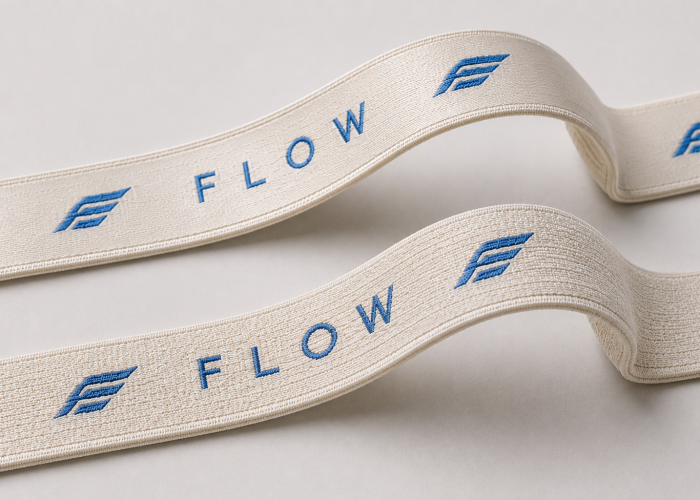
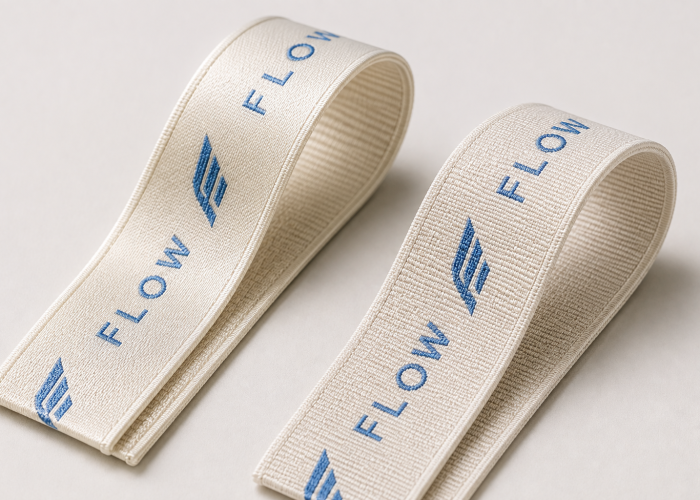
Yes. Strap material can change whether a woven logo looks smooth, textured, matte, or lustrous. Specify the finish you want separately from the fibre type, because nylon or polyester alone does not guarantee a particular logo finish.
The material name tells the manufacturer the fibre family, but not exactly how the finished jacquard surface should look. Within the same material, yarns can differ in smoothness, texture and lustre, while the way those yarns are arranged in the jacquard face changes how the surface reflects light. Construction matters too: changing density to improve logo definition can also change the character of the woven surface. This is why two straps can both meet a “polyester” specification yet still present the same logo differently. Material and construction have to be judged together rather than using fibre type as a shortcut for finish.
If finish matters to the sports bra design, provide an approved physical reference or clearly define the intended appearance—for example, low-lustre and smooth rather than simply specifying polyester. Compare the first sample with that target under the same normal lighting and viewing angle. If the logo is too shiny but its detail, stretch, and feel are otherwise correct, review whether another suitable yarn within the selected material can change the surface before replacing the material. If changing yarn or construction fixes the finish but damages logo definition or strap performance, reject that adjustment. The correct finish is the one that can coexist with the approved branding and strap requirements, not simply the matte or glossiest sample.
Send us the sample and artwork. We can review what should change first—without automatically changing a material that already works.
The same material and logo can produce different clarity because the woven result also depends on strap width, yarn selection, jacquard structure, density, thickness, and elastic behaviour. To reproduce an approved logo, use the approved strap as the benchmark—not just the material name and artwork.
A woven logo is formed by the complete strap construction. Width determines how much physical space the artwork receives, while the yarn and jacquard structure determine how that space is used to form letter edges, curves, and gaps. Technical jacquard guidance links yarn density and available yarn intersections with pattern definition; for elastic jacquard, density, tension, and structure can also affect edge clarity and small lettering. Artwork size matters as well: the same logo placed on a narrower elastic has less space available for its smallest features.
If you’re reproducing an approved sports bra strap, send the physical reference together with the artwork and complete strap specification. Compare width, thickness, stretch, feel, and the smallest important logo features. If width or stretch differs from the approved reference, correct that specification before judging whether the logo has been reproduced successfully. If those requirements already match but the logo still differs, ask the manufacturer to compare the yarn and jacquard construction with the reference before changing the artwork. Do not use “same material” as proof that a different strap construction should produce the same logo result. The approved sample shows what the complete set of requirements achieved together.
Yes. Keep the sports bra strap at the softness your product requires and judge whether the logo is clear enough within that specification. Do not make the strap firmer just to maximise logo sharpness; if a brand-critical detail cannot be reproduced at the required softness, treat it as a specification conflict before changing the softness target.
Softness and logo clarity are not opposite properties by default. The conflict appears when a construction change used to improve one begins moving the other away from its target. For example, changing density or structural control may improve the definition of a small logo feature, but those changes can also alter the webbing’s hand and elastic behaviour. This is why a sample with sharper lettering is not automatically a better sports bra strap. The logo improvement only works if the construction still delivers the feel and performance already required by the product.
If softness is defined by a reference strap, approved sample, or existing product specification, keep that target unchanged during the first logo adjustment. If the softness passes but the logo fails, review the construction while holding the softness target. If the next sample improves the logo but becomes unacceptably firmer, reject that adjustment rather than approving the logo in isolation. When reasonable construction options cannot satisfy both requirements, compare whether the artwork, material, or softness has more room to change based on the product priorities. Stop chasing sharper edges once the logo meets the brand requirement; extra definition has no development value if it moves the strap away from its required feel.
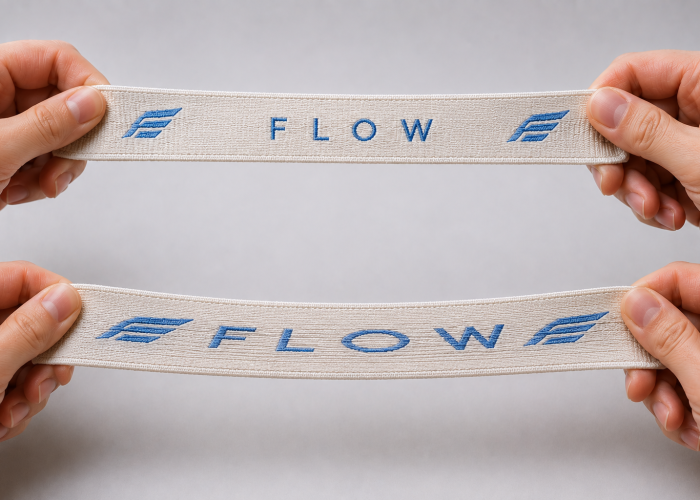
Yes. Judge the woven logo at the sports bra strap’s required working stretch, because a material that gives a clear logo when relaxed may not give the same result under extension. If the strap meets its stretch requirement but the logo does not, review the jacquard construction and artwork before changing an otherwise suitable material.
A woven logo moves with the elastic structure around it. As the strap extends, letter spacing, proportions, small openings, and edges can change. How much they change is not controlled by the fibre name alone; yarn tension, density, and the jacquard structure also influence how the pattern behaves during extension. Technical guidance for jacquard elastic similarly identifies tension and structure as factors behind stretched or compressed lettering and reduced edge definition. This is why a good relaxed logo does not prove that the branding will remain acceptable in the condition where the sports bra actually uses it.
During sampling, identify one or two brand-critical features and check them with the strap relaxed, at the product’s required working stretch, and again after release. If the strap reaches the correct extension but the logo becomes unacceptable, review how the jacquard construction carries those features before blaming the material. If the logo looks good under stretch but the strap no longer meets its stretch or recovery requirement, reject that construction too. Do not select between materials from relaxed logo appearance alone. Approve the material, strap performance, and branding under the same use condition.
Send us both samples and your target requirements. We can review whether the next adjustment should be in the construction, artwork, or material.
Adjust the logo instead of the strap material when the material already meets the sports bra requirements and only an adjustable artwork detail prevents a clear woven result. Keep the material unless the failing detail is essential to the brand and cannot be recovered through a suitable jacquard construction.
The failure pattern helps determine what should change. If the strap meets its required feel, stretch, recovery, and finish, while one secondary gap, thin line, or small decorative feature fails, changing the material would reopen requirements that are already working. Adjust that specific artwork feature first. If several otherwise workable letters or edges lose definition, however, the problem is less likely to be one isolated artwork detail; review the jacquard construction before simplifying several parts of the logo. Small lettering and tight details are known constraints in jacquard development, but their result also depends on how the artwork is translated into the woven structure.
Protect the brand-critical features throughout that process. If a small secondary feature can be opened, strengthened, or simplified without changing logo recognition, sample that adjustment while keeping the approved material. If an essential letterform, symbol, or defining shape still fails after reasonable construction adjustments, stop simplifying the artwork. At that point, the artwork has reached its adjustment boundary and material or construction alternatives should be compared instead. The easiest manufacturing change is not necessarily the right product change; preserve the requirements that are already approved unless the sample shows they are causing the limitation.
Sports bra strap material affects woven branding, but material alone does not determine the result. Logo detail, finish, softness, and appearance under stretch come from the material working with the complete jacquard construction. When a sample falls short, identify which requirement is actually limiting the result before changing an approved material. If you have a strap specification and logo artwork ready, send them to Anmyda for a manufacturing review before sampling.
We will contact you within 1 working day, please pay attention to the email with the suffix “@anmyda.com”.