
Your silicone logo holds well on one webbing, but the same logo starts peeling on another. When that happens, it is easy to assume the second webbing is simply unsuitable for silicone—but that conclusion can lead you to change the wrong specification.
Your silicone logo peels on one webbing but holds on another because the two webbings do not provide the same conditions for the silicone logo. Differences in the finished surface affect adhesion, while differences in webbing construction and stretch change how the printed area behaves during use. This does not automatically mean the peeling webbing is unsuitable for silicone.
Read on to learn what can cause the difference, how to identify whether the webbing or printing needs attention, and what to consider before changing your webbing or logo method.

Webbing manufacturing expert with 15+ years of experience helping product developers build high-performance straps for industrial, medical, and outdoor use.
Webbing surface affects silicone logo adhesion by changing the bonding interface between the silicone and the webbing. Different finishes, treatments, or surface conditions can make that bond easier or harder to achieve consistently, which is why the same silicone logo may hold on one webbing but peel on another.
For example, two webbings may both be polyester, but that does not mean their finished surfaces are identical. One may have a finishing treatment added for hand feel, water repellency, or another performance requirement, while the other may not. Silicone-printing guidance specifically warns that some synthetic fabric treatments can interfere with silicone curing or adhesion. But the opposite assumption—treated, smooth, or coated webbing always causes poor adhesion—is also wrong. The result depends on the actual finished surface and the silicone system used with it.
So if your logo holds on one polyester webbing but peels on another, don’t conclude that the material specification explains the difference. Compare the finished Webbing A with the finished Webbing B. Ask your supplier whether their surface finishes or treatments differ and whether the silicone has been evaluated on the exact webbing you intend to use.
If a particular finish provides a function your product needs, keep that requirement fixed first. Let the manufacturer evaluate whether the silicone printing can be adapted to that surface before asking you to remove the finish or change the webbing.
Yes. Different webbing constructions can change silicone logo durability by changing how the webbing bends and deforms beneath the printed area. If one construction creates more repeated deformation at the logo location, the bonded silicone faces a different mechanical demand than it does on a construction that stays more stable there.
This can happen even when two webbings have the same material and width. Yarn size, warp and weft density, weave structure, and thickness work together to influence the webbing’s firmness, flexibility, and bending behaviour. For example, changing yarn size without considering density may not produce the same behaviour as changing the yarn-and-density combination. That is why “both are 25 mm polyester webbing” tells you very little about how the two constructions will behave beneath the logo.
This does not mean firmer webbing is always better for silicone. A flexible construction is not automatically a problem either. Silicone textile-printing systems can have high elongation, so the relevant question is whether the actual printed combination can tolerate the deformation occurring at that logo location.
If one construction holds and another peels, compare how the logo area behaves after assembly—not just how the loose webbings feel in your hand. If the peeling construction was chosen for support, thickness, flexibility, or another functional requirement, don’t change it first. Have the manufacturer evaluate the silicone on that exact construction under its intended movement before deciding that the webbing itself needs to change.
Send us the two webbing specifications or samples. We’ll help you compare what may be affecting the silicone adhesion before you change the webbing.
When elastic webbing stretches, the silicone logo stretches with the printed area while the bond underneath has to remain secure. If two webbings work at different stretch levels, the same silicone logo is not experiencing the same condition on both—and that can produce different durability results.
You may have two 40 mm elastic webbings that look almost identical on the table. Once fitted to the product, one stretches only slightly while the other extends much further through the logo area. That difference matters even if the artwork and logo size stay exactly the same. It does not mean the higher-stretch webbing will automatically peel; silicone textile inks can be highly elastic. What matters is whether the silicone system and its adhesion can handle the stretch the webbing actually reaches in use.
This is also why the webbing’s maximum stretch percentage does not tell the whole story. Your product may use only part of that available stretch. The working stretch at the logo location is what the silicone actually has to follow.
If one webbing holds and another peels, give your supplier the working length or stretch requirement instead of only sending the relaxed webbing. Let them evaluate the logo in that condition. If the stretch is needed for fit, adjustment, or support, keep it fixed first and see whether the silicone solution can be adapted before changing how the webbing is supposed to perform.
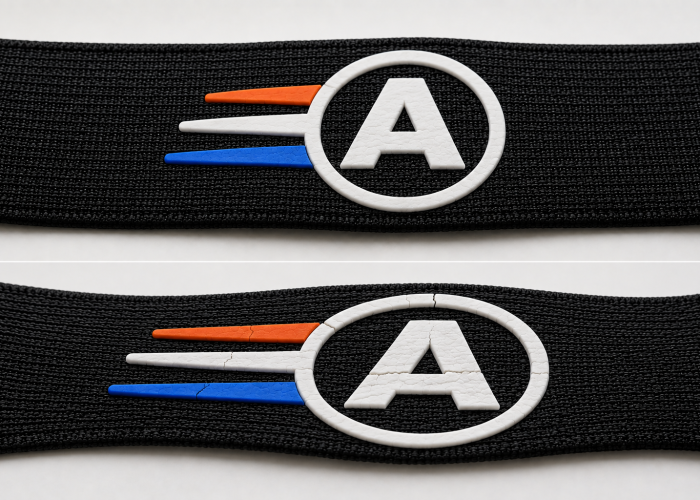
A silicone logo looks fine at first when its initial adhesion and appearance are acceptable, but peeling can appear later when repeated use exposes a weakness that a flat sample check did not reveal. This is why two webbings can both pass sampling and still give different results in the finished product.
A clean logo with tight edges tells you what the print looks like when new. It does not tell you what happens after that area repeatedly bends around an adjuster, stretches during wear, or moves every time the product is used. One webbing may keep the logo area relatively stable, while another puts that same area through more movement. Both samples looked good because neither had yet experienced the condition that separates their performance.
That gives you a useful warning during development: don’t treat appearance approval and durability approval as the same decision. If the application puts meaningful movement through the logo area, that condition needs to be part of the evaluation.
Before production, show your supplier where the logo sits and how that section works in the finished product. If it stretches, evaluate it at its working stretch; if hardware creates the repeated bend, evaluate it assembled with that hardware. Then compare the two webbings under the relevant condition. The one that still looks good after that evaluation gives you much stronger evidence than two samples that simply look identical when new.
Send us the failed sample details and the webbing that worked. We’ll help you compare the two results and identify what deserves investigation first.
If the peeling consistently follows one webbing while the printing conditions stay controlled, something specific to that webbing-and-silicone combination deserves closer investigation. If similar peeling continues across different suitable webbings, the common printing conditions become the stronger suspect.
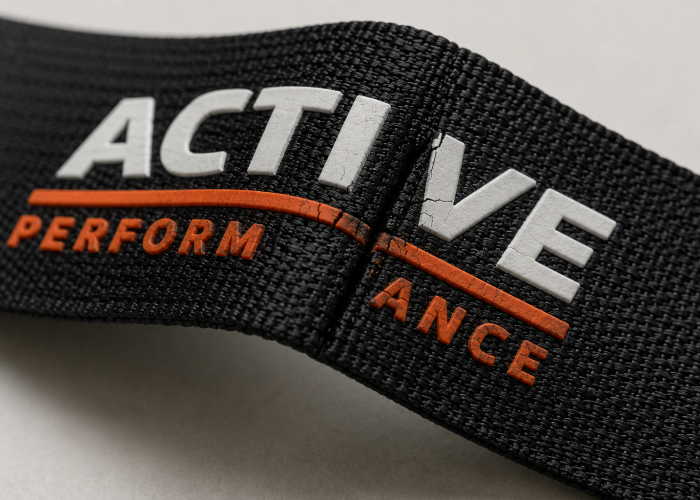
When Webbing A holds well but Webbing B repeatedly peels under otherwise controlled conditions, the difference gives the manufacturer a direction to investigate. The two webbings may have different finished surfaces, constructions, or working stretch. But that does not prove Webbing B is defective or unsuitable for silicone. The printing solution that works on Webbing A may simply not achieve the same compatibility on Webbing B.
This is why changing several variables together can hide the real cause. If the next sample uses another webbing, a different silicone setup, and a modified logo and then passes, you know the result improved—but you still don’t know which change was necessary. That becomes a problem if you later want to return to one of the original specifications.
If your supplier recommends changing the webbing, ask what comparison led to that recommendation. If one webbing passes and another fails under controlled conditions, ask whether the printing solution has also been evaluated specifically for the webbing that peels. Then decide whether adapting the printing or changing the webbing creates the smaller compromise for your finished product.
Yes, but only when the same printing process achieves the required adhesion and durability on each webbing. A process proven on Webbing A is not automatically proven on Webbing B, even when the two webbings have similar specifications.
Two polyester webbings, for instance, may have different finished surfaces. Two elastic webbings may look almost identical when relaxed but operate at different working stretch. Either difference changes the conditions under which the silicone logo has to perform. Commercial silicone textile inks are available for polyester, nylon, blends, and highly elastic textiles, so a different webbing does not automatically require a different logo method.
Nor does every webbing require a completely different printing process. Sometimes the process already proven on one webbing produces the same acceptable result on another. In other cases, the second webbing needs a printing-side adjustment before it reaches the same adhesion or durability. What worked on the first webbing is a useful reference, not automatic approval for the second.
If the logo already works on one webbing, use its approved appearance and durability as the reference when evaluating another. Let the manufacturer determine whether the existing printing process transfers successfully or needs adjustment. You don’t need to specify how the printing should change; you need to confirm that the final webbing-and-logo combination still gives you the result you approved.
Change the webbing when the silicone logo still cannot meet your adhesion or durability requirement on it, and another webbing can solve the problem without sacrificing a more important product requirement. A peeling sample alone is not enough reason to replace a webbing that otherwise works well for your product.
Suppose the webbing was selected because its stretch and firmness give your finished strap the fit and support you need. Replacing it with an easier-to-print construction may improve the silicone result but change performance you have already approved. A failed silicone result only tells you that the tested webbing-and-printing combination did not meet the requirement; it does not tell you that changing the webbing is automatically the right solution.
But the webbing should not be protected simply because it was selected first. If another webbing still meets your required stretch, firmness, appearance, and other important specifications while giving reliable silicone adhesion, changing it may be the simpler solution.
If your supplier recommends a different webbing, ask whether the change is necessary for achieving the required logo durability or simply the easiest manufacturing solution. Then check the proposed replacement against the webbing requirements you already approved. If those requirements remain intact, changing the webbing may make sense. If they don’t, the logo problem has been solved by creating a different product problem.
Before changing an approved webbing requirement, let’s check whether the replacement solves the silicone problem without changing the performance your product needs.
Choose another logo method when silicone still cannot meet your required adhesion or durability after practical adjustments, and keeping silicone would force you to compromise a more important webbing or product requirement. One failed silicone sample is not enough reason to make that decision.
If the webbing is already giving your product the stretch, support, surface, or appearance it needs but silicone still cannot remain durable on it, repeatedly changing the webbing just to preserve the logo method starts to make less sense. The opposite is also true: if a small printing or logo adjustment solves the peeling while keeping the appearance you want, there is little reason to abandon silicone. Silicone textile inks are specifically designed to provide textile adhesion, elongation, and durability when the ink system and substrate are compatible.
The decision therefore isn’t whether silicone is a good or bad logo method in general. It is whether silicone can give you the required result on the webbing your product actually needs.
If silicone still fails after the relevant adjustments, tell your supplier which requirements must remain unchanged—such as the webbing performance, surface, logo appearance, or placement. Then compare alternative logo methods around those fixed requirements. The better alternative isn’t simply the one that avoids peeling; it’s the one that solves the logo problem without creating a bigger compromise elsewhere in your product.
A silicone logo that holds on one webbing but peels on another does not automatically mean the second webbing is unsuitable. Differences in surface, construction, stretch, and printing compatibility can all change the result.
Before changing an approved specification, identify where the difference comes from and which adjustment creates the smallest compromise. If you’re dealing with silicone peeling on your webbing, send us your samples and requirements. We can help you evaluate the combination and decide what to change next.
We will contact you within 1 working day, please pay attention to the email with the suffix “@anmyda.com”.