
Silicone logo cracking is not always the same failure. A crack across a repeated fold, a broken thin detail, and an edge that starts lifting after bending can point to different problems—and they should not automatically be fixed in the same way.
Silicone logos crack after repeated bending when movement repeatedly concentrates stress in a part of the printed logo that cannot accommodate the deformation. Where the failure starts and what it looks like help identify whether the main issue comes from logo placement, webbing movement, logo construction, adhesion, or the printing setup.
Read on to diagnose the failure from its crack pattern and actual movement, then decide which variable to adjust first without unnecessarily changing the webbing or logo design.

Webbing manufacturing expert with 15+ years of experience helping product developers build high-performance straps for industrial, medical, and outdoor use.
Silicone logos can crack at fold points when the same part of the printed logo is repeatedly forced through a tight bend. The risk is higher when the logo crosses a fixed fold around a buckle, adjuster, or another area that repeatedly bends in the same position.
A logo on a relatively flat part of the strap may flex with the webbing without a problem. Put the same logo across a fixed fold, however, and one narrow part of the logo has to flex every time the strap moves. If that printed area cannot repeatedly accommodate the movement, cracking can eventually start at or close to the fold.
The failure location helps determine whether placement is actually the problem. If a crack repeatedly appears along the same bend line while the rest of the logo remains intact, the fold position is a strong suspect. If cracks appear in several areas away from the fold, placement alone may not explain the failure. If the silicone edge starts lifting or separating from the webbing instead, adhesion should also be checked rather than treating it as the same cracking problem.
If the failure follows a fixed bend, change placement before changing the whole logo or webbing. Move the logo away from the repeated fold where the product design allows it. If placement is fixed, reduce how much of the logo crosses the tightest bend and review whether the selected silicone print construction is suitable for repeated flexing. Then test that exact bend under the intended use condition before approval. If the printed area must continue folding sharply at the same point and the logo cannot tolerate it reliably, a different logo placement or branding method may be the better solution.
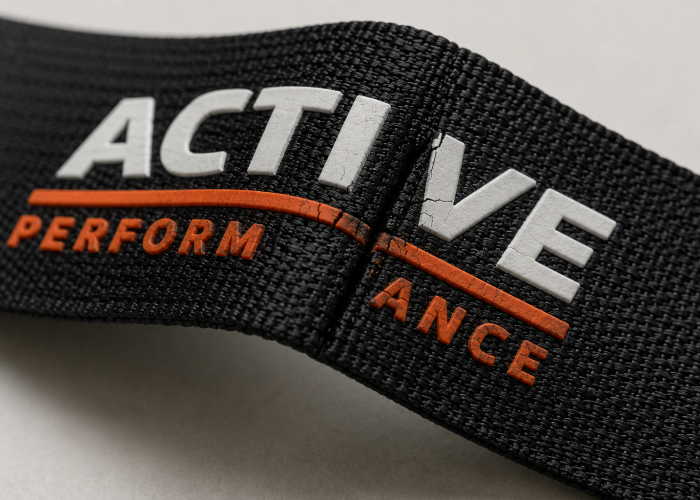
Yes. Stretching elastic webbing can increase silicone logo cracking when the printed area cannot repeatedly follow the stretch required in actual use. However, elastic webbing itself is not automatically the problem—a suitable silicone print can accommodate substantial stretch when the complete logo and webbing combination is designed for it.
For example, an elastic waistband may stretch considerably when being put on, while another elastic strap may operate at much lower extension. A silicone logo spanning the first area has to stretch and recover much more with the webbing. Logo size and geometry matter too: a large solid printed area and a design broken into smaller elements do not necessarily respond to the same stretch in the same way.
The failure itself helps identify what to investigate. If the silicone develops cracks only after repeated stretching while remaining firmly attached, the flexibility of the printed logo should be checked first. If the silicone remains intact but starts lifting or separating from the webbing, adhesion is the stronger suspect. If cracking also appears in areas that experience little stretch, webbing elongation alone probably does not explain the problem.
For elastic applications, define the stretch the strap actually reaches in use and test the printed area at that condition. If the silicone itself cracks, review the print flexibility and logo geometry before changing the webbing. If it lifts or separates, investigate adhesion and webbing compatibility instead. If the logo must stay in a high-stretch zone, adapt the logo and printing system to the required stretch rather than reducing the webbing’s functional elasticity just to protect the print.
Send us the failure photo and strap movement—we’ll help identify which variable should be checked first.
Silicone logos can crack first at thin strokes, narrow connections, sharp transitions, or small edge details because these features can become local weak points when the webbing repeatedly bends or stretches. The thicker main body of the same logo may remain intact while one small feature starts failing.
This is common with fine lettering, thin borders, sharp corners, or narrow sections connecting two parts of a logo. When the webbing moves, these details have to move with it. A narrow connection or abrupt change from a thick area to a thin one can concentrate movement into that smaller feature, making it less tolerant of repeated flexing than the broader parts of the logo.
Where the failure appears helps identify whether logo geometry is actually responsible. If the same thin stroke, corner, or narrow connection cracks while thicker areas remain sound and firmly attached, that feature is the stronger suspect. If a larger section of the logo edge starts lifting from the webbing, check adhesion instead. If a crack crosses both thick and thin areas along the same fold line, repeated bending and logo placement are more likely to be driving the failure.
When cracking is limited to one fine feature, change that feature before redesigning the whole logo. Strengthen a thin stroke, make a narrow connection more substantial, or soften an abrupt transition where the approved design allows it, then retest the same movement. If several important details require substantial changes, increasing the overall logo size or creating an approved simplified version may be more practical. If those details are essential to the brand identity and cannot change, consider another branding method rather than repeatedly modifying the original logo.
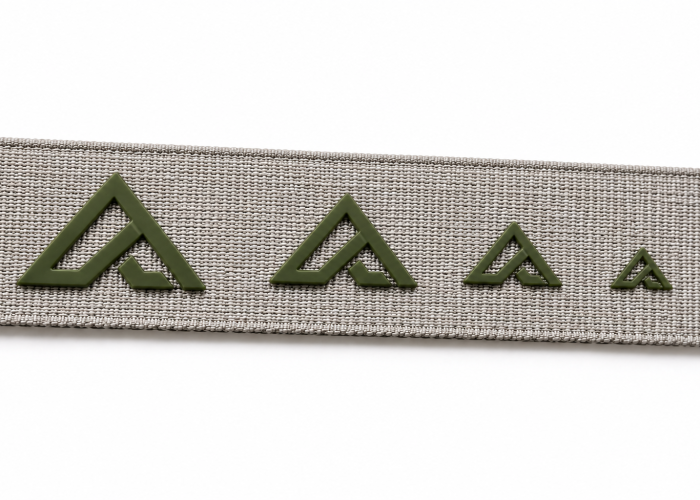
The same silicone logo can crack on one webbing but not another because different webbings can change both how much the printed area moves and how well the silicone bonds to it—even when the width, material name, and logo stay the same.
For example, two 25 mm polyester webbings may look similar but have different constructions. One may be tightly woven with relatively little movement through the logo area, while another may stretch or flex more during use. Their surface finish or treatment can also differ, changing the conditions where the silicone bonds to the webbing. So if the logo performs differently, “both are polyester” is not enough to conclude that the webbings should behave the same.
The type of failure helps narrow down what changed. If the silicone remains firmly attached but cracks when the second webbing moves more, compare the movement of the two webbings and the flexibility of the printed logo first. If the logo starts lifting or separating instead, surface condition and adhesion compatibility become stronger suspects. If both webbings move similarly and the silicone remains well bonded, don’t automatically blame the webbing—the printing conditions should also be checked.
When comparing a good webbing with a failing one, keep the logo and printing setup as consistent as possible and compare the webbings themselves first. Check how each webbing bends or stretches at the printed area, then identify whether the failure is cracking or separation. Cracking while the logo remains bonded points toward movement and print flexibility; lifting points toward adhesion compatibility. Change the variable linked to that failure rather than automatically redesigning the logo. If the required webbing cannot work reliably with the existing silicone setup, adjust the print/adhesion system before compromising a functional webbing requirement.
Share your webbing and logo requirements—we’ll help compare the likely movement, surface, and adhesion factors.
Yes, nylon and polyester can affect silicone logo performance, but fibre material alone does not tell you which webbing is more likely to crack. The webbing construction, stretch, surface finish, silicone system, and adhesion also need to be considered before blaming the material.
For example, changing from polyester webbing to nylon may also change how much the strap stretches, how tightly it is woven, or how its surface is finished. If the silicone then cracks, it is easy to assume nylon caused the problem. But suitable silicone systems can bond and flex successfully on both nylon and polyester, so the fibre name alone does not explain the failure.
Look at what changed together with the material. If the silicone remains firmly bonded but cracking appears on the webbing that stretches or bends more, compare movement through the printed area first. If the logo lifts or separates instead, investigate surface condition and adhesion compatibility. And if the nylon and polyester webbings have different constructions, their performance should not be treated as a material-only comparison.
When choosing between nylon and polyester, select the material for the strap’s functional requirements first, then validate the silicone on that actual webbing. If one version fails, compare movement and adhesion before changing material. Only blame the fibre material when comparable nylon and polyester webbings show the same repeatable difference under the same print and test conditions. Otherwise, switching materials may change the webbing without fixing the real cause.
Rough or strongly textured webbing can contribute to silicone logo failure, but texture itself does not automatically make silicone crack. Pronounced ribs, raised yarns, or an uneven woven face can make it harder to achieve the same print contact and coverage as on a flatter surface, so the type and location of the failure need to be checked first.
For example, compare a tightly woven webbing with a relatively flat face to one with pronounced ribs or raised yarns. The same logo may not sit on these two surfaces in exactly the same way, particularly around fine details and edges. This does not mean the textured webbing will necessarily crack the silicone. It means the actual logo-to-webbing interface needs to be evaluated rather than assuming that a print proven on a smooth webbing will perform identically on a more pronounced surface.
The failure pattern helps separate texture from other causes. If the silicone itself cracks but remains firmly bonded, check the movement of the webbing and the print construction before blaming the surface. If lifting or separation repeatedly occurs in areas where the surface makes consistent bonding difficult, surface structure and adhesion compatibility deserve closer attention. If the crack follows a fixed fold regardless of the surface texture, bending and placement remain stronger suspects.
If the textured surface appears to be contributing, first determine whether the problem is cracking or adhesion before changing the logo. For adhesion-related failure, review the printing and adhesion setup on that actual webbing. For cracking while the silicone remains well bonded, investigate movement and print flexibility instead. If the required logo still cannot perform reliably on the selected surface, consider a flatter webbing construction where the strap requirements allow it. If changing the webbing would compromise the product requirement, keep the webbing and evaluate a more suitable printing setup or branding method instead.
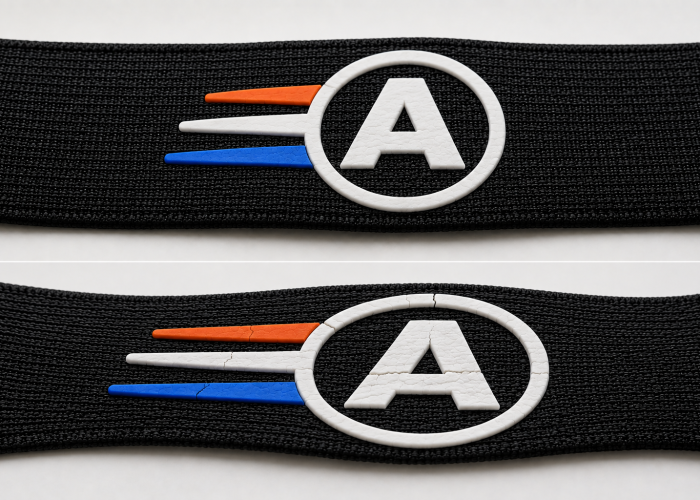
Thicker silicone printing can increase cracking risk when the added logo height makes the printed area less able to follow repeated bending or stretching. Thickness is more likely to be contributing when increasing the logo height reduces durability under otherwise comparable conditions.
For example, compare the same logo produced at around 0.4 mm and 1.0 mm finished height. These are comparison examples, not universal thickness limits. If the 0.4 mm version survives repeated bending but the 1.0 mm version cracks on the same webbing, in the same position, and under the same movement, the increased print build becomes a credible factor to investigate. A raised logo can still be suitable—the question is whether the required height and required strap movement can work together.
The failure pattern helps confirm the direction. If the 1.0 mm version cracks through the silicone while remaining firmly bonded, but the 0.4 mm version survives, thickness deserves attention. If the 1.0 mm logo lifts instead, adhesion is a stronger suspect. If both versions crack along the same fixed fold, reducing thickness may not solve the real problem because placement is still exposing both versions to the same severe bend.
If the thicker version alone fails, first decide whether the approved logo height can change. If the 3D effect is flexible, test a lower height and compare durability again. If the 1.0 mm height is a fixed branding requirement, give the supplier both requirements—1.0 mm finished height and the required bending/stretch performance—and ask them to develop the printing solution around both rather than reducing the height without approval. If the logo also crosses a severe bend, changing placement may be the better compromise. When height and placement are both fixed, require the final construction to pass the actual flex test before production.
Send us your application conditions—we’ll help define what the printed webbing should be tested against.
Low or high temperatures can increase silicone logo cracking when the printed logo can no longer tolerate the strap’s required bending or stretching under that condition. If the same failure occurs at room temperature, temperature is unlikely to be the main cause.
For example, an outdoor strap may need to bend repeatedly at −20°C, while another application may need to perform around +60°C. Use 23°C as a room-temperature reference and compare the same printed webbing under the same movement. These temperatures are examples for diagnosis, not universal silicone limits. A sample that works at 23°C cannot automatically be assumed to give the same result at the actual operating temperature.
The comparison helps identify whether temperature is really involved. If the logo passes repeated bending at 23°C but cracks under the same movement at −20°C, low-temperature performance deserves attention. If it passes at 23°C but fails at +60°C, investigate the high-temperature condition. If the same crack develops at the same location at all three temperatures, placement, logo construction, or repeated movement is more likely to be the main cause. If the silicone lifts instead of cracking, adhesion should be investigated separately.
For a temperature-sensitive product, give the supplier the required operating range before sampling and test the printed webbing under both temperature and actual strap movement. Simply exposing a sample to −20°C does not prove that the logo can repeatedly bend at −20°C. Compare the target-temperature result with the 23°C reference. If failure occurs only at the required temperature, keep the necessary webbing, logo, and operating-temperature requirements clear and ask the supplier to adjust the printing solution around them. Only change a product requirement when testing shows that the original combination cannot be made reliable.
Test silicone logo durability by reproducing the bending, stretching, and environmental conditions the printed webbing will experience in actual use, then check where and how the failure starts. A flat sample that looks good after printing is not enough to confirm durability.
For example, if a strap repeatedly folds around a buckle, test the logo at that same fold position rather than bending it randomly by hand. If an elastic strap normally reaches 30% stretch, test the printed area at that stretch instead of pulling it to an arbitrary maximum. For an outdoor application required to work at −20°C, repeat the required movement at that temperature as well as at room temperature. The test condition should come from the application, not from one bend or stretch number used for every webbing.
During testing, record the movement, test condition, failure location, and number of cycles when the first visible change appears. There is no single cycle count that proves durability for every strap; the required number should come from the product requirement or an agreed development test. A crack following a fixed fold points toward placement or bending, while a thin detail breaking suggests logo geometry. If the silicone lifts instead of cracking, adhesion deserves separate investigation.
Before production, agree with the supplier on the test condition and acceptable result rather than approving from appearance alone. Use the intended production webbing, final-size logo, approved logo height, and required application movement. Test several samples under the same condition. If one survives while another fails much earlier, don’t approve from the best-performing piece—the repeatability problem still needs to be resolved. Keep the approved sample and agreed test condition as the production reference.
Reduce silicone logo cracking by changing the variable linked to the observed failure first, rather than redesigning the strap or changing several specifications at once. The failure pattern should determine which adjustment is tried first.
For example, if a crack repeatedly follows a buckle fold, move the logo first where the design allows it. If only a thin letter or narrow connection breaks, adjust that feature first rather than simplifying the whole artwork. If a 1.0 mm raised logo fails while a 0.4 mm version survives the same test, decide whether logo height can change. If the silicone lifts rather than cracks, ask the supplier to address the printing and adhesion compatibility instead of redesigning the artwork. If failure appears only at the required operating temperature, keep that temperature requirement clear and have the printing solution developed around it.
Change one relevant variable at a time and repeat the same test. Changing the webbing, logo height, artwork, and placement together may produce a passing sample, but it does not tell you which change solved the problem—or whether an important product requirement was sacrificed unnecessarily. This matters when requirements such as webbing strength, elasticity, width, material, logo appearance, or operating temperature have already been approved.
When several requirements conflict, decide which are fixed and which are negotiable before approving a change. For example, if the product requires 30% functional stretch, a fixed logo position, and a 1.0 mm raised appearance, reducing the webbing stretch simply to prevent cracking may compromise the strap’s function. Preserve the functional requirement first and adjust the logo or printing solution where possible. If all critical requirements are fixed and silicone printing still cannot pass the agreed durability test repeatably, stop modifying the strap around the logo and consider a branding method better suited to the application.
Silicone logo cracking should be diagnosed from where the failure starts, what movement causes it, and whether the silicone cracks or separates from the webbing. That evidence helps identify which variable should change first without unnecessarily compromising the strap.
If your silicone logo is cracking during sampling or use, send us the webbing, logo requirements, and failure details. We can help identify the likely cause and determine what should be adjusted before production.
We will contact you within 1 working day, please pay attention to the email with the suffix “@anmyda.com”.