
When an outdoor webbing RFQ comes to us, UV resistance and abrasion resistance are often listed together as if they were one durability requirement. They are not. How long the strap stays exposed, what UV exposure is allowed to change, and how much abrasion the product actually sees can lead us to different material and protection routes.
For a strap that stays outdoors for years, it can make sense to build more of that protection into the material itself, even when the raw-material MOQ is higher. For a strap used outdoors only occasionally, high-tenacity webbing with added UV protection may already be enough. The important part is not to specify the highest resistance you can get, but to match the webbing to the exposure the product will actually see.
That is why we made this page. We want to share the few decisions we normally look at before choosing a UV- and abrasion-resistant webbing—especially where a simple “UV resistant + abrasion resistant” specification does not tell the manufacturer enough.
A boat-cover strap that stays outside year-round and is designed around a 3–5 year service life is one type of project. A camping compression strap used outdoors 20–30 days a year and stored indoors the rest of the time is another. Both need UV resistance, but there is no reason to start them with the same material solution.
Polyester vs. nylon, UV stabilizers, solution-dyed yarn, abrasion resistance—you can find pages and pages about these online. Ask AI and you’ll probably have the basics before your coffee gets cold. You guys know how to use Google, so we won’t spend your time repeating them here.
Here is the part that matters when you actually develop the webbing. For long, continuous exposure, it can make sense to put more of the UV performance into the yarn or material itself, such as a UV-stabilized or solution-dyed high-tenacity polyester. For shorter or intermittent exposure, a standard high-tenacity polyester construction with added UV protection may already be the better fit.
And this choice can change the MOQ quite a lot. Once you specify a specialty yarn, stabilized grade, or solution-dyed color, you may also inherit the raw-material supplier’s minimum. In our projects, that can push the starting quantity into roughly 3,000–5,000 m, while adding UV protection to a more standard construction can sometimes start around 500 m. The exact minimum still depends on the yarn, color, and supplier.
That doesn’t mean the lower-MOQ route is the cheaper version of the same thing. If the strap stays on a boat, dock, or outdoor machine season after season, the longer-term material route may be exactly what the product needs. If the strap spends most of its life in storage, you may simply be buying a material specification the product never needed.
So give your supplier the exposure first:
“This strap stays outdoors year-round. We are designing for about five years of service.”
or:
“This strap is outdoors around 30 days a year and stored indoors the rest of the time.”
That is much more useful than starting with “Use solution-dyed polyester” or “Add a UV agent.” Let the exposure decide the UV route, not the other way around.
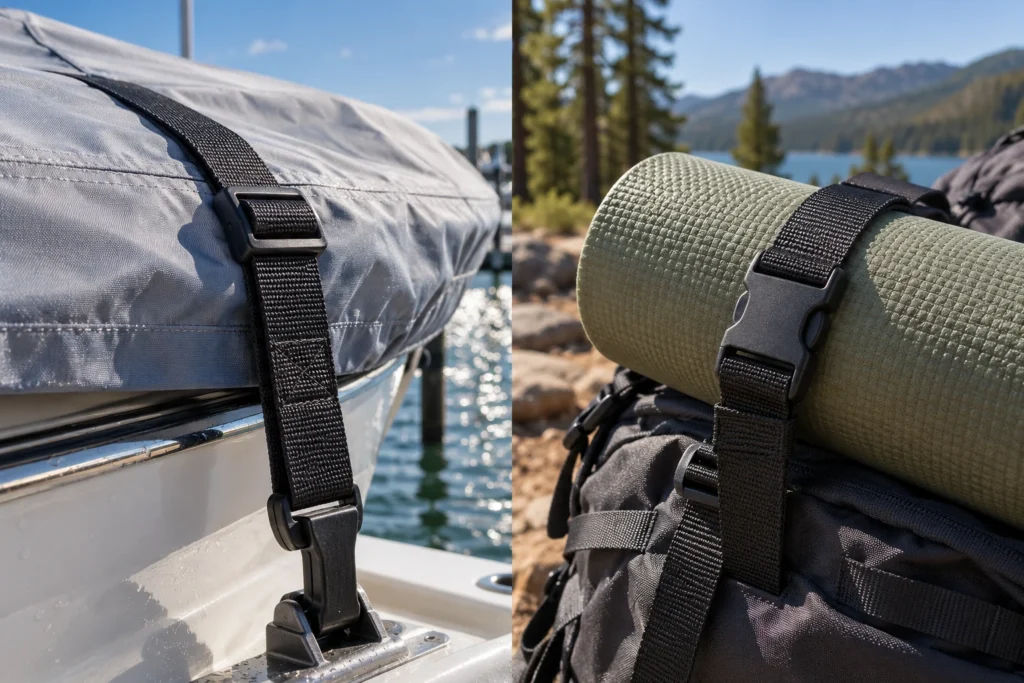
Before you ask for “UV resistant” webbing, decide what UV failure means for your finished product. That part belongs to you. Your supplier can recommend the material and UV protection, but they should not be guessing what your product can or cannot afford to lose.
For a branded outdoor strap, failure may be badly faded black or a washed-out logo, even while the webbing is still strong enough. For a cargo restraint, some fading may be perfectly acceptable, while losing too much breaking strength is not.
So don’t try to design the UV solution for your supplier. Give them the result the product needs to keep.
For example:
“The webbing and logo need to stay within our approved appearance after the required outdoor exposure.”
or:
“Color change is acceptable, but the webbing still needs to meet our minimum breaking strength after the required UV exposure.”
If both matter, specify both separately. And don’t use fading to judge the remaining strength—the two are not reliable substitutes for each other.
Once the failure point is clear, your supplier has something useful to work from. They can then recommend the material, dye system, UV protection, and validation around that target.
You define what the product cannot afford to lose. Let the webbing solution follow from there.
If your strap sits in the sun every day but only rubs occasionally, build around the UV exposure first. If it rubs against equipment every working cycle but only sees the sun occasionally, build around abrasion first. Don’t make both requirements equally important just because both appear on the drawing.
For a permanent outdoor restraint, long-term UV exposure may need to drive the base material first. Abrasion can then be adjusted through the yarn, webbing construction, or finishing if the first sample still needs more protection.
An industrial wear strap can be the opposite. If it rubs against equipment thousands of times during normal use, abrasion should drive the base webbing. UV protection can then be matched to the amount of outdoor exposure the strap actually sees.
This is why “high UV + high abrasion resistance” doesn’t tell your supplier as much as it seems to. You don’t necessarily need one material that is excellent at everything. Sometimes one requirement belongs in the base webbing and the other can be added or adjusted without changing the whole material route.
So tell your supplier which exposure the strap lives with every day, and which one only happens occasionally. That gives them a much better starting point for the material and construction than simply asking for the highest UV and abrasion resistance they can offer.
We turn your ideas into webbing, manufacture it, and deliver it straight to your doorstep.
We will contact you within 1 working day, please pay attention to the email with the suffix “@anmyda.com”.