
Developing webbing for extreme temperatures may seem to start with one question: how much heat or cold can the material handle? In practice, that temperature number alone does not tell you which webbing material to use.
Start with what the webbing still needs to do at that temperature, and for how long. Holding a load, staying flexible, or continuing to stretch and recover can lead to very different material choices under the same temperature. From there, you can work through the elastic material, secondary treatments, actual-use testing, service life, and whether the specialized material is practical for your production volume.
Start with the function your webbing cannot afford to lose. Then put that function into the actual temperature and exposure time. The material comes last: choose the one that can still provide the required performance after that exposure.
A snowmobile cargo tie-down, for example, needs to retain its load-restraint function in cold conditions. Polyester cargo webbing is commonly used down to around -40°C, so high-tenacity polyester can still be practical if it continues to meet the required working load at that temperature. An extreme-looking temperature alone is not a reason to move to a specialized fiber.
A firefighter safety or rescue harness also needs to retain load-bearing performance, but under severe heat and flame exposure. Firefighter thermal requirements can include exposure around 260°C for 5 minutes, and aramid webbing is used for this type of heat-resistant, life-safety application. Here the required function must survive a much more severe thermal condition, so the material direction changes.
The development order is therefore: required function → working temperature → exposure time → required retained performance → material. This keeps the material selection tied to what the webbing actually has to do, rather than how impressive a material’s maximum temperature rating looks.
If your webbing still needs to stretch and recover under extreme heat or cold, elasticity does not necessarily have to be removed from the design. One practical direction is to consider specialized silicone elastomers instead of conventional elastic materials.
Some specialized silicone compounds have published temperature ranges of approximately -75°C to +225°C. This shows that elasticity across a very wide temperature range is technically possible. However, this range describes the elastomer material itself—not the finished elastic webbing or the amount of recovery it can maintain throughout that range.
The important part is how the elastic webbing will actually work. At very low temperatures, elastomers become harder and dynamic elasticity can be lost before the material itself fails. At high temperatures, exposure time matters; repeated stretching also adds another demand on the elastic component. So a strap that stretches occasionally and one that repeatedly stretches thousands of times should not be treated as the same requirement, even at the same temperature.
For your project, define four things before selecting the elastic material:
Working temperature → Exposure time → Required stretch & recovery → Stretch frequency
Then use the silicone elastomer’s temperature range to screen possible materials, not to rate the finished webbing. The selected elastic material still needs to be woven into the actual construction and tested for the stretch and recovery your product needs under its real working condition.
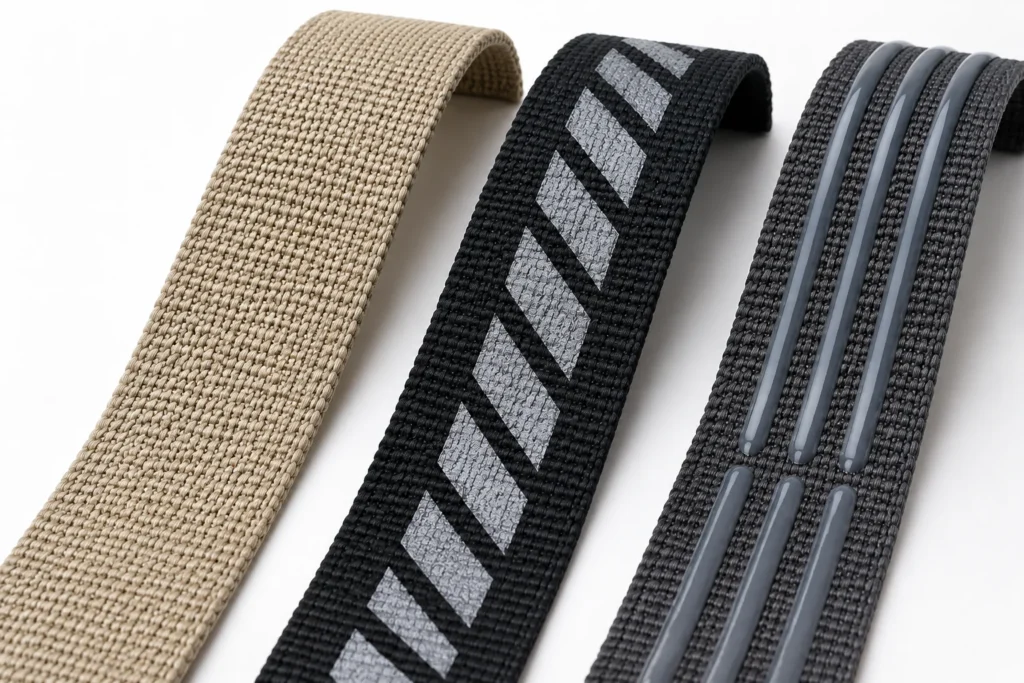
For webbing used under extreme heat or cold, secondary treatments are better avoided unless the product really needs them. The base webbing can be developed specifically for the required temperature and function, but every treatment added afterward introduces another material that may not perform under the same condition.
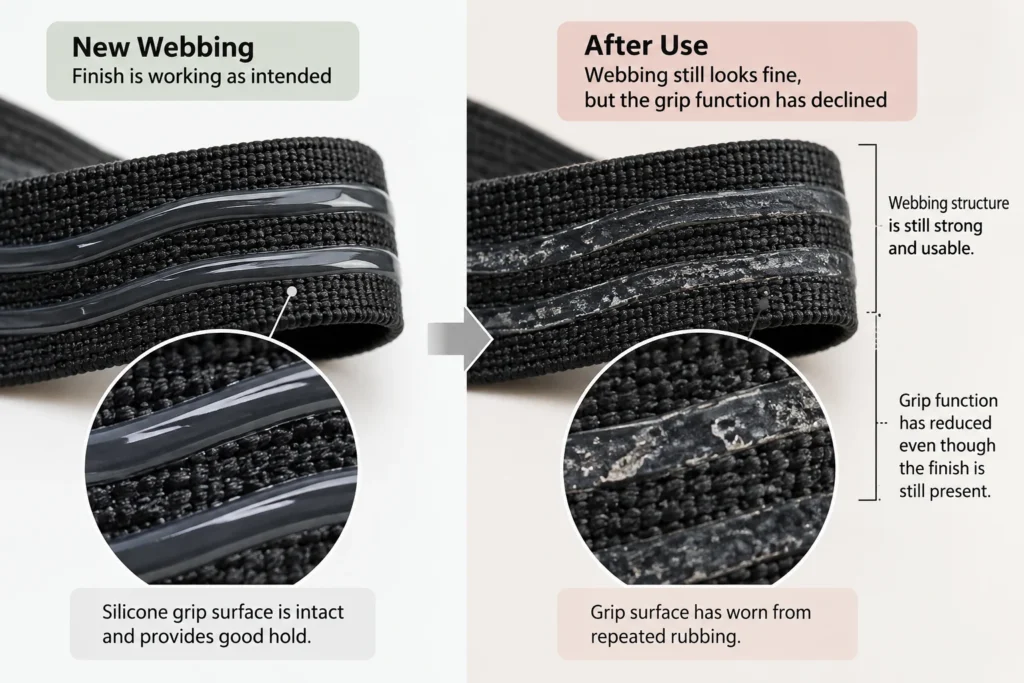
This matters with treatments such as screen printing and anti-slip silicone. Even when the base webbing can handle the working temperature, the added ink, binder, or silicone system may not have the same temperature capability. A treatment added for branding or grip can therefore become the limitation of an otherwise suitable webbing.
Keep extreme-temperature webbing as simple as the product allows. If branding is necessary, jacquard can be considered because the design is woven into the webbing rather than added as a surface treatment, provided the jacquard yarn also meets the temperature requirement. If a secondary treatment is essential, validate the specific treatment together with the finished webbing under the actual working condition.
Once the material is selected, use the required function—not visible damage—as the pass or fail point for temperature testing. A webbing can still look normal after extreme heat or cold while its strength, flexibility, or recovery has already changed.
For a snowmobile cargo tie-down, passing a -40°C exposure test is not enough if the strap can no longer provide the required restraint performance. For an extreme-temperature elastic webbing, the elastic core remaining intact is not the result that matters—the webbing still needs to deliver the required stretch and recovery at the working temperature.
Set the required performance first, then test the finished webbing against it:
Required performance → Actual temperature + exposure time → Test the same function → Pass or adjust
This keeps the test tied to the product itself. The sample passes when it can still do the job you designed it for—not simply because it survived the temperature.
For webbing that stays in extreme heat or cold for long periods, do not wait for visible damage before replacing it. Thermal exposure builds up over time, and the webbing can start losing the performance you rely on before anything looks obviously wrong.
How often you inspect it should follow the actual exposure. A strap exposed to 180°C for several hours every day is not the same as one that reaches 180°C only occasionally, even when both use the same material. Temperature, exposure time, and frequency all affect how the webbing ages.
Start checking before you expect the webbing to need replacement. Look at the function your product relies on—strength, flexibility, stretch and recovery, or another required performance. If that performance starts to change, replace the complete webbing component rather than waiting for failure.
One thing to expect with extreme-temperature webbing is a much higher MOQ. In the projects we have handled, once specialized temperature-resistant materials are involved, around 5,000 meters or more is quite normal.
Most of that MOQ comes from the material itself. Standard polyester and nylon are regularly used in webbing production, so sourcing smaller quantities is much easier. Aramid, LCP, and specialized temperature-resistant elastic materials are different. They are not materials a webbing factory normally keeps in every size, color, or specification, so the required yarn or elastic component often has to be sourced specifically for the project. The supplier’s material MOQ then becomes part of your finished webbing MOQ.
This is worth checking when you decide to move into a specialized material. Compare the available material MOQ with the volume your product can realistically use. If your project needs 800 meters but the material starts around 5,000 meters of finished webbing, the material may work technically, but it may not make sense for your project yet.
We take your ideas from sample development to bulk production, delivered straight to your doorstep.
We will contact you within 1 working day, please pay attention to the email with the suffix “@anmyda.com”.