
Nylon and polyester are both widely used for elastic sports bra straps, but they do not give the developer the same starting point. The difference matters most when the strap sits directly against the skin and its material has to work with the complete elastic construction.
Nylon is generally the better starting choice for sports bra straps when softness, smooth skin contact, flexibility, and a premium handfeel are the main requirements. Choose polyester instead when low moisture absorption, faster drying, or greater stability in wet conditions has higher priority.
Read on to see where these differences actually matter in a sports bra strap, which properties should not be judged by fibre type alone, and when polyester gives you a stronger reason to move away from nylon.

Webbing manufacturing expert with 15+ years of experience helping product developers build high-performance straps for industrial, medical, and outdoor use.
Nylon is usually the better starting choice for sports bra straps when next-to-skin softness and a smooth handfeel are priorities. Start with nylon for this feel requirement, then confirm it in the actual elastic construction rather than assuming the nylon specification alone will make the finished strap soft.
The important distinction is between selecting nylon and approving a nylon strap. The finished feel also depends on the yarn form, elastic component, density, and how the strap is constructed. This is why two straps specified as nylon can still feel noticeably different. Sports-textile research similarly shows that fibre characteristics, yarn characteristics, elasticity, and textile construction work together to determine finished performance.
If softness is a priority, start sampling with nylon and provide an approved strap or handfeel reference when available. Check overall softness, edge feel, stretch, and recovery on the same sample. If the nylon sample feels too firm, keep the material fixed first and ask whether the construction can be softened without moving those other requirements outside target. If making it softer causes stretch, recovery, or stability to fail, stop pushing softness through that construction. Compare another nylon construction or a polyester alternative against the same requirements instead. Nylon gives you the better starting direction for feel; the complete sample decides whether that advantage has actually been achieved.
Polyester becomes the better choice when low moisture absorption and faster drying are priority requirements for the sports bra strap. Choose it for those requirements—not simply because the sports bra will be used during exercise.
Polyester’s lower moisture regain gives it a genuine material advantage over nylon when limiting absorbed moisture and drying behaviour matter. But that does not mean every high-sweat sports bra needs a polyester strap. Moisture behaviour in sports textiles is also affected by fibre geometry, yarn and textile construction, while current moisture-management sports bras are successfully made with nylon-rich as well as polyester-containing material systems. The material advantage therefore has to solve an actual strap requirement before it becomes a reason to switch.
If moisture performance matters to your project, evaluate the finished strap against the same acceptance criterion or test requirement used for the product. If the nylon construction already passes, keep it when its feel and other requirements are also approved. If it fails, sample a polyester construction while keeping width, target handfeel, stretch, and recovery as consistent as practical. If polyester passes the moisture requirement but loses an important feel or performance requirement, that is a specification trade-off—not automatically a better strap. Move to polyester when it solves a moisture requirement the nylon construction cannot meet, not simply because polyester has the stronger moisture property on paper.
Send us your sports bra strap requirements. We can review which material gives you the better starting point before you sample.
Material strongly influences the starting softness of a sports bra strap, with nylon generally giving a softer, smoother starting point than polyester. The finished softness still needs to be confirmed on the actual strap, because yarn selection, elastic content, and construction can strengthen or reduce that material advantage.
This is why two nylon straps can both meet the same material specification and still feel different. A strap made with finer, smoother yarns and a more flexible construction can feel softer than one built with a firmer, denser structure. The elastic component also contributes to how the strap bends and feels in the hand. So when a nylon sample feels too firm, “nylon isn’t soft enough” is usually too early a conclusion. The material may be suitable while the current construction is not giving the required handfeel.
If you have an approved reference, compare the new sample against it for surface feel, flexibility, edge feel, stretch, and recovery, rather than judging softness alone. If the nylon sample is too firm while its other requirements pass, keep nylon fixed first and ask for a softer construction. Compare the next sample against the same reference. If softness improves but recovery or stability moves outside the target, don’t keep pushing that construction. At that point, compare another construction or material route. Change the material when the required softness cannot be achieved without sacrificing another important strap requirement—not simply because the first sample feels too firm.
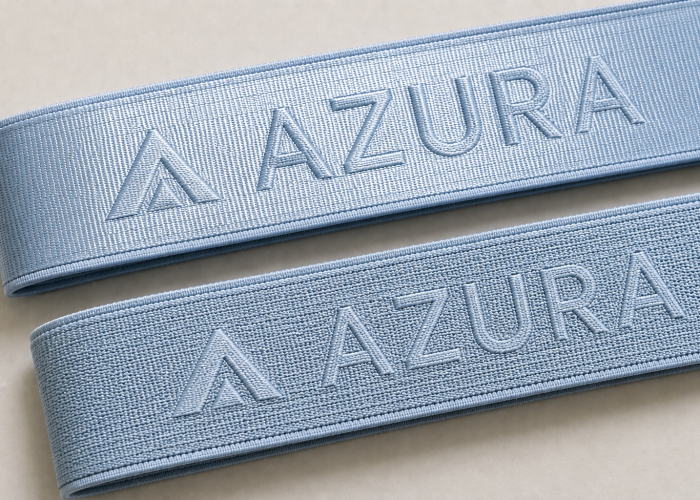
Yes. Strap material can contribute to an uncomfortable sports bra strap edge through its surface feel and yarn characteristics. If only the edge feels uncomfortable while the strap surface meets your target, keep the material fixed first and review the edge construction before changing nylon or polyester.
The edge should be evaluated separately from the centre of the strap. A soft surface does not guarantee a soft edge because the yarns are controlled differently where the woven structure finishes. Edge construction, yarn tension, thickness, and finishing can create a firmer or more noticeable contact area even when the centre feels smooth. This is also why choosing nylon for its softer starting feel does not guarantee that every nylon sports bra strap will have a comfortable edge. The fibre is one contributor; where the discomfort appears tells you where to investigate first.
During sampling, run a finger across the centre, both edges, and the transition between them, then evaluate the strap in its intended orientation on the garment. If the centre passes and only one or both edges feel too firm or rough, keep the approved material and overall handfeel as fixed requirements while the manufacturer adjusts the edge construction. If that adjustment improves the edge but changes width, stretch, recovery, or stability beyond the approved target, reject it and try another construction. Only reconsider nylon or polyester when acceptable edge comfort cannot be achieved without disturbing the other strap requirements that already pass.
Send us your specification and sample reference. We can review whether the material or strap construction should change first.
Yes. The material combination directly affects sports bra strap stretch and recovery, especially the elastic yarn used in the strap. Nylon or polyester also contributes to the finished behaviour, so stretch and recovery should be developed from the complete material combination rather than the main fibre alone.
A sports bra strap described as “nylon” or “polyester” is normally an elastic material system rather than a single fibre. The main yarn works with an elastic yarn such as elastane/spandex. How much elastic yarn is used, what elastic yarn is selected, and how it is built into the strap all affect how easily the strap extends and how strongly it returns. The surrounding nylon or polyester yarn and the webbing construction also influence the finished result. This is why two nylon-and-spandex straps can meet the same basic material description yet behave differently when stretched.
If a sample misses your stretch or recovery target, compare the complete material combination and construction with the approved reference before changing nylon to polyester or vice versa. If surface feel already passes, keep the main fibre fixed first and review the elastic component and how it is built into the strap. Sample the adjustment against the same stretch, recovery, and handfeel targets. If recovery improves but the strap becomes too firm, the adjustment has created a new problem rather than solved the original one. Change the main fibre only when the current material combination cannot deliver the required performance without sacrificing another approved requirement.
Yes. Material affects sports bra strap shape stability, but the way the strap loses its shape tells you whether material should be changed first. Check whether the strap narrows, curls, twists, or changes mainly after moisture exposure before replacing nylon with polyester.
Shape stability is not the same as stretch recovery. A strap can return to approximately the correct length after extension and still return in the wrong form. For example, it may become narrower, one edge may curl, or the strap may no longer lie flat. Those failure patterns matter because they can point to different causes. A curled edge can come from an unbalanced edge or webbing construction, while a change that appears mainly after wet use or washing gives the material’s moisture behaviour more reason to be investigated.
During sampling, record what changes and when. If the strap returns to length but becomes narrower, treat width stability separately from recovery. If only one edge curls while the rest remains flat, review the edge and construction balance before changing material. If the strap looks correct when dry but repeatedly changes after the relevant sweat, moisture, or wash condition, compare the material combination under that same condition.
Polyester absorbs less moisture than nylon, so it becomes a stronger candidate when the instability is linked to moisture—but the finished polyester strap still needs to prove the improvement. Change material when the failure pattern points to material behaviour; don’t use a nylon-to-polyester switch as the first fix for every strap that loses its shape.
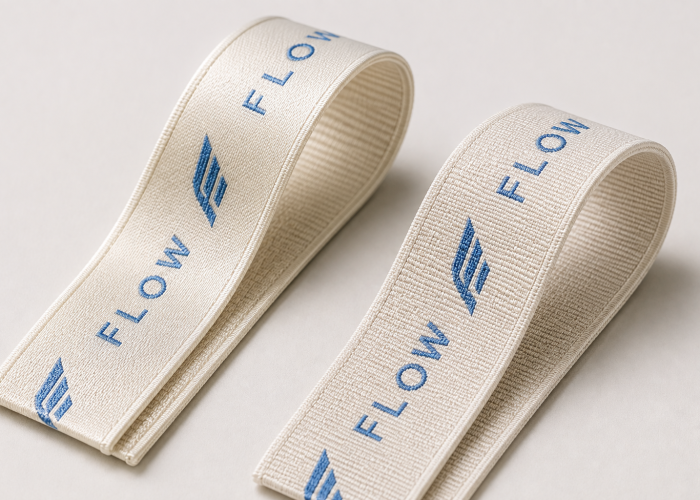
Sports bra strap material can affect woven logo clarity because nylon and polyester do not always use the same yarn or work the same way in a jacquard construction. Confirm the logo on the actual strap before approving the material, especially when the artwork contains small lettering or fine details.
Material is only one part of the woven result. The yarn selected within that material, strap width, jacquard construction, density, and artwork all influence how clearly small letters, curves, and gaps can be reproduced. This means switching from nylon to polyester while keeping the same logo does not guarantee the same result. It also means a less-clear sample is not enough evidence to conclude that the new material is unsuitable. The limitation may sit in how that material and artwork have been brought together in the current construction.
During sampling, identify the smallest brand-critical feature and use it as the comparison point. If the strap meets its feel, stretch, and recovery requirements but that feature loses clarity, keep those approved requirements fixed first and review the jacquard construction. If improving the logo causes the strap to become too firm or changes its elastic performance, reject that adjustment. If reasonable construction changes still cannot reproduce a brand-critical detail, then compare the alternative material or an acceptable artwork adjustment. Do not choose nylon or polyester from logo sharpness alone; the material only works when the branding and strap requirements can pass together.
Send us your target feel, stretch, recovery, and material requirements. We can review which specification has room to change before you develop the next sample.
The better material combination pairs the required surface feel with an elastic system that delivers the target stretch and recovery without sacrificing comfort or stability. Start with the sports bra strap requirement that has the least flexibility, then develop and sample the material combination around it.
This is why the material decision should not stop at “nylon or polyester.” A sports bra strap combines the main yarn with an elastic component, and those materials have to work together in the finished construction. If a smooth next-to-skin feel is already fixed, the material combination has to preserve that feel while achieving the required elastic performance. If stretch and recovery are fixed instead, the surface yarn and construction need to work around those targets. Polyester becomes a stronger candidate when low moisture absorption is a fixed priority, but its feel and the complete strap performance still need to pass.
During development, keep the least flexible requirement fixed while adjusting the others around it. If feel is fixed, compare material combinations without allowing a better recovery result to make the strap unacceptably firm. If stretch and recovery are fixed, compare nylon or polyester options without weakening those targets to achieve a preferred surface feel.
If improving one requirement repeatedly pushes another outside its approved range, you have reached the limit of that material combination and should compare another route rather than keep adjusting the same one. The better combination is the one that meets the important sports bra strap requirements together—not the one with the strongest individual fibre property.
Nylon is usually the better starting choice for sports bra straps when softness and smooth skin contact lead the specification, while polyester becomes more valuable when low moisture absorption and faster drying have higher priority. Whichever you choose, judge the complete strap—not the fibre alone. Material combination, elastic performance, edge comfort, shape stability, and branding still need to work together. If you have a strap specification ready, send it to Anmyda for a material review before sampling.
We will contact you within 1 working day, please pay attention to the email with the suffix “@anmyda.com”.