
“Skin contact” is not enough to define a webbing requirement. A supplier still needs to know whether the strap sits directly on bare skin or over clothing, how much it is allowed to move, and what parts of the finished strap will actually touch the body.
We handle plenty of projects where the first requirement is simply “soft,” “comfortable,” or “skin-friendly.” Nothing wrong with that—but those words don’t tell us enough to build the right webbing. A sports bra band, an overnight monitoring belt, and an orthopedic support strap can all touch the skin and still need very different constructions.
So before you settle on the material or construction, there are a few details worth thinking through first. These are the ones we most often wish had been defined earlier when a skin-contact project reaches us.
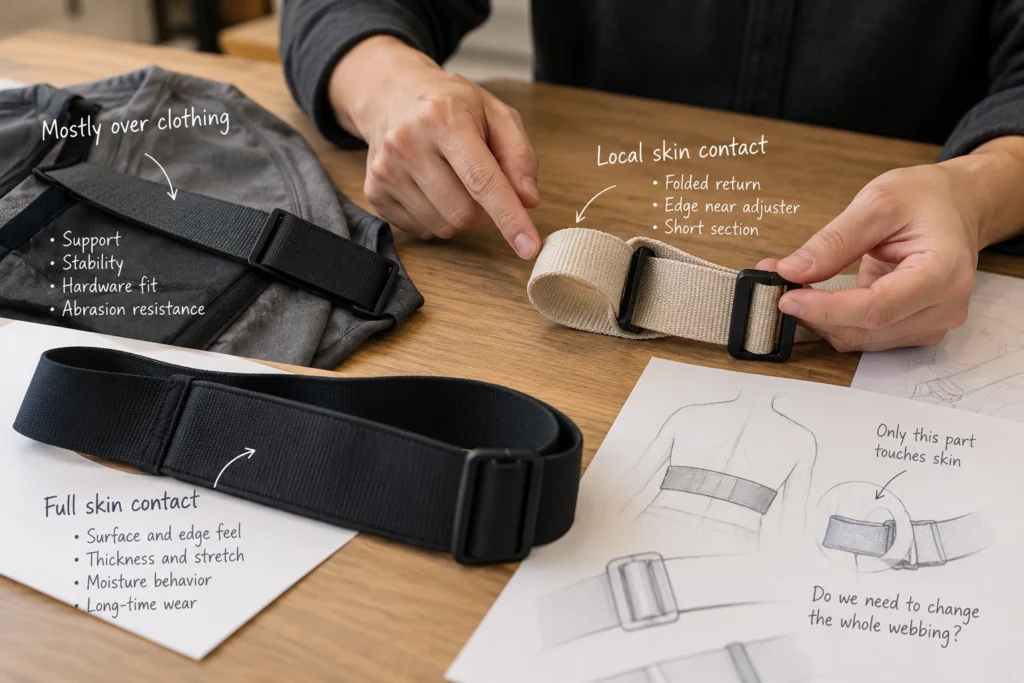
If most of the strap sits directly on the skin, then yes—design the base webbing around that contact. But if only one small area touches the body, don’t redesign the whole webbing just to fix that one spot. A local change may solve it much more cleanly.
We get projects described as “skin-contact straps” where, once you look at the finished assembly, most of the webbing actually runs over clothing or fabric. Sometimes it is only a folded return, an edge near the adjuster, or a short section that reaches the skin. That is a very different problem from an overnight monitoring belt that stays against the body for hours.
This matters because making the whole webbing softer is rarely a free change. You may need to change the yarn, thickness, density, or elastic construction. Then the stretch and recovery can move, the strap may lose some stability, or the thickness may no longer suit the adjuster you already designed around. That’s a lot to change if the real problem is only 30 mm of contact near one end.
For that kind of local contact, look at the spot first. A softer edge, different fold, backing, or local treatment may solve it without disturbing the rest of the webbing.
If skin contact is how the strap normally works, build for it in the webbing. If the contact is local, try to solve that spot before changing the whole construction.
A skin-contact strap still has a job to do. Don’t specify softness on its own—define what the webbing still needs to hold, support, compress, position, or recover after you make it softer. Comfort is another requirement, not a replacement for the strap’s original function.
“Can you make it softer?” is something we hear a lot. Usually we can. The important part is how we get there. Changing the surface yarn may be a relatively small adjustment. But if the softer target requires a looser construction, less thickness, or a different elastic structure, you are changing the same webbing structure that controls stretch, recovery, support, and stability.
That doesn’t mean softer webbing is less stable. Sometimes the feel can be improved without changing much of the strap’s behavior. The problem starts when the route to a softer feel also changes the performance your product relies on.
Think about an overnight monitoring belt. It needs to feel comfortable for hours, but it still has to keep the sensing area where it belongs. An orthopedic support strap needs comfort too, but not at the expense of the controlled support it was designed to provide.
So instead of specifying only “very soft,” keep the function in the requirement:
Soft against the skin while maintaining firm recovery.
Soft against the skin while holding the sensor position.
Soft against the skin while maintaining controlled support.
Now your supplier knows what they can improve—and what they should not soften away.
A soft webbing face doesn’t guarantee a comfortable finished strap. When you design the strap, look at every part that can reach the skin—not just the webbing surface. Cutting, folding, sewing, branding, and hardware assembly can all create contact points that weren’t there on the original roll.
This is something worth separating early: is the contact problem already in the webbing, or will your finished design create it? If the webbing surface or edge itself is the problem, then changing the yarn, construction, thickness, or edge may make sense. If the problem only appears after assembly, changing the whole webbing may be fixing the wrong thing.
A folded end is a good example. Fold a perfectly soft webbing back, add stitching, and you have two layers concentrated in one small area. Put that area under tension or beside an adjuster and it can become the hardest part of the strap. Making the original webbing softer doesn’t necessarily remove that pressure point.
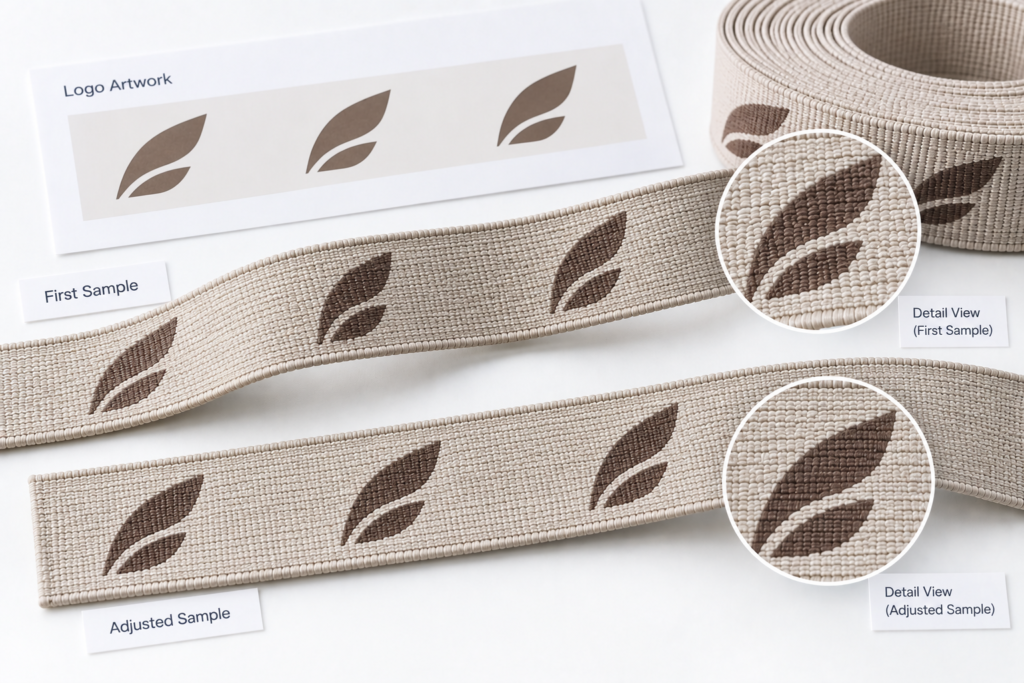
Jacquard needs the same thinking. For a skin-contact strap, decide which side faces the body before you settle on the logo construction. The front may look and feel exactly as you want, while the body-facing side has a different yarn structure. Branding and skin contact have to work on the same piece of webbing, so don’t treat them as two separate decisions.
Heat-cut ends are simpler. If a cut end will sit against the body, move it, cover it, or change the way the strap is folded before asking for a different base webbing.
A useful rule is: fix an assembly-created contact problem in the assembly first. Change the base webbing when the problem really comes from the webbing itself. That can save you from changing thickness, stretch, recovery, logo appearance, or hardware fit just to solve one small contact point.
Latex-free isn’t a comfort feature you add later. It’s a material restriction that should be decided before the elastic construction is developed. If your product doesn’t require it, don’t add the restriction just because the webbing touches skin.
This is something worth thinking about early with medical and orthopedic straps, long-wear body sensors, sleep-monitoring belts, underwear waistbands, sports bra elastics, and other elastic straps worn close to the body. They don’t all need to be latex-free. But these are the kinds of projects where a customer, brand, hospital, or product specification may put restrictions on natural rubber latex.
A typical RFQ might say “polyester elastic webbing” or “nylon elastic webbing,” and at first glance that looks like the material has already been decided. From the webbing side, it hasn’t. Polyester or nylon may describe the yarn you see on the surface; the elastic component inside still needs its own material decision.
Take an overnight monitoring belt as an example. You might specify polyester because you want a particular surface feel and then spend most of the design discussion on width, stretch, and comfort. If the finished device also needs to be latex-free, that requirement has to reach the elastic core. A soft polyester surface doesn’t tell you what is providing the stretch underneath.
The same applies to an orthopedic support or close-to-skin apparel elastic. If natural rubber latex has to be excluded, don’t assume an existing elastic construction can simply be carried over to another core material. The supplier may need a different material route while still meeting your stretch, recovery, thickness, and feel targets.
So when latex-free really is part of the product requirement, write it that way from the beginning:
Polyester elastic webbing with a latex-free elastic core.
And keep one boundary clear: latex-free doesn’t mean allergy-free or biocompatible. It tells your supplier that natural rubber latex must be excluded from the elastic system. If a medical or wearable product needs broader skin-contact compliance, define that separately.
The simple rule is: if latex-free matters, specify the core before the supplier develops the elastic construction—not after.
Silicone can stop a good strap from slipping. It can’t turn the wrong elastic into the right strap. If the webbing is too loose, has the wrong stretch, or doesn’t recover well enough to hold the product, fix that first. Add grip for the movement that’s left.
Think about the leg gripper on cycling shorts. The elastic still has to hold the leg opening at the right tension. The silicone has a different job: it adds friction against the skin to keep that edge from riding up while the leg keeps moving. Those two jobs work together, but they aren’t interchangeable.
An orthopedic support makes the difference even clearer. If the support keeps sliding because the elastic tension is too low, adding more silicone is asking the grip to fight the wrong problem. Get the support and recovery right first; then use the grip to control the remaining migration.
This is also why we don’t treat silicone as a simple yes/no requirement. Two lines, several rows of dots, or a larger coated area don’t give you the same contact surface. Dots and spaced lines leave more textile exposed between the silicone; broader coverage puts more silicone against the contact surface. If a few well-placed lines already control the movement, covering the rest of the webbing doesn’t solve another problem.
And be clear about what you are gripping. On cycling shorts, silicone may sit directly against the skin. In another design, the soft textile side may face the body while the silicone grips a fabric layer instead. Both are anti-slip webbing, but the silicone belongs on a different interface.
So before you draw the silicone pattern, answer three things:
What movement is the elastic itself supposed to control?
What movement is still left for the silicone to control?
What surface does the silicone actually need to grip?
Then decide the side, pattern, and coverage.
Let the elastic do the holding. Let the silicone do the gripping.
We turn your ideas into webbing, manufacture it, and deliver it straight to your doorstep.
Have your product requirements, specifications, or artwork ready? Share your project with us to discuss the next step in development.
We will contact you within 1 working day, please pay attention to the email with the suffix “@anmyda.com”.