
You may receive a screen printing quote for your custom webbing that is higher than expected, even when the logo looks simple. The reason is not always obvious from the artwork or webbing specification alone.
Screen printing cost is usually higher when your logo has more colors, fine or tightly spaced details, large print coverage, or when the webbing surface and construction make the required print result harder to reproduce consistently. Order quantity also affects how much of the printing cost is spread across each meter or piece.
Read on to see which logo and webbing requirements are driving your printing cost, why suppliers may quote differently, and what you can adjust without giving up requirements your product or branding actually needs.

Webbing manufacturing expert with 15+ years of experience helping product developers build high-performance straps for industrial, medical, and outdoor use.
Screen printing cost on webbing is mainly driven by your logo colors, detail, print coverage, order quantity, and how demanding the required print result is on your selected webbing. The cost can come from one of these requirements or from how several of them work together.
Your one-color logo, for example, may still cost more than expected if it contains small lettering or narrow gaps that must stay sharp on a pronounced webbing surface. A simpler one-color logo on the same webbing may be much easier to reproduce. The same interaction works the other way: a detailed logo that prints well on one webbing may become more demanding when you move it to a different surface or construction. This is why color count or webbing type alone rarely explains the whole quote.
Order quantity affects the picture differently. Custom screen printing involves work that has to be completed for your design before and around production, so a smaller order gives you less production over which to spread those costs. Increasing quantity can therefore reduce the printing cost per meter, but it does not remove a difficult logo or webbing requirement.
If your printing quote is higher than expected, don’t guess which specification is responsible. Ask your supplier which requirement is adding the most cost, then compare one meaningful alternative. If a third color is suspected, compare two-color and three-color pricing. If a small tagline is the issue, compare the cost with and without it. This shows you whether changing that requirement creates enough saving to justify the compromise.
Fine lines, small text, narrow gaps, and closely spaced elements can increase your webbing screen printing cost when they require tighter reproduction than the rest of your logo. A logo does not need to look complicated overall for one small feature to create the more demanding printing requirement.
Your main brand name may be large and straightforward while a small tagline underneath contains thin strokes, tight spacing, and tiny internal openings. In that case, most of your logo may reproduce comfortably, but the supplier still has to produce the small tagline clearly enough to meet your approved appearance. Screen-printing resolution depends partly on the relationship between the smallest artwork features and the screen/stencil used to reproduce them, so fine details cannot be judged only from the overall size of the logo.
This means “simplify your logo” is often too broad a cost-saving recommendation. If one small tagline is creating the extra requirement, changing the main brand mark, larger lettering, and other features that already work does nothing useful. The better question is whether that specific detail is important enough to justify the additional printing requirement.
If your supplier says logo complexity is increasing your cost, ask which feature is responsible and what the price difference would be if only that feature changed. If enlarging or removing secondary text produces little saving, there may be no reason to compromise your branding. If one non-essential detail creates a meaningful cost difference, you now have a clear trade-off to evaluate. Keep brand-critical details fixed; adjust secondary features only when the saving is actually worth the change.
Let’s identify which logo detail is actually adding cost before you simplify the whole design.
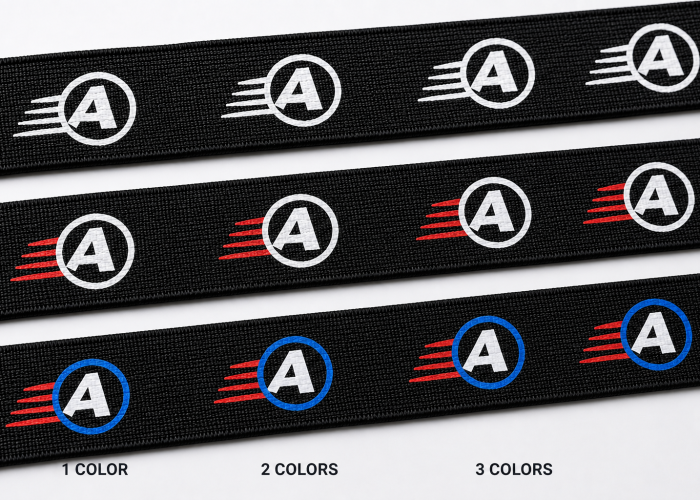
Adding colors generally increases your webbing screen printing cost because each additional spot color requires another screen and printing operation. A one-color logo requires one color separation, while a three-color logo normally requires three; if those colors must meet precisely, the printing requirement becomes more demanding again.
If your logo changes from one color to three colors, you are not simply buying two additional ink colors. The printer now has three color layers to reproduce and keep correctly aligned. But color count alone still does not tell the whole story. A four-color logo with large, separated color blocks may leave more registration margin than a two-color logo with small elements that must meet precisely edge-to-edge. So the extra cost can come from both the additional colors and what those colors are required to do.
This is why reducing three colors to two does not automatically make it a good cost-saving decision. If the third color is only a small decorative accent, removing it eliminates an entire color operation while changing little of your main branding. If all three colors are essential to the brand, the same saving comes with a much larger compromise.
If color count is increasing your quote, ask for the actual cost difference between the versions you would genuinely accept. Compare your three-color artwork with an approved two-color version, for example. If removing one secondary color saves very little, keep the intended branding. If it produces a meaningful saving, you now know exactly what that color costs your project and can decide whether it is worth keeping.
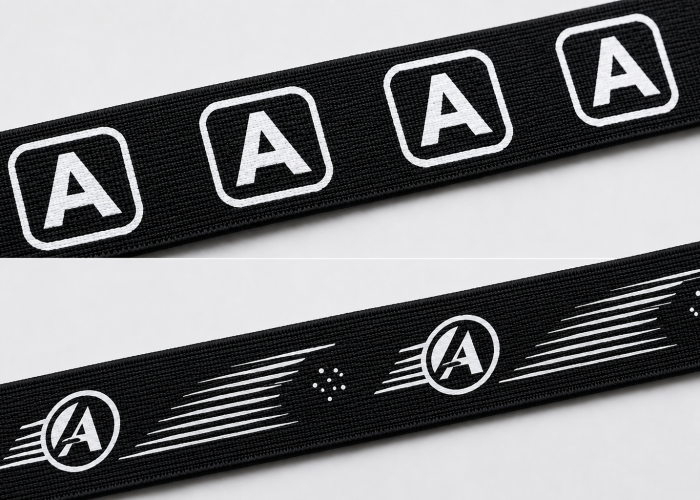
Yes, print coverage can affect your webbing printing cost when a larger solid printed area requires more ink or different printing conditions to achieve the coverage and appearance you approved. But a physically larger logo does not automatically mean higher printing cost—the amount of the logo that is actually filled with ink matters too. Ink-consumption calculations likewise depend on design area, percentage coverage, mesh and print quantity rather than dimensions alone.
For example, your 100 mm-long outline wordmark may occupy a large section of the webbing while leaving most of that area unprinted. A 50 mm-long solid block logo occupies less length but can contain much more actual ink coverage. So if your supplier says the printed area is affecting the quote, simply shortening the 100 mm logo may not address the requirement that is creating the cost.
The required appearance matters as well. A solid light-colored logo on dark webbing may need enough ink deposit to achieve the opacity you approved, while a smaller or more open design creates a different coverage requirement. Screen-printing mesh selection directly affects ink deposit: coarser meshes generally deposit more ink, while finer meshes favour detail with a thinner deposit. This is why logo dimensions, actual coverage, and required appearance should not be treated as the same specification.
If coverage is increasing your quote, ask your supplier what change would actually reduce the cost before making your logo smaller. Compare one realistic alternative—for example, your solid logo versus an acceptable outline version, or full coverage versus a reduced-fill design. Then compare the price difference. If reducing coverage creates a meaningful saving without weakening the appearance your brand needs, it is a useful cost lever. If it barely changes the quote, there is little reason to compromise an approved logo simply to make it smaller.
Compare your colors, details, and coverage to find where a change could create a meaningful saving.
Your webbing surface can increase screen printing cost when it makes the logo appearance or adhesion you require more demanding to achieve. But a textured, coated, or less uniform surface is not automatically more expensive to print—the important question is what your logo needs that surface to reproduce.
You may see this directly in your webbing sample. If a large, solid logo looks good but small lettering or narrow gaps lose definition, the surface may be affecting those fine details rather than the whole print. If both simple and detailed areas look correct but the ink does not bond well, that points to a different problem. Coatings and other surface characteristics can affect ink adhesion, so the suitable ink or surface treatment may need to change rather than your artwork.
This means the same webbing surface can create very different printing requirements for different logos. A pronounced woven texture may be perfectly workable for your large, simple wordmark but more demanding when your logo requires tiny text and sharp negative spaces. So don’t treat “textured webbing” itself as the cost driver without knowing which print requirement it is affecting.
If your supplier says the webbing surface is increasing your quote, ask what specifically becomes more expensive to achieve. If only fine details are creating the difficulty, compare your original logo with an acceptable simplified version on the same webbing and check the price difference. If adhesion is the issue across the whole logo, changing a small artwork detail is unlikely to solve it. And if the webbing surface is required for your product’s function or appearance, keep that requirement fixed while you evaluate the printing solution first.
Elastic webbing can cost more to screen print when your finished logo must stretch and recover with the webbing, requiring a print system that can meet that movement without losing the approved appearance or durability. But the important requirement is not simply how far the webbing can stretch—it is how much stretch the printed logo actually needs to tolerate in your application.
Suppose your elastic webbing can extend considerably, but your finished strap normally uses only part of that available stretch. The print requirement is different from an application that repeatedly stretches the webbing much closer to its working limit. Stretch-capable textile inks and additives are specifically available for flexible substrates, and silicone textile inks can provide very high elongation. This confirms that elastic materials can be screen printed successfully when the print system matches the required movement.
There can also be a trade-off. For one commercial stretch additive, the manufacturer notes that increasing the additive improves flexibility but can reduce ink opacity above a certain proportion. That specific percentage is product-dependent, but the broader manufacturing lesson is useful: asking for more print stretch than your product actually needs can introduce another printing requirement rather than giving you a free improvement.
If elastic webbing is increasing your quote, tell your supplier how the strap will actually stretch in use, not only the webbing’s maximum stretch percentage. If your webbing can stretch 80% but your application normally uses around 20%, for example, that working condition is important information for evaluating the print. If the elastic construction is essential to your product, keep it fixed and compare savings elsewhere first. Don’t reduce the webbing performance your product needs simply to make the logo cheaper to print.
Two suppliers can quote different screen printing costs for the same custom webbing because their production capability, efficiency, and pricing structure can differ—and sometimes because they are not quoting exactly the same print result. A lower price does not automatically mean lower quality, and a higher price does not automatically mean a better print.
You may send the same three-color logo, 25 mm webbing, and 5,000 m quantity to two suppliers and still receive noticeably different prices. First check that both quotes cover the same webbing construction, logo size, colors, quantity, and the appearance or durability requirements important to your project. If one supplier has interpreted something differently, align that requirement and compare the updated prices.
If the specifications already match, use the same print reference to judge both suppliers. This could be your approved webbing sample, agreed logo appearance, color target, or another reference that clearly shows the result you expect. If both suppliers can produce samples that meet the same requirements, there is no reason to assume the lower price hides a quality problem. The difference may simply come from how efficiently each supplier can produce and price your job.
If one sample cannot meet an important requirement, however, the two prices are no longer buying the same result. Confirm the requirement first, compare the result second, and compare the price third. Once both suppliers can meet the same approved standard, you can make the commercial decision based on price, MOQ, lead time, and the other factors that matter to your order.
Let’s find a lower-cost printing option without sacrificing the webbing requirements your product needs.
Change the requirement that creates a meaningful saving while giving up the least important product or branding value first. Secondary colors, decorative details, or unnecessary print coverage are worth investigating when they are actually contributing enough cost to justify the change.
Suppose your third logo color is only a small accent. Instead of removing it simply because fewer colors generally cost less, ask for your three-color and acceptable two-color versions at the same order quantity. If the two-color version saves $0.03 per meter, that may sound insignificant at first. But across a 10,000 m order, the total saving is $300. The $0.03 figure is only an example—the useful number is the actual difference from your own quotation.
Now compare that total saving with what you give up. If the third color is secondary and $300 matters to the project, removing it may be reasonable. If it is important to your brand, the same $300 may not justify the change. Use the same calculation for a small tagline, solid logo coverage, or another adjustable feature.
Functional webbing requirements need a higher threshold for change. If your elastic construction or particular webbing surface is necessary for the finished product, don’t sacrifice it for a printing saving without considering what you lose elsewhere. Change one requirement, calculate the saving across your full order, and compare that saving with the value of the requirement you would give up. That’s how you reduce real project cost rather than simply chasing the lowest price per meter.
A high screen printing cost does not always mean your webbing or logo is simply “too expensive to print.” The extra cost may come from a specific color, fine detail, print coverage, or the result required on your selected webbing.
Before changing an approved specification, find out which requirement is actually affecting the quote and how much you would save by changing it. If you’re unsure where the cost is coming from, send us your webbing and logo requirements. We can help you identify practical options before you compromise something your product or brand needs.
We will contact you within 1 working day, please pay attention to the email with the suffix “@anmyda.com”.