
Your supplier just said your safety strap is “too thick to sew” or “too thin for load.” It’s a common quoting setback — caused less by design error and more by equipment and coating limitations at general textile shops.
Most safety belt webbings measure 1.6 – 2.2 mm thick, balancing strength, energy absorption, and buckle fit. Thickness isn’t just a visual spec — it’s a functional parameter verified through tension and coating tests to ensure performance and manufacturability.
This post explains how to choose and specify webbing thickness that suppliers can actually produce — covering material, weave, and coating effects, plus tolerance and cost trade-offs. Read on to make your RFQ thickness-ready and avoid rejection delays.


Webbing manufacturing expert with 15+ years of experience helping product developers build high-performance straps for industrial, medical, and outdoor use.
Webbing thickness determines load control, buckle fit, and energy absorption in a safety belt. Thicker straps absorb shock but can jam in hardware or resist folding; thinner ones ease assembly but stretch or tear earlier.
Most rejected drawings come from ignoring this balance. If the gauge doesn’t match the hardware slot or sewing capability, suppliers raise cost or reject the quote entirely. Even a 0.2 mm deviation can affect stitch penetration or folding radius.
Experienced engineers check stiffness vs. foldability early, using sample pulls or small test loops to verify comfort and mechanical behavior before committing to production.
RFQ-Ready Line:
Specify target thickness with hardware fit in mind — e.g. 1.9 ± 0.1 mm, verified for 2 mm buckle slot clearance and sewing through two layers.
Most safety belt webbings range from 1.6 mm to 2.2 mm, balancing strength, flexibility, and hardware compatibility. Material below 1.5 mm risks failing elongation or abrasion tests; above 2.3 mm often exceeds sewing or coating limits.
Thickness variation is the top cause of quoting delays. When suppliers see “about 2 mm,” each interprets tolerance differently — some undercut to ease sewing, others over-build for strength. Precision saves time: stating ± 0.1 mm under test tension gives comparable results across vendors.
Use tension-measured data (not relaxed gauge) to ensure load consistency and certification success.
RFQ-Ready Line:
List target thickness and test condition — e.g. 2.0 ± 0.1 mm measured under 2 kN tension. This keeps supplier quotes aligned and avoids re-measurement disputes.

Thickness defines how a safety belt balances strength, stiffness, and comfort. A thicker webbing raises tensile capacity and reduces elongation, but adds rigidity and sewing resistance. Thinner webbing flexes easily yet risks over-stretch or edge curling during use.
Sourcing problems often occur when engineers equate “stronger” with “thicker.” In reality, the belt must flex enough to route through anchors while staying firm enough to share load evenly. A 2.3 mm strap can meet tensile targets but feel uncomfortably rigid in body restraints; a 1.5 mm version may pass flexibility checks but creep after repeated tension cycles.
Experienced manufacturers verify stiffness at 10 % of breaking load to ensure controlled stretch. This confirms that energy absorption and comfort align with regulatory behavior without creating a harsh feel. A reliable rule: every 0.1 mm increase in gauge changes elongation by roughly 3–4 % in typical polyester constructions.
Engineering Note:
If user comfort and strength conflict, prioritize elongation control. Specify 2.0 ± 0.1 mm achieving ≤ 8 % stretch at 10 % of rated load — it gives reliable tension without sacrificing foldability or sewing speed.
Send your current safety-belt spec — we’ll confirm workable tolerances and quote within 24 hours
Too-thick webbing causes sewing distortion and buckle interference; too-thin webbing fails to maintain geometry under load. Both extremes delay quotes and raise test costs.
Over-thick belts exceed sewing clearance or slot width. Stitch compression increases friction, creating skipped seams or folded edges that compromise strength. Once thickness exceeds hardware tolerance by 0.2–0.3 mm, assembly issues appear and certification pull tests often fail at the seam.
Too-thin belts (≤ 1.5 mm) lose cross-sectional fiber support. They may pass initial strength but deform under sustained tension, leading to buckle tilt or uneven load transfer. This is one of the most common “re-sample” triggers before production approval.
Professional suppliers counter this with in-line gauge control — measuring functional thickness under constant 2 kN tension rather than relaxed state. It ensures the delivered belt matches hardware setup, not just nominal design.
Specification Tip:
Replace vague text like “approx. 2 mm” with “2.0 ± 0.1 mm after coating, verified under 2 kN tension.” This gives sewing teams confidence in foldability and avoids post-quote adjustment.
Material modulus and weave density jointly set webbing thickness, stiffness, and stretch. Nylon compresses more under load, giving thinner but more elastic straps. Polyester maintains gauge and stiffness, making it ideal when long-term elongation control or heat resistance is required.
Weave density then fine-tunes feel. High-pick patterns pack fibers tightly, adding 0.1–0.3 mm to gauge and improving abrasion resistance; open weaves reduce weight but increase elongation and edge fray risk. These micro-differences explain why two “2 mm polyester webbings” from different suppliers can behave completely differently.
Misalignment often begins in the RFQ stage: drawings list only “polyester webbing 48 mm” without denier or density details. Vendors fill the gap with their own construction, leading to variable thickness and inconsistent stiffness between samples. The fix is to define fiber type + denier + pick count together.
Sourcing Insight:
For load-bearing safety belts, specify high-tenacity polyester, 48 picks/inch, 2.0 ± 0.1 mm functional thickness under 2 kN tension. Including weave density locks both mechanical and dimensional behavior across suppliers.
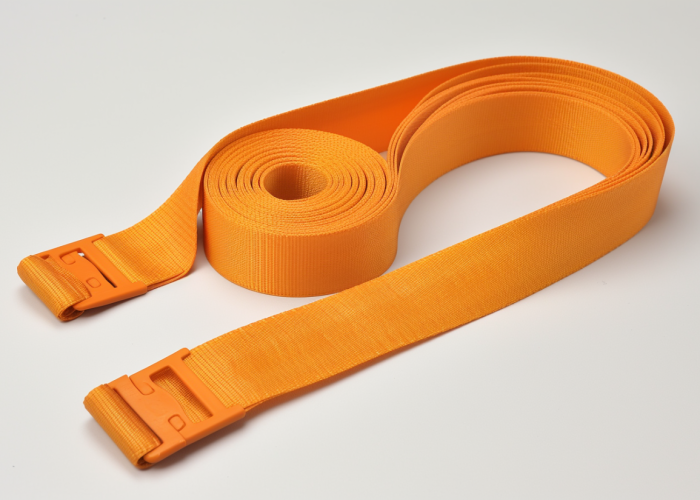
Coatings typically change webbing thickness by 0.05 – 0.25 mm depending on the finish and curing method. A simple PU, FR, or color treatment can push a 2.0 mm strap to 2.15 mm once cured — small on paper, large in production.
That difference is where most rejected samples start. Coating lines that apply material without tension control create uneven buildup along edges, so the gauge that read 2.0 mm pre-finish becomes unpredictable after heat setting. Once folded for sewing, it no longer fits the machine clearance or buckle slot.
Controlled lines handle this differently. Every batch runs under fixed tension through metered coating blades and post-cure verification at 2 kN. Thickness stays consistent across the roll, even with multi-layer finishes. The result: finished belts that fold, stitch, and pass tensile testing on the first run — no trimming, no “second sample” request.
RFQ-Ready Line:
Define whether your requirement is before or after coating — e.g. 2.0 ± 0.1 mm finished thickness after PU coating, verified under 2 kN tension. That keeps design, coating, and assembly teams aligned from the start.
Precision webbing holds ±0.1 mm thickness tolerance for consistent strength and fit. Anything wider introduces folding resistance and variable stitch compression that delay approval.
Most redesigns we receive begin with suppliers who measured relaxed webbing instead of loaded gauge. A belt reading 2.0 mm on the bench often measures 2.25 mm under real tension, forcing buckle rework or coating removal. Once production starts, that error multiplies across every roll.
In a controlled setup, tension-based micrometers verify thickness at defined load — usually 2 kN — before cutting begins. This confirms the strap’s functional dimension, not its resting one. It’s the reason tolerances hold through sewing and final inspection, even on tight automotive programs.
That consistency shortens quoting cycles because nothing requires re-measurement or extra samples. Stable tolerance is the hidden speed factor — parts fit, stitch penetration stays uniform, and certification data repeat cleanly.
RFQ-Ready Line:
State tolerance and measurement load in one sentence: “Thickness = 2.0 ± 0.1 mm measured under 2 kN tension after finishing.” It signals precision control and prevents tolerance debate later.
Every 0.1 mm of uncontrolled thickness adds time and cost — through slower sewing, extra calibration, and scrap. It’s rarely visible on drawings but quickly shows up on the schedule.
When gauge drifts beyond tolerance, coating heads must be reset, sewing speed drops, and quality checks multiply. A single re-setup can consume a day on mid-volume runs, and thicker rolls reduce yield per spool. Even if the material passes strength tests, inconsistency forces cautious feed rates and more operator adjustments — the hidden tax of poor control.
Lines built for dimensional consistency don’t face those penalties. Stable gauge allows predictable feed and one-pass stitching, so output remains continuous. That’s how short-lead projects finish without the “waiting on recalibration” messages that slow most vendors.
Maintaining dimensional integrity isn’t just a quality choice — it’s the reason deadlines hold. Engineers who specify realistic thickness tolerance early protect both schedule and budget.
RFQ-Ready Line:
Write it like this: “Target thickness = 2.0 ± 0.1 mm; allowable variation after coating ≤ +0.05 mm.” It keeps production flow steady and eliminates unplanned lead-time extensions.
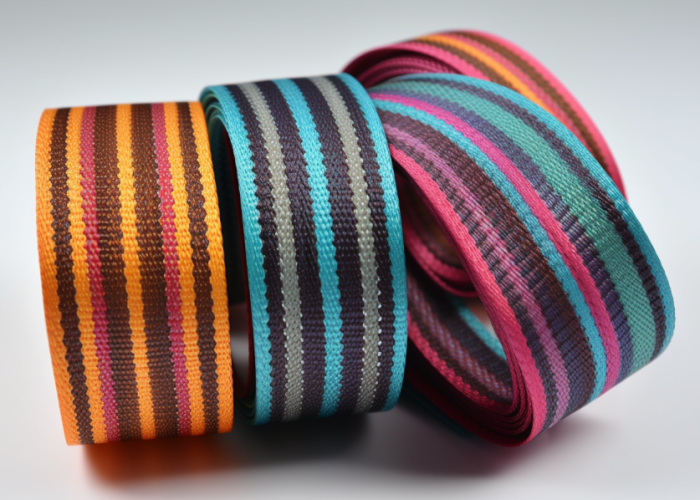
Webbing thickness must match hardware slot and stitch penetration depth to prevent folding stress and seam distortion. A perfect material can fail assembly if it’s even 0.2 mm out of range.
Most belt integration issues appear at the sewing and buckle stage, not weaving. When thickness exceeds slot clearance, the strap forms “memory folds” that reduce load-sharing across threads. Too thin, and stitches cut fibers instead of gripping them. Both mistakes lead to early elongation drift or edge tearing after fatigue cycles.
Reliable production aligns webbing gauge, stitch density, and buckle geometry from the start. Experienced fabricators test folded samples under load, verifying that the double-layer thickness fits feed plate and punch limits without compressing the coating. This early adjustment prevents the common “flattened edge” failure visible after crash or pull testing.
Thickness isn’t just a spec — it’s a mechanical interface. Once that interface fits correctly, sewing consistency, buckle function, and long-term comfort all stabilize automatically.
RFQ-Ready Line:
When submitting hardware or sewing specs, include both dimensions: “Webbing = 2.0 ± 0.1 mm; total fold-over = 4.0 ± 0.15 mm for 2 mm slot hardware.” It guarantees first-fit success and uniform stitching depth.
A clear thickness statement prevents quoting delays and re-sampling. Most sourcing setbacks happen when drawings say “approx. 2 mm” or omit the test condition. Precision phrasing shortens review time and makes cost estimates comparable across suppliers.
Effective RFQs express three things together — target gauge, tolerance, and verification load. For example: “2.0 ± 0.1 mm measured under 2 kN tension after PU coating.” That single line tells production how to calibrate tension, what coating step applies, and what inspection method to use.
Suppliers quoting without that detail usually build in safety margins — higher price, longer lead time — to cover uncertainty. Clear parameters let capable manufacturers quote confidently and start faster. In regulated products like safety belts, this also ensures identical results during ISO 9001 and ASTM D5034 tensile validation, avoiding retest fees.
The payoff is measurable: accurate RFQs typically reduce lead-time revisions by 20–30 % and keep tolerance compliance above 95 %. Clarity upstream saves time downstream.
RFQ-Ready Line:
Use full specification language: “Finished thickness = 2.0 ± 0.1 mm, verified under 2 kN tension per ASTM D5034.” That’s the format that moves your project straight to sampling — not back to clarification.
Safety-belt webbing thickness isn’t just a number — it defines fit, strength, and approval speed. When gauge, coating, and hardware align, projects move straight to sampling without rework. Upload your drawing today for a 24-hour manufacturability review and quote confirmation based on tested production data.
Yes, but only if the hardware slot and stitch setup allow it. Above 2.3 mm, most heavy-duty sewing machines need slower feed rates or modified presser-feet. Thicker webbing is practical for industrial harnesses, not seat-belt assemblies where flexibility and fit matter more. Always confirm hardware clearance before increasing gauge.
Nominal thickness is measured on relaxed material; functional thickness is recorded under defined tension (typically 2 kN). Certification and fit depend on the functional value because coatings compress during sewing. Always list test load in your RFQ to avoid 0.2–0.3 mm discrepancies between supplier readings.
Moisture absorption can slightly swell nylon (≈ 1–2 %), altering thickness readings and elongation. Polyester and polypropylene remain dimensionally stable. Conditioning samples at 21 °C / 65 % RH for 24 hours before measurement ensures consistent results across labs and suppliers.
Minimal for solution-dyed yarns, but noticeable (≈ +0.05 mm) when pigment coatings or back finishes are applied post-weaving. Darker shades often require heavier binder content, so always measure after dye fixation or specify finished thickness after coloration.
For safety-grade belts, verify every 100 m or once per production hour — whichever comes first. Continuous tension-based monitoring prevents drift from coating buildup or loom heat. Recorded readings should stay within ±0.1 mm of target across the roll.
Share the drawing and desired load rating. A qualified webbing manufacturer can simulate gauge, coating, and fold fit within 24 hours. You’ll receive feasibility notes, workable tolerances, and lead-time confirmation — avoiding trial-and-error sampling.
We will contact you within 1 working day, please pay attention to the email with the suffix “@anmyda.com”.